Lala Amarnath (11 September 1911 – 5 August 2000) was an Indian cricketer who scored India’s first Test century, on his debut in 1933, and was the first captain of independent India. An attacking batsman, a canny medium-pace bowler and a man who never backed down from a quarrel, he was sent home from a tour in disgrace, vindicated, and later led India to its first victory in a Test series. He was afterwards a selector, manager and commentator, and the father of two Test cricketers.
Quick Facts
| Full name | Nanik Amarnath Bhardwaj |
| Born | 11 September 1911, Kapurthala, Punjab |
| Died | 5 August 2000, New Delhi (aged 88) |
| Sport | Cricket |
| Role | Right-handed batsman; right-arm medium-pace bowler |
| Tests | 24 (1933–1952); 878 runs, 45 wickets |
| Captaincy | 15 Tests (1947–1952) |
| Awards | Padma Bhushan (1991) |
| Children | Surinder, Mohinder and Rajinder Amarnath, among others |
Early Life
He was born at Kapurthala into a poor Brahmin family and brought up in Lahore by his grandfather after his mother’s death. A Muslim cricketing family of the city noticed his talent, took him in and saw to his training. He began as a wicketkeeper and batsman in the Lahore club game.
The First Century
He was chosen for India’s first Test on home soil, against England at the Bombay Gymkhana in December 1933. In the second innings, with India facing defeat, he made 118, reaching his hundred in under two hours with a series of hooks and drives. The crowd ran on to the field; women threw their jewellery to him, and he was garlanded at the wicket. India lost the match, but the country had its first Test hundred.
1936
On the tour of England in 1936 he was the best all-rounder in the side, with more than six hundred runs and thirty wickets by the end of June. The team was captained by the Maharajkumar of Vizianagram, a poor player who held the post by influence, and it was riven by faction. After Amarnath, kept waiting with his pads on, showed his temper in the dressing room during a county match, the captain and the manager sent him home on the next boat for indiscipline.
An inquiry in India cleared him. He did not play another Test for ten years, the war taking up most of them.
Captain
He toured England in 1946, and when the appointed captain withdrew he led India to Australia in 1947–48, the first tour by the independent country. India lost heavily to Bradman’s side, but Amarnath made a string of double centuries against the state teams. He is the only bowler to have dismissed Don Bradman hit wicket in a Test.
In 1949 he fell out with the secretary of the board, whom he accused publicly of mismanagement, and was suspended. He was reinstated the next year.
He returned as captain for Pakistan’s first Test tour, in 1952–53, and India won the series two matches to one, its first series victory. He retired from Test cricket at its end.
Style
As a batsman he was a strokemaker who took the attack to fast bowlers. As a bowler he ran in four paces and moved the ball both ways off the wrong foot with great accuracy, keeping the best batsmen quiet for hours. He was an instinctive and aggressive captain with a deep knowledge of the game.
Later Roles
- chairman of the national selectors; in 1959 he insisted on picking the off-spinner Jasu Patel for the Kanpur Test, and Patel’s fourteen wickets gave India its first win over Australia
- manager of Indian teams on tour
- for many years a radio and television commentator, blunt and often funny
- a coach who trained his own sons with famous severity
Honours
He received the Padma Bhushan in 1991, and the Indian board’s first lifetime achievement award, named after C. K. Nayudu, in 1994.
Family
Three of his sons played first-class cricket. Surinder scored a century on his Test debut, as his father had done. Mohinder played sixty-nine Tests and was the player of the match in both the semi-final and the final of the World Cup that India won in 1983 under Kapil Dev.
Death
He died in New Delhi on 5 August 2000, aged eighty-eight.
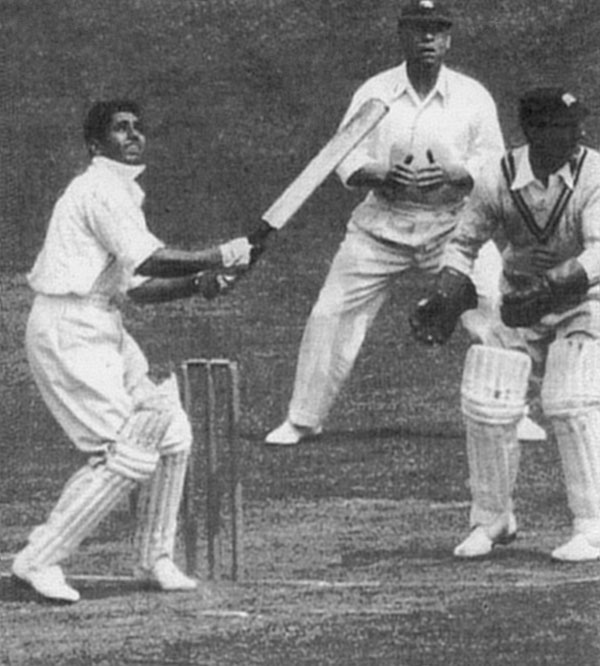
Featured image: Lala Amarnath batting against Middlesex at Lord’s, May 1936. Photo by an unknown photographer, in the public domain, via Wikimedia Commons.