
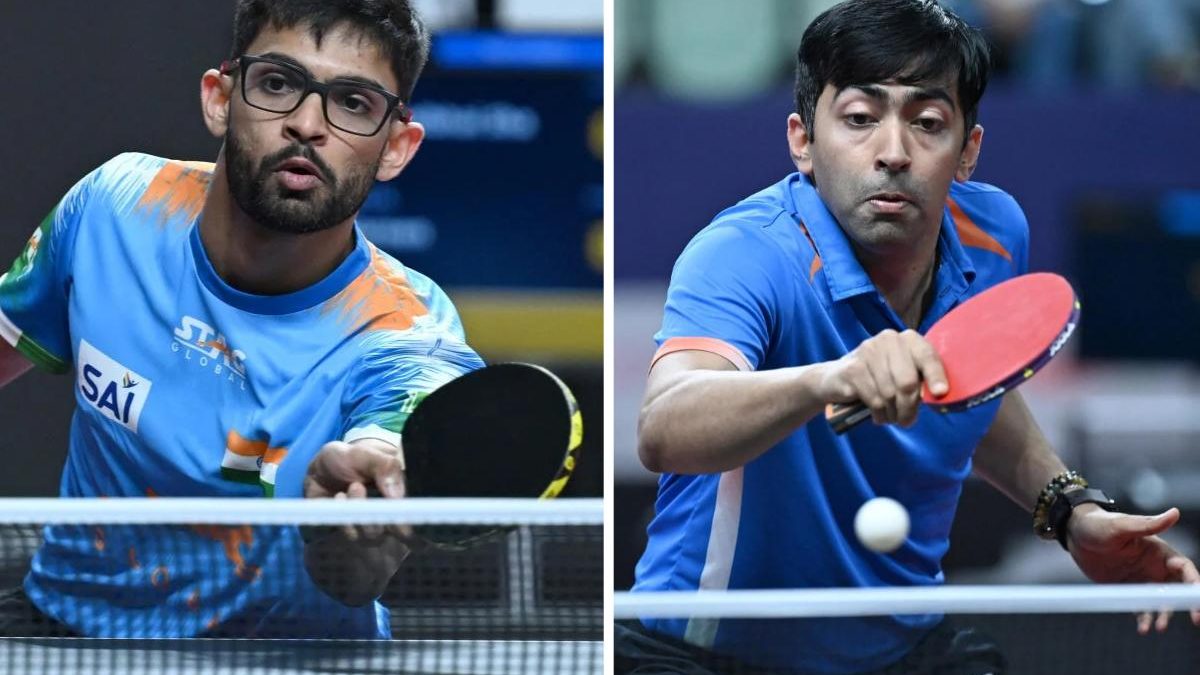
A selection decision in Indian table tennis has turned into a debate about rules, fairness and what a federation owes its players. The choice to drop Harmeet Desai and include Manush Shah in India's team for the International Table Tennis Federation (ITTF) Mixed Team World Cup in Chengdu, to be held from November 29 to December 6, has come under scrutiny, as The Hindu reported on Thursday, November 19, 2026. At the heart of the dispute is a simple question: why did the federation set aside its own points system this time?
The numbers are what make the case so pointed. According to the report, based on the Table Tennis Federation of India's (TTFI) points system, which was released in July, and its selection criteria, Harmeet should have made the cut instead of Manush. On the cut-off date of November 2, 2026, Harmeet had 55 points, made up of 35 for his domestic ranking and 20 for his world ranking. Manush had 40 points, made up of 5 for his domestic ranking and 35 for his world ranking. By that measure, Harmeet was 15 points ahead.
The report adds that, going by world rankings alone, Manush was ahead of Harmeet in men's singles, men's doubles and mixed doubles. That is the heart of the federation's defence, and it is not a weak one. In a Mixed Team World Cup, where doubles play a major role, a player's standing in doubles and mixed doubles can matter more than his singles ranking or domestic results. But the dispute is not only about who is the better player for this event. It is about whether the rules announced beforehand were followed.
The Hindu notes that the TTFI has on several previous occasions adhered strictly to its points system. When selecting the squad for the Asian Games in Aichi-Nagoya, for instance, it dropped Manika Batra because she had fewer points and named her as a reserve. The report also says it is reliably learnt that the Indian team was selected according to the TTFI's points system in all three previous editions of the Mixed Team World Cup. If that is the case, the departure this time stands out as an exception to a consistent practice.
Harmeet's reaction reflects the frustration of a player who feels he did what was asked of him. "What should I do to make it to the Indian team?" he asked. "I skipped a few WTT Feeder events to play in domestic tournaments and accumulate points. I did not enter WTT tournaments abroad because I believed I would be there in the team for the Mixed Team World Cup. In the previous editions of the tournament, the TTFI used its points system. So, why the change now?" His question points to the practical cost of an unexpected rule change: he made scheduling choices on the basis of the published system, and, in his view, the system was not followed.
The federation's response, as far as the report shows, has come in two forms. Indu Puri, chairperson of the ad-hoc committee, referred questions to the Selection Committee. One of its members, speaking to The Hindu on condition of anonymity, said the decision was unanimously agreed upon by the committee. "This is not a tournament like the Asian Games or WTT," the member said. "The Mixed Team World Cup is different, with doubles playing a major role. The TTFI's points system will not be applicable here. Manush is among the world's top-six in mixed doubles and is the highest world-ranked Indian in men's singles."
That explanation argues that the event's format justifies a different approach. The weakness, critics would say, is that it was not announced in advance and that it contradicts the practice in earlier editions. A top paddler quoted anonymously in the report was blunt about it: "This is unprecedented. The TTFI's Selection Committee has bypassed its own policy and picked Manush. The federation has not made such an exception for Sharath Kamal or Manika Batra or any other top player in the recent past. Never before has any exception been made for any tournament."
Because the committee member and the paddler both spoke anonymously, readers should treat their statements as claims, not as verified facts. What is documented are the points: 55 for Harmeet and 40 for Manush on the cut-off date, as per the report, along with the fact that the points system was released in July and that the federation used it for the Asian Games squad. The rest is competing interpretation.
The full squad for Chengdu shows who made the team. The men's team is Ankur Bhattacharjee, Payas Jain, Manush Shah and Manav Thakkar. The women's team is Diya Chitale, Syndrela Das, Yashaswini Ghorpade and Sutirtha Mukherjee. The squad is a young one, and the debate over one place does not take away from the fact that it will have to perform in a demanding international event.
It would be unfair to cast the dispute as simply good against bad. A selection committee has a legitimate interest in picking the combination most likely to win in a format built around mixed doubles. Federations around the world sometimes use discretion for team events, and a points system, however transparent, cannot capture every dimension of a player's suitability. At the same time, athletes need predictability. When criteria are published, players plan their seasons around them, and changing the approach without notice undermines trust, regardless of whether the new choice is defensible on sporting grounds.
Two practical issues follow from this. The first is communication. If the federation intended to treat the Mixed Team World Cup differently from other events, it could have said so when it released the points system in July, so that players such as Harmeet could plan accordingly. The report suggests it did not, and that is why the decision has caused such unease. The second is consistency. If exceptions can be made for one event, players will want to know the rules for the next one, and whether the points system applies at all.
There are lessons for Indian sport more broadly. Selection disputes have a long history across disciplines, and they tend to leave a mark on players' confidence in the system. Clear criteria, applied consistently, and open explanation of any departure from them are the standard remedies. The ad-hoc committee's decision to refer questions to the Selection Committee, and the Selection Committee's decision to speak only anonymously, mean that the federation has not yet given a full on-the-record account.
For now, the squad is set, and the players will travel to Chengdu to compete from November 29. Whether Manush's selection is vindicated by results, or whether the controversy lingers, will become clearer once the event begins. If the pairing performs well in the mixed doubles, the committee's argument about the importance of doubles will look sound. If not, the criticism that the federation bypassed its own policy will grow louder.
Either way, the episode has already left a question that the TTFI will need to answer more clearly: when it publishes a points system and a set of criteria, is that the rule, or only a guide? Harmeet has put the question plainly, and the answer will matter to every player who builds a season around a federation's word.


Leave a Reply