
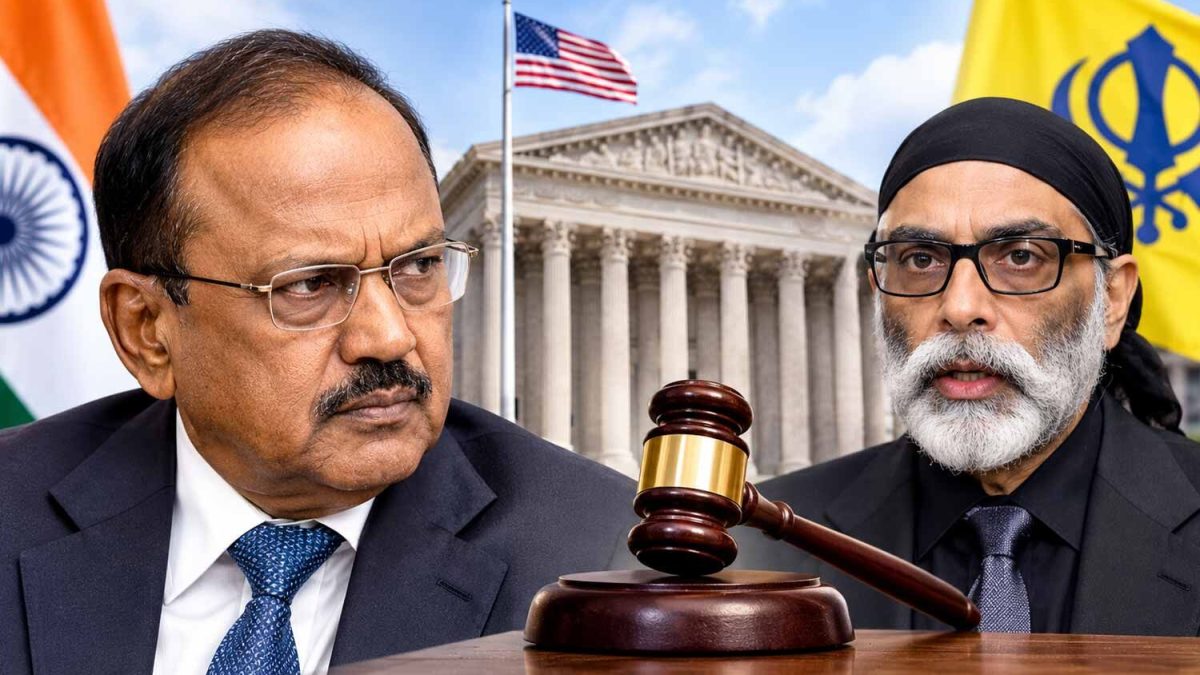
A United States federal court has ordered that summonses for National Security Adviser Ajit Doval and former Research and Analysis Wing chief Samant Goel be delivered through courts in Delhi, in connection with a civil lawsuit filed by Khalistani separatist Gurpatwant Singh Pannun. The order, dated 13 November 2026, was passed by the United States District Court for the Southern District of New York and was reported on 19 November. It directs the court's clerk to send the summonses and accompanying judicial documents to the Patiala House District Court for Mr. Doval, and to the Dwarka and Tis Hazari district courts for Mr. Goel. India has rejected the lawsuit, and the order raises a fresh question about whether, and how, a foreign civil suit against senior Indian officials can be served.
Mr. Pannun, a US-based legal counsel for the banned organisation Sikhs for Justice, is wanted by Indian investigators on various terror charges. He filed the civil lawsuit seeking damages over an alleged attempt on his life, and he accuses Mr. Doval of orchestrating the alleged assassination plot with the involvement of India's external intelligence agency, RAW. According to earlier reports, the suit was filed in September 2024 against the Indian government, Mr. Doval, Mr. Goel and others, and a summons was issued the next day giving the defendants 21 days to respond. The United States government is not a party to the case.
The latest order is, on its face, about a procedural problem: how to deliver legal papers to defendants who are located abroad and who contest the court's authority. In her order, Judge Katherine Polk Failla wrote: "The court respectfully requests the assistance of receiving Indian courts in effecting service of process upon the defendants in this civil action pending before this court." She cited the Hague Conventions and the relevant provisions of India's Code of Civil Procedure, under which summonses issued by foreign civil courts that have been notified by the central government can be transmitted to Indian courts and served in the same manner as summonses from domestic courts.
The order also records what had already been tried. The standard procedure for serving summonses through India's central authority under the Hague Convention had been attempted but rejected, the court noted. The court then authorised an alternative mode of service under Article 19 of the convention and the relevant provisions of the Code of Civil Procedure. Last month, it had tried to deliver the summonses to Mr. Doval and Mr. Goel through a diplomatic note issued by the State Department to the Indian Embassy in Washington. The latest direction to use Delhi's district courts is therefore the third route that the court has tried.
India's position on the matter has been firm. External Affairs Ministry spokesperson Randhir Jaiswal said on 10 November: "We reject the fabricated and malicious attacks on our high officials. Also, we reject the frivolous lawsuits. A request for serving of judicial documents in India can only be routed through India's designated central authority, which is the Ministry of Law and Justice." In other words, New Delhi is not only denying the allegations but also insisting on a particular channel for the service of papers, one that it controls and that it has so far declined to use for these summonses. Earlier, in 2024, the government had also described the case as unwarranted and unsubstantiated.
The dispute over channels is not a minor technicality. Service of process is the step that formally brings a defendant into a lawsuit, and a defendant who has not been properly served can argue that a court has no power over them. For Mr. Pannun's lawyers, a way of serving the summonses through Indian courts would help to move the case forward. For the Indian side, accepting service through any route might be seen as accepting the court's jurisdiction, which the government rejects. It is possible that officials in Delhi will argue that the Hague Convention's central-authority channel is the only valid one, and that the Delhi courts have no obligation to act on a request that has not come through it.
The civil case has to be seen alongside a separate criminal matter in the same New York court. That case concerns Indian national Nikhil Gupta and a former RAW officer, Vikash Yadav, over an alleged murder-for-hire plot. Gupta pleaded guilty in February 2026 to charges that included murder-for-hire and conspiracy to commit murder-for-hire, according to reports at the time, while Mr. Yadav was reported to remain at large and wanted by the FBI. The Hindu's report stresses that the civil lawsuit is separate from those criminal proceedings. The distinction matters: the criminal case is brought by United States prosecutors and has already produced a guilty plea, whereas the civil case is a private action for damages brought by Mr. Pannun himself.
In the civil suit, Mr. Pannun has named senior serving and former officials, and that makes it politically sensitive. India has long maintained that the allegations around the plot are being used to target its institutions, while Mr. Pannun's organisation is banned in India and he himself is wanted on terror charges. Even so, the plot against him has been treated seriously by United States authorities, and the New York court has shown that it intends to pursue every available route for service. How an Indian court would respond to a request that originates in a foreign civil suit against the country's own NSA is an open question.
Several things could happen next. The Delhi courts named in the order could receive the documents and decide whether to act on them, in which case the central government might intervene to argue that the request is not valid. Alternatively, the Ministry of Law and Justice could be asked to take a position on whether the court's use of Article 19 and the Code of Civil Procedure is proper. If service is held to be complete, the defendants will face a deadline to respond, and they might choose to appear only to contest jurisdiction or sovereign immunity, as foreign officials often do. If service is not completed, Mr. Pannun's lawyers may return to the court with a request for yet another mode of service.
The episode comes at a time when India's ties with the United States are broad and complex, covering trade, technology and defence, and the government has tried to keep the Pannun matter from overshadowing them. Public statements from both sides have generally treated the criminal case and the civil suit as matters for the courts. The new order is unlikely to change that, but it keeps the issue in the news and puts a spotlight on the question of how far a foreign court can reach into the affairs of senior Indian officials.
For now, the facts are limited. A US judge has directed that summonses be sent to three Delhi district courts. India has rejected the lawsuit as fabricated and malicious and says that service can only go through the Ministry of Law and Justice. Mr. Pannun's allegations have not been tested in court, and none of the claims against Mr. Doval and Mr. Goel has been proved. What the order does show is the determination of the New York court to give the suit a chance to proceed, and the determination of the Indian government to contest it at every step. The next move will come from the Delhi courts, or from the central authority that New Delhi says is the only proper route.


Leave a Reply