
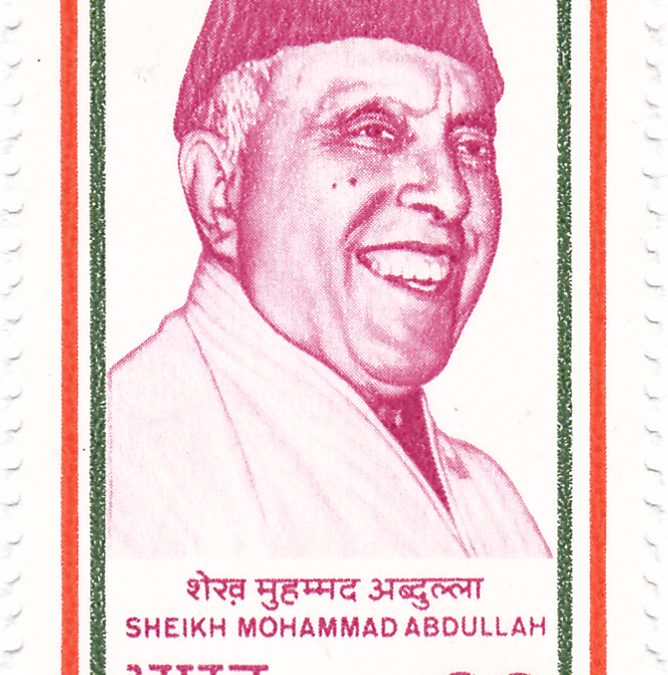
Sheikh Mohammad Abdullah (5 December 1905 – 8 September 1982), known as Sher-e-Kashmir, the Lion of Kashmir, was a Kashmiri political leader who dominated the politics of Jammu and Kashmir for half a century. He led the popular movement against the rule of the Maharaja, supported the state’s accession to India in 1947, became its Prime Minister, and carried out the most thorough land reform in the subcontinent. Dismissed and arrested in 1953, he was held for most of the next fifteen years, and returned to power in 1975.
Quick Facts
| Full name | Sheikh Mohammad Abdullah |
| Born | 5 December 1905, Soura, Srinagar |
| Died | 8 September 1982, Srinagar (aged 76) |
| Education | Islamia College, Lahore; Aligarh Muslim University (M.Sc. in chemistry, 1930) |
| Party | Jammu and Kashmir National Conference |
| Offices | Prime Minister of Jammu and Kashmir (1948–1953); Chief Minister (1975–1982) |
| Notable work | Aatish-e-Chinar (autobiography) |
| Spouse | Begum Akbar Jahan |
| Children | Farooq Abdullah and others |
Early Life
He was born at Soura, on the edge of Srinagar, into a family that traded in shawls. His father died two weeks before his birth. He grew up in hardship, studied at Lahore and took a master’s degree in chemistry at Aligarh.
In the Kashmir of the Dogra Maharajas the Muslim majority were mostly poor peasants and craftsmen, taxed heavily and almost shut out of government service. Abdullah, one of the few Muslim graduates of the state, was given a post as a schoolteacher.
1931
He joined a group of young men who met in a reading room to discuss their grievances. On 13 July 1931 the Maharaja’s police fired on a crowd outside the Srinagar jail, killing twenty-one people. Abdullah emerged from the agitation that followed as the leader of the Kashmiri Muslims. In 1932 he founded the Muslim Conference.
The National Conference
Under the influence of Jawaharlal Nehru, who became a close friend, he came to hold that the struggle was one of all the state’s people against autocracy. In 1939 the party was renamed the National Conference and opened to Hindus and Sikhs. In 1944 it adopted a programme called Naya Kashmir, promising a constitutional government, land for the tiller and equality for women. In 1946 he launched the Quit Kashmir movement against the Maharaja and was jailed.
1947
He was released at the end of September 1947. Within weeks tribesmen from Pakistan invaded. He rejected the two-nation theory and supported the Maharaja’s accession to India; his party’s volunteers kept order in Srinagar until the Indian Army landed. He was made head of the emergency administration and, in March 1948, Prime Minister of the state.
Prime Minister
- **Land reform:** the law of 1950 abolished large estates, set a ceiling of about twenty-three acres and transferred the surplus to the tillers without compensation to the owners
- **Debt:** the debts of peasants and artisans were scaled down
- **Autonomy:** Article 370 of the Indian Constitution gave the state its own constitution and limited the Centre’s powers, and the Delhi Agreement of 1952 defined the relationship. The rule of the Dogra dynasty was ended.
Dismissal
An agitation in Jammu demanded the state’s full integration with India. Abdullah grew bitter, and began to speak of other possibilities for Kashmir, independence among them. His cabinet split. On 8 August 1953 the head of state dismissed him, and he was arrested the next day. His deputy, Bakshi Ghulam Mohammad, took over.
He was held without trial until 1958, released for a few months and rearrested, and then tried in a conspiracy case that was withdrawn in April 1964. Nehru, a few weeks before his own death, sent him to Pakistan to explore a settlement. He was detained again from 1965 to 1968 and banished from the state in 1971.
The Accord
After long negotiation he reached an agreement with Indira Gandhi in February 1975. He accepted that the accession was final; the state kept Article 370. He became Chief Minister with the support of the Congress, and in 1977 won an election generally regarded as the fairest the state had seen.
Death
He died in Srinagar on 8 September 1982. His funeral was attended by a vast crowd. He had named his son, Farooq Abdullah, as his successor, and his grandson Omar later held the same office.
Legacy
He remains the most disputed figure in the history of Kashmir: to many the man who gave the peasant his land and his dignity, to others the one who tied Kashmir to India, and to others again a leader whose loyalty Delhi never trusted. During the insurgency of the 1990s his grave had to be guarded.
Featured image: Sheikh Abdullah, from a 1988 postage stamp of India. Photo by India Post, Government of India, licensed under Government Open Data License – India, via Wikimedia Commons.



