
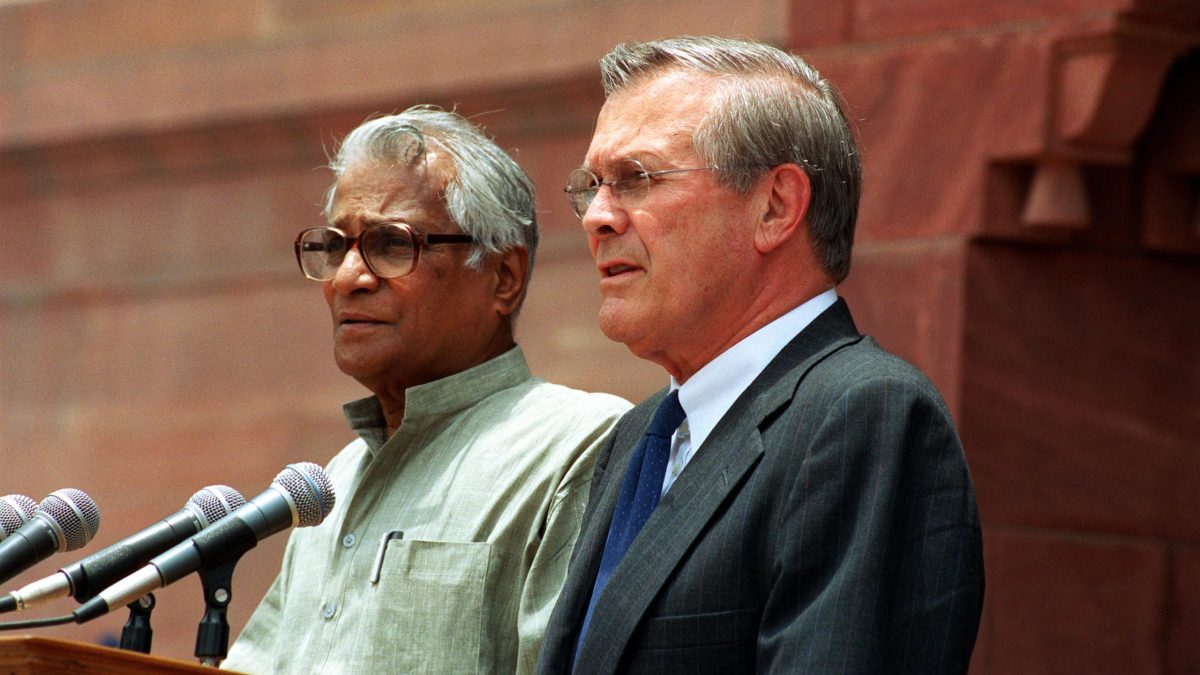
George Fernandes (3 June 1930 – 29 January 2019) was an Indian trade unionist, socialist politician and journalist. He rose from sleeping on Bombay’s pavements to leading its unions, organised the all-India railway strike of 1974, went underground during the Emergency and later served as Union Minister for Industry, Railways and Defence. He was Defence Minister from 1998 to 2004, during the nuclear tests at Pokhran and the Kargil War.
Quick Facts
| Full name | George Mathew Fernandes |
| Born | 3 June 1930, Mangalore, Madras Presidency (now Karnataka), India |
| Died | 29 January 2019, New Delhi (aged 88) |
| Parties | Socialist parties; Janata Party; Janata Dal; Samata Party (founder, 1994); Janata Dal (United) |
| Offices | Minister of Industry (1977–1979); Minister of Railways (1989–1990); Minister of Defence (1998–2004) |
| Spouse | Leila Kabir (m. 1971) |
| Children | 1 son (Sean) |
| Honour | Padma Vibhushan (2020, posthumous) |
Early Life
Fernandes was the eldest of six sons in a Mangalorean Catholic family. Sent to a seminary in Bangalore to become a priest, he left after two years, disillusioned. In 1949 he went to Bombay looking for work and at first slept on the street. Influenced by the union leader Placid D’Mello and the socialist Ram Manohar Lohia, he organised dock, hotel and transport workers and could bring the city to a halt.
Political Career
In 1967 he defeated the powerful Congress leader S. K. Patil in Bombay South. As president of the All India Railwaymen’s Federation he led a strike of about 1.7 million railway workers in May 1974, which the government broke with mass arrests.
When Indira Gandhi declared the Emergency in 1975 he went underground, disguised at times as a Sikh. He was arrested in Calcutta in June 1976 and charged in the Baroda dynamite case with plotting to blow up government property. A photograph of him raising his chained hands became a symbol of resistance. He won Muzaffarpur in Bihar by a huge margin in 1977 without leaving jail.
As Industry Minister in the Janata government he insisted that foreign companies dilute their ownership, which led IBM and Coca-Cola to leave India. As Railways Minister he launched the Konkan Railway, entrusting it to E. Sreedharan. He formed the Samata Party with Nitish Kumar in 1994 and was convenor of the National Democratic Alliance under Atal Bihari Vajpayee. As Defence Minister he visited the Siachen glacier many times. He stepped down for some months in 2001 after the Tehelka sting on defence deals; he denied wrongdoing.
Final Years
He suffered from Alzheimer’s and Parkinson’s diseases and spent his last decade away from public life. He died in Delhi on 29 January 2019.
Frequently Asked Questions
When and where was George Fernandes born?
George Fernandes was born on 3 June 1930 in Mangalore, Madras Presidency (now Karnataka), India.
When did George Fernandes die?
Died: 29 January 2019, New Delhi (aged 88).
Featured image: George Fernandes (left), then Defence Minister, at a joint press conference with US Defense Secretary Donald Rumsfeld outside South Block, New Delhi, 12 June 2002. Photo by Helene C. Stikkel, in the public domain, via Wikimedia Commons.



