
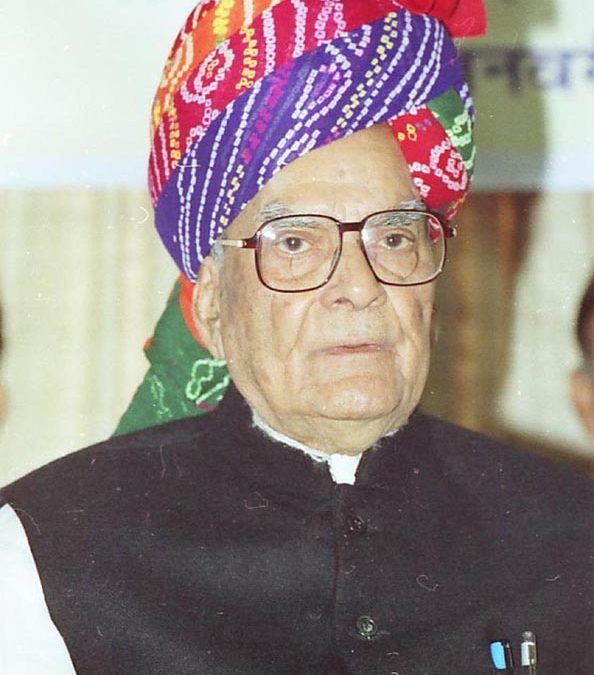
Bhairon Singh Shekhawat (23 October 1923 – 15 May 2010) was an Indian politician who was Chief Minister of Rajasthan three times and the eleventh Vice-President of India, from 2002 to 2007. A member of the first Rajasthan assembly of 1952, he sat in legislatures for half a century. He was the tallest leader of the Jana Sangh and the Bharatiya Janata Party in the state, known across party lines for his friendships and his skill at holding governments together.
Quick Facts
| Full name | Bhairon Singh Shekhawat |
| Born | 23 October 1923, Khachariawas, Sikar district, Rajasthan |
| Died | 15 May 2010, Jaipur (aged 86) |
| Parties | Bharatiya Jana Sangh; Janata Party; Bharatiya Janata Party |
| Offices | Chief Minister of Rajasthan (1977–1980; 1990–1992; 1993–1998); Vice-President of India (2002–2007) |
| Awards | Padma Bhushan (2003) |
| Spouse | Suraj Kanwar |
| Children | 1 daughter |
Early Life
He was born in a village in the Shekhawati region into a Rajput family of small means. His father, a schoolteacher, died when he was at school, and he gave up his studies to farm the family’s land and support his mother and younger brothers. He then served as a sub-inspector of police in the princely state of Sikar.
Into Politics
He left the police and in 1952 stood for the new Rajasthan assembly as a candidate of the Jana Sangh, it is said with ten rupees borrowed from his wife. He won. He was returned in almost every election for the next fifty years, from a number of different constituencies.
In his first term the government moved to abolish the jagirdari system of feudal landholding. Most of his party’s legislators were jagirdars themselves and opposed the measure. Shekhawat, a Rajput, supported it, and several of his colleagues left the party.
He was jailed during the Emergency of 1975–77.
Chief Minister
1977–1980
He led the Janata Party to victory in Rajasthan in 1977 and became the state’s first non-Congress Chief Minister. His best-known measure was Antyodaya, “the rise of the last”: in every village the five poorest families were identified and given help to earn a living, by a loan, a cow, a plot or a pension. The scheme was praised by the World Bank’s president and copied elsewhere. He also started a food-for-work programme.
His government was dismissed in 1980 when Indira Gandhi returned to power.
1990–1992 and 1993–1998
He became Chief Minister again in 1990 at the head of a coalition. The government was dismissed in December 1992 after the demolition at Ayodhya. He won the election that followed and, without a majority of his own, formed a government with the support of independents that lasted its full term. He promoted tourism, including the Palace on Wheels and heritage hotels, mining and industry, and family planning, barring those with more than two children from standing for village councils.
Against Sati
In September 1987 a young widow, Roop Kanwar, was burnt on her husband’s pyre at Deorala, in his own region, and many Rajput organisations glorified the act. Shekhawat, then Leader of the Opposition, condemned it publicly and at some political risk.
Vice-President
He was elected Vice-President in August 2002. As chairman of the Rajya Sabha he was good-humoured and firm, and members of all parties called him Babosa, the head of the family.
In 2007 he stood for President as an independent backed by the National Democratic Alliance. He lost to Pratibha Patil, herself a former Governor of Rajasthan, and resigned as Vice-President the same day.
Last Years
He announced a campaign against corruption and for a time considered contesting the Lok Sabha election of 2009 against his own party’s wishes. He died of cancer in Jaipur on 15 May 2010 and was cremated with state honours.
Personal Life
He married Suraj Kanwar in 1941; their daughter, Ratan Kanwar, is married to Narpat Singh Rajvi, who was a minister in Rajasthan. He was succeeded as Vice-President by Hamid Ansari.
Featured image: Bhairon Singh Shekhawat as Vice-President, in a Rajasthani turban at a book release, January 2004. Photo by the Government of India, licensed under Government Open Data License – India, via Wikimedia Commons.



