
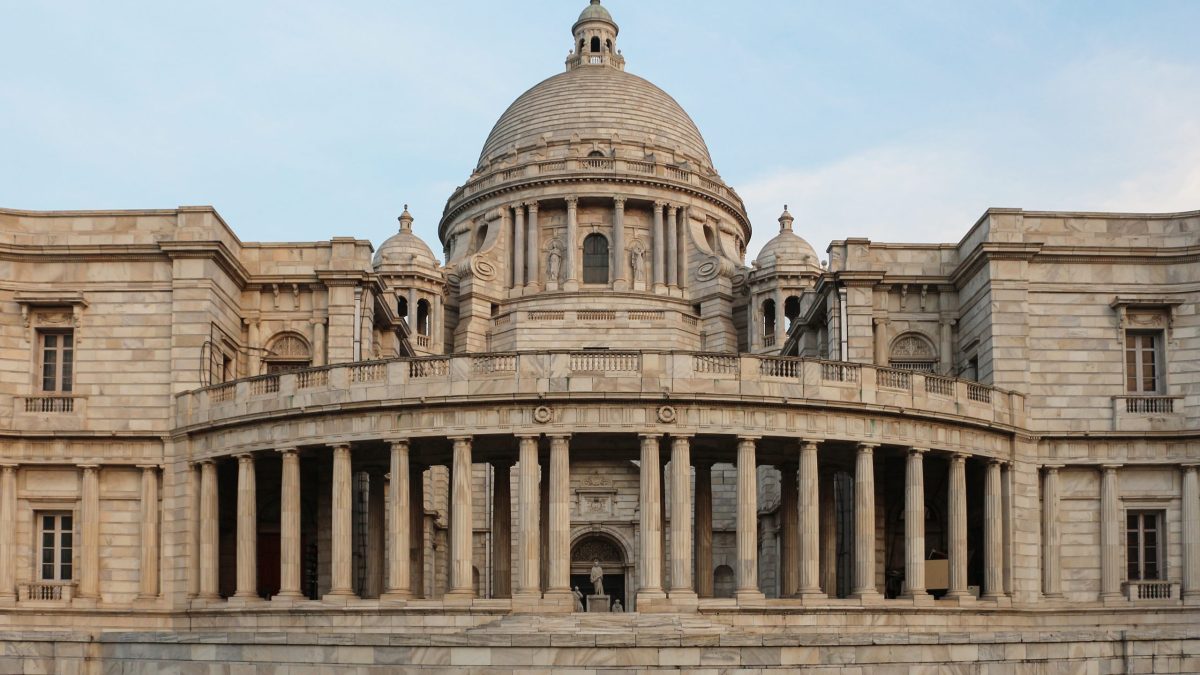
The Victoria Memorial is a large marble museum and monument on the Maidan in central Kolkata. It was built between 1906 and 1921 and is dedicated to Queen Victoria, Empress of India from 1876 to 1901. Wikipedia describes it as the largest monument to a monarch anywhere in the world, standing in 26 hectares of gardens.
The idea came from Lord Curzon, the Viceroy. After Victoria died on 22 January 1901, Curzon wrote two days later to the Secretary of State for India, noting the importance of her image in promoting loyalty, and proposed a grand building with a museum and gardens. Historian Durba Ghosh notes that his plans for a historical museum had existed before her death, and the queen’s death gave him an occasion. On 26 February 1901 he told the Asiatic Society that the city should have a building “stately, spacious, monumental and grand” that would teach history to all residents.
The money came from the public. Princes, officials, politicians and the people of India responded to Curzon’s appeal, and the total cost of construction, Rs 1.05 crore, was entirely met from voluntary subscriptions. The site chosen was near the present-day Raj Bhavan, then Government House.
Progress was slow. Curzon left India in 1905 and local enthusiasm fell. There was also uncertainty about whether the foundations would hold, and tests were carried out. The Prince of Wales, the future George V, laid the foundation stone on 4 January 1906. The construction was handed to Martin and Company of Calcutta, founded by Rajendranath Mukherjee and Thomas Acquin Martin, and the work on the superstructure began in 1910. In 1911 the emperor announced that the capital would move to Delhi, so the memorial would stand in a provincial capital rather than the national one. It was opened to the public in December 1921 by the Prince of Wales, the future Edward VIII.
The architect was William Emerson. The design is Indo-Saracenic, mixing British and Mughal elements with Venetian, Egyptian and Deccani influences. The building measures 103 by 69 metres and rises to 56 metres. It is built of white Makrana marble, the stone also used for the Taj Mahal. Curzon deliberately wanted the central chamber to be 64 feet, or 20 metres, in diameter, slightly larger than the Taj Mahal’s, and the dome echoes that of the Taj in its design.
Sculpture is part of the structure. On top of the central dome stands the 4.9-metre Angel of Victory by Emerson’s assistant Vincent Jerome Esch, cast by H. H. Martyn and Company of Cheltenham, and allegorical figures representing Art, Architecture, Justice and Charity surround the dome. The memorial ended up with two statues of the queen: a bronze by George Frampton made for her Diamond Jubilee of 1897, and a marble statue commissioned later from Thomas Brock.
The gardens were designed by Lord Redesdale and David Prain, and Esch designed the bridge on the north and the garden gates. They cover 26 hectares and are maintained by a team of 21 gardeners, with statues of colonial figures along the paved quadrangles.
Today the building is a museum under the Ministry of Culture. It has 25 galleries, including a royal gallery, a national leaders’ gallery, a portrait gallery, a sculpture gallery and an arms and armoury gallery, and it holds the largest single collection of works by Thomas Daniell and his nephew William Daniell. After 1947 some additions were made to the memorial.
The Victoria Memorial is the work of an imperial plan realised after the empire had begun to shift. It was started to glorify a queen and a rule, and it was finished as a museum, which is how Kolkata uses it.
Featured image: The west facade of the Victoria Memorial in Kolkata (file photo). Photo by Bernard Gagnon, licensed under CC BY-SA 3.0, via Wikimedia Commons.

Leave a Reply