
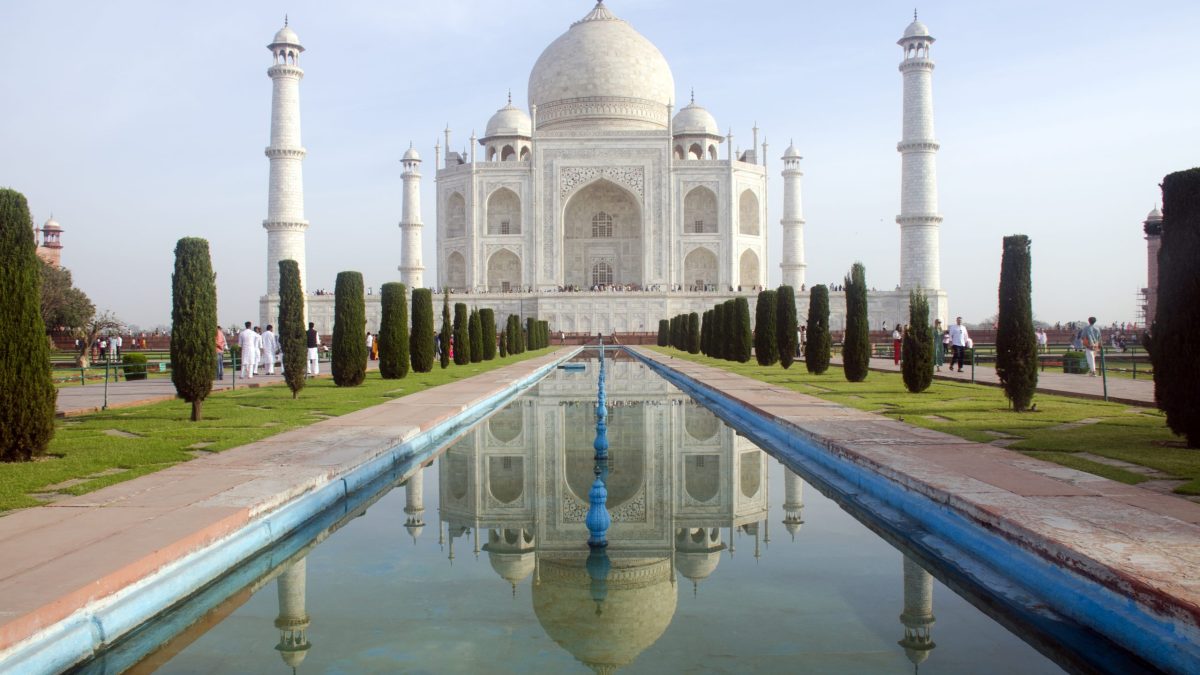
The Taj Mahal, on the bank of the Yamuna at Agra in Uttar Pradesh, is the most famous building in India and one of the most recognised in the world. The Mughal emperor Shah Jahan built it as the tomb of his wife Mumtaz Mahal. UNESCO inscribed it as a World Heritage Site in 1983, calling it “the jewel of Muslim art in India”.
At a glance
- Location: Agra, Uttar Pradesh
- Inscribed: 1983
- Type: Cultural
- Built: 1632 to about 1653
- Built by: Shah Jahan, fifth Mughal emperor
History
Mumtaz Mahal died in 1631 at Burhanpur while giving birth to her fourteenth child. The grieving emperor chose a site downstream from Agra Fort for her tomb. Work began in 1632. The mausoleum itself was finished in about 1648, and the mosque, guest house, gateway and garden some five years later. About 20,000 workers are said to have been employed. The chief architect is generally named as Ustad Ahmad Lahauri.
Shah Jahan was deposed by his son Aurangzeb in 1658 and spent his last years confined in Agra Fort, within sight of the tomb. He was buried beside his wife in 1666.
Architecture
- The tomb: white marble from Makrana in Rajasthan, on a square plinth, with a central dome rising to about 73 metres and four smaller domed kiosks
- The minarets: four, built to lean very slightly outward so that they would fall away from the tomb in an earthquake
- Decoration: verses from the Quran in black marble calligraphy, and flowers inlaid in semi-precious stones, the technique called pietra dura
- The garden: a charbagh, divided into four by water channels, with the tomb placed at the end and not the centre
- Flanking buildings: a red sandstone mosque on the west and an identical building, the jawab or “answer”, on the east for symmetry
The cenotaphs in the main chamber are symbolic; the actual graves lie in a crypt below.
Why it is a World Heritage Site
UNESCO recognises the Taj Mahal as a masterpiece of human creative genius: the finest achievement of Indo-Islamic architecture, perfect in its proportions and in the harmony of building, garden and river.
Conservation
Air pollution has yellowed the marble in places, and the Supreme Court has ordered controls on industry and traffic in a protected zone around the monument. The marble is cleaned periodically with a clay pack.
Visiting
Agra is about 200 kilometres from Delhi by road or rail. The monument is closed to tourists on Fridays. Sunrise is the most popular time to visit.
Image: The Taj Mahal reflected in the water channel of its garden, Agra. Photo by Rangan Datta Wiki, licensed under CC BY-SA 4.0, via Wikimedia Commons.



Leave a Reply