
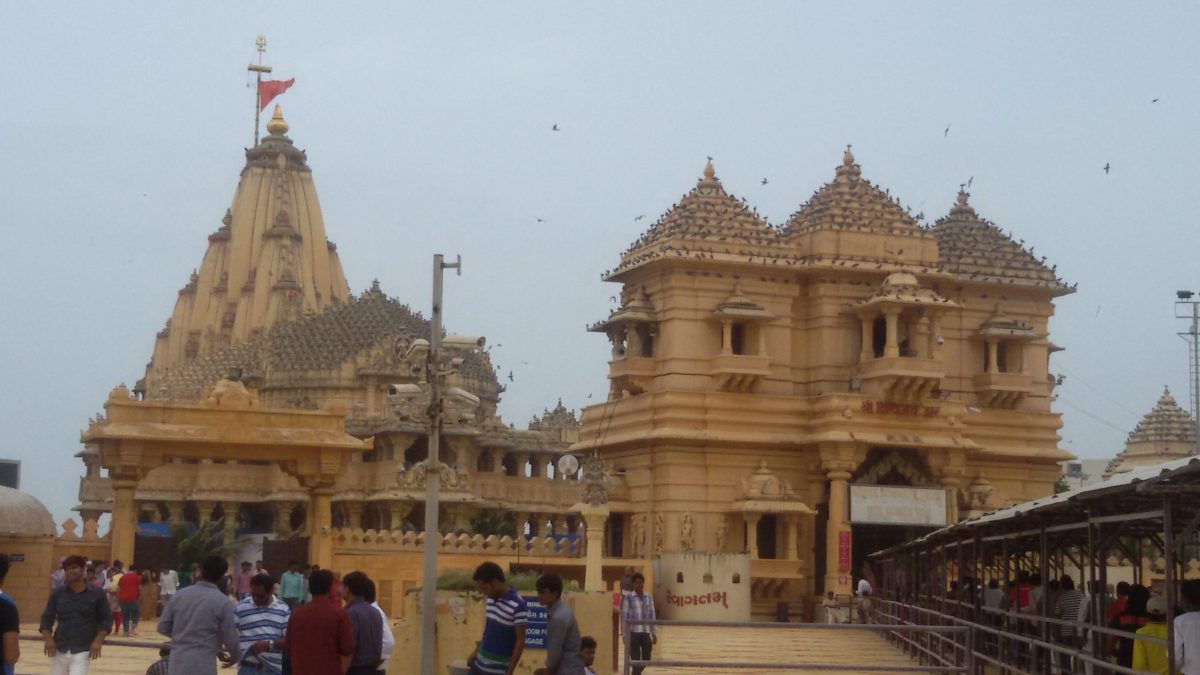
The Somnath Temple at Prabhas Patan, near Veraval in Gujarat, is a Shiva temple and the first of the twelve jyotirlinga shrines. It is among the most sacred pilgrimage sites for Hindus. Its structure today is a mid-20th-century reconstruction on the site of a much older and often damaged shrine, and its history is told in layers.
The earliest temple is uncertain. Estimates of its date range from the early centuries of the first millennium to about the 9th century, and while texts such as the Mahabharata and the Bhagavata Purana mention a pilgrimage site at Prabhas Patan on the Saurashtra coast, archaeology has not found traces of an early temple. The site was occupied during the Indus Valley Civilisation, between 2000 and 1200 BCE, and again from about 400 BCE. The location matters: it lies by the port of Veraval, a medieval trading harbour, and the 11th-century historian Al-Biruni wrote that Somnath was famous because it was a harbour for seafarers travelling between East Africa and China.
The first well-known attack was in January 1026, in the reign of Bhima I, when Mahmud of Ghazni crossed the Thar desert and raided the temple, desecrated its jyotirlinga and carried off a large amount of wealth, estimated at 20 million dinars in the account cited. Historians note that the condition of the temple after the raid is unclear, because an inscription of 1038 from a Kadamba king of Goa is silent about it, which could suggest desecration rather than total destruction.
The temple was rebuilt. Kumarapala, who ruled from 1143 to 1172, rebuilt it in stone and studded it with jewels, according to an inscription of 1169, after being urged by the Pashupata ascetic Bhava Brihaspati, replacing a decaying wooden temple.
Later centuries brought more damage, according to the sources. In 1299 Alauddin Khalji’s army, led by Ulugh Khan, defeated the Vaghela king Karna and sacked the temple. The temple was damaged again in 1395 by Zafar Khan, the last governor of Gujarat under the Delhi Sultanate, and in 1451 by the Gujarat sultan Mahmud Begada. By 1665 Aurangzeb ordered its destruction, though the order seems not to have been carried out then; in 1706 he ordered its destruction and conversion into a mosque, and that order appears to have been carried out, though with little effort.
Ahilyabai Holkar, the Queen of Malwa, built a separate smaller temple near the ruins of the main shrine in the 18th century. In the late 19th and early 20th centuries colonial historians and archaeologists studied the ruins, which showed a historic Hindu temple being turned into a mosque.
After independence the ruins were demolished and the present temple was built. The reconstruction was started on the orders of Vallabhbhai Patel, the first deputy prime minister, and was completed in May 1951. The new temple is in the Maru-Gurjara style of Hindu temple architecture.
The name means “Lord of the Soma”, or moon, and the site is also called Prabhasa, “place of splendour”. It is one of five revered sites on the Indian coast, along with Dwarka, Puri, Rameswaram and Chidambaram. The Shiva Purana places Somnath first on its list of jyotirlingas.
The present temple stands about 400 kilometres south-west of Ahmedabad and 82 kilometres south of Junagadh, and the structure shows how a place of worship can be rebuilt many times and still keep its place in religious memory. Accounts of the raids differ among historians, so the dates above are best read with the cited sources.
Featured image: The Somnath Temple at Prabhas Patan, Gujarat (file photo). Photo by Aditya Mahar, licensed under CC BY-SA 4.0, via Wikimedia Commons.


Leave a Reply