
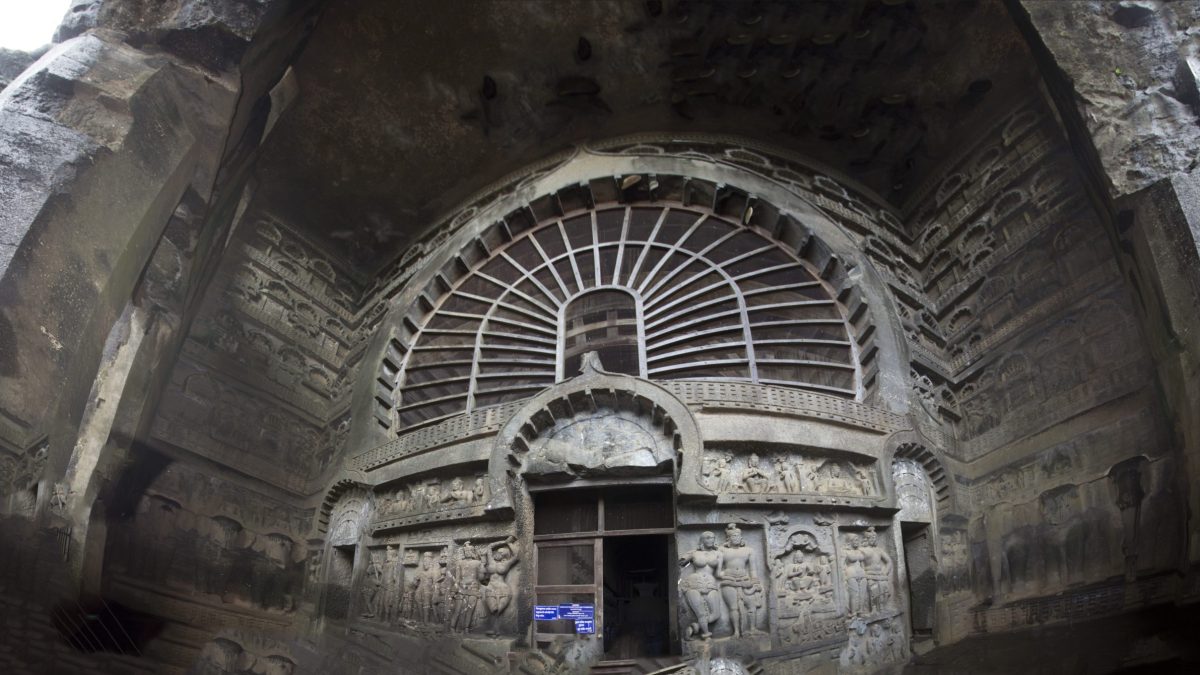
The Satavahanas ruled the Deccan plateau from about the late second century BCE to the early third century CE. Their kingdom lay mainly in present-day Maharashtra, Andhra Pradesh and Telangana, and at times extended into Gujarat, Madhya Pradesh and Karnataka. They stood between north and south, and carried goods and ideas between the Gangetic plain and the tip of the peninsula.
Quick Facts
| Period | Late 2nd century BCE to early 3rd century CE (some scholars date the start earlier) |
| Region | Deccan: Maharashtra, Andhra Pradesh, Telangana |
| Capitals | Pratishthana (Paithan) and Amaravati (Dharanikota) |
| Greatest rulers | Gautamiputra Satakarni, Vasisthiputra Pulumavi |
| Known for | Coinage, Buddhist monuments, trade |
Origins
Where the dynasty began is debated. The Puranas say the first king overthrew the Kanva dynasty, but this is not backed by archaeology, and some scholars place the origin in the western Deccan, because early inscriptions are found there, while others look to the east. The Puranas also call them Andhras, but modern scholars do not agree on how to read this term.
Wars and Rulers
The Satavahanas struggled for a long time with the Shakas, the Western Satraps who ruled Gujarat and Malwa. The dynasty reached its height under Gautamiputra Satakarni and his son Vasisthiputra Pulumavi, in the second century CE. An inscription at Nashik, made by Gautamiputra’s mother Gautami Balashri, praises her son as the destroyer of the Shakas, Yavanas and Pahlavas, and describes his rule as extending over a large area. Silver coins of the Shaka ruler Nahapana, restruck with Gautamiputra’s own stamp, have been found as evidence of his victory.
Coins and Language
The Satavahanas were among the earliest issuers of Indian state coins bearing the portraits of rulers. Their coins, of lead, copper and silver, carry inscriptions in Prakrit, which was the language of their inscriptions, and a few have Tamil or Telugu legends as well. Satavahana kings often used their mothers’ names as part of their own, such as Gautamiputra, “son of Gautami”, a feature that is rare in ancient India.
Trade with Rome
The Deccan ports, with the internal trade routes to them, brought Indian goods to the Roman world. The Periplus of the Erythraean Sea, a Greek merchant’s handbook of the first century CE, lists markets such as Paithan and Tagara in the interior as sources of cotton cloth, gems and other goods. The Roman writer Pliny the Elder complained that India took vast sums of Roman gold in return for luxuries. Roman coins have been found at sites in the Deccan.
Art and Monuments
The Satavahana period produced some of India’s most important Buddhist monuments: the rock-cut caves at Karla, Nashik and Kanheri, and the great stupa at Amaravati, where carved marble slabs show scenes of Buddha’s life. The gateways added to the stupa at Sanchi are also associated with the dynasty.
Decline
By the early third century CE the kingdom had split into smaller states. Their successors in the south included the Ikshvakus and, later, the Pallavas, who had once served them as feudatories. For a northern contemporary, see the Kushan Empire.
Featured image: The entrance of the Karla Caves in Maharashtra, Buddhist rock-cut caves made in the Satavahana period. Photo by Riffythomas, licensed under CC BY-SA 4.0, via Wikimedia Commons.


Leave a Reply