
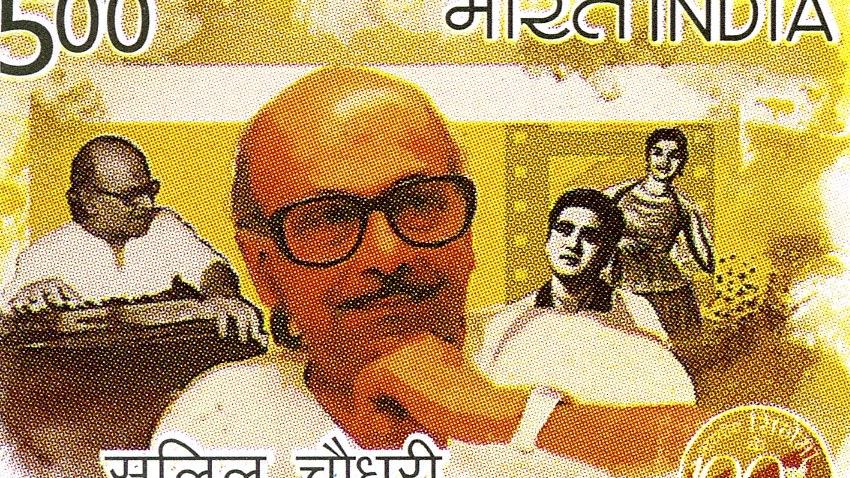
Salil Chowdhury was born on 19 November 1925 in the 24 Parganas district of Bengal and died on 5 September 1995 in Kolkata. He was a composer, lyricist and poet who worked in Bengali, Hindi and Malayalam cinema, and he is regarded as one of the most original film composers in India.
He spent his childhood in the tea-garden region of Assam, where his father was a medical officer, and was exposed to folk songs and Western classical music. In 1944 he joined the Indian People’s Theatre Association (IPTA) in Calcutta and became a full-time member, writing songs of protest and social comment that spread widely across Bengal.
He made his Hindi film debut as a music director with Bimal Roy’s Do Bigha Zamin (1953), then composed Madhumati (1958), whose songs including “Suhana Safar” and “Aaja Re Pardesi” won him the Filmfare Award for Best Music Director. He later composed Parakh (1960), Anand (1971) and Chhoti Si Baat (1975).
In Malayalam he composed for Chemmeen (1965), and his songs became closely associated with the state’s cinema. He often blended Western orchestration and Indian melodies.
He is remembered for his willingness to use unusual structures, and for songs such as “Kahin Door Jab Din Dhal Jaye” from Anand, sung by Mukesh, which remains a staple of Hindi film music.
Featured image: Salil Chowdhury on a 2013 Indian postage stamp (cropped). Photo by India Post, Government of India, licensed under GODL-India, via Wikimedia Commons.




Leave a Reply