
The Rashtrakuta Empire ruled large parts of the Indian subcontinent from the middle of the eighth century to the late tenth. At its peak, from Manyakheta in the Deccan, it stretched from the Ganga-Yamuna doab in the north to Kanyakumari in the south. An Arabic text of 851, the Silsilat al-Tawarikh, called it one of the four principal empires of the world. It is also remembered for the Kailasa temple at Ellora.
Quick Facts
| Period | c. 753–973 CE |
| Capital | Manyakheta (Malkhed), Karnataka |
| Great rulers | Dantidurga, Krishna I, Govinda III, Amoghavarsha I, Indra III |
| Famous for | Kailasa temple at Ellora; Kannada literature |
| Rivals | Palas of Bengal, Gurjara-Pratiharas |
Rise
The Rashtrakutas began as feudatories of the Badami Chalukyas. Dantidurga overthrew Kirtivarman II in about 753 and built a new empire, with the area around Kalaburagi in modern Karnataka as its base. He and his successors expanded north and south.
The Struggle for Kannauj
Between the eighth and tenth centuries three empires fought for the rich Gangetic plain and the seat of imperial prestige, Kannauj: the Palas of Bengal, the Gurjara-Pratiharas of the north-west and the Rashtrakutas. This tripartite struggle saw each power take the city for brief periods. Govinda III, in the early ninth century, was a great conqueror who campaigned in the north, and Indra III sacked Kannauj in the early tenth century, though no rule over the north was ever stable.
Amoghavarsha I
Amoghavarsha I (c. 814–878) had one of the longest reigns in Indian history. He moved the capital to Manyakheta and encouraged learning. The Kavirajamarga, the earliest surviving work on Kannada poetics, is attributed to him or to his court, and he patronised Jain scholars and mathematicians. Later in life he is said to have turned to the Jain faith. Arab travellers noted the wealth of the kingdom and its king, whom they called the Balhara.
The Kailasa Temple
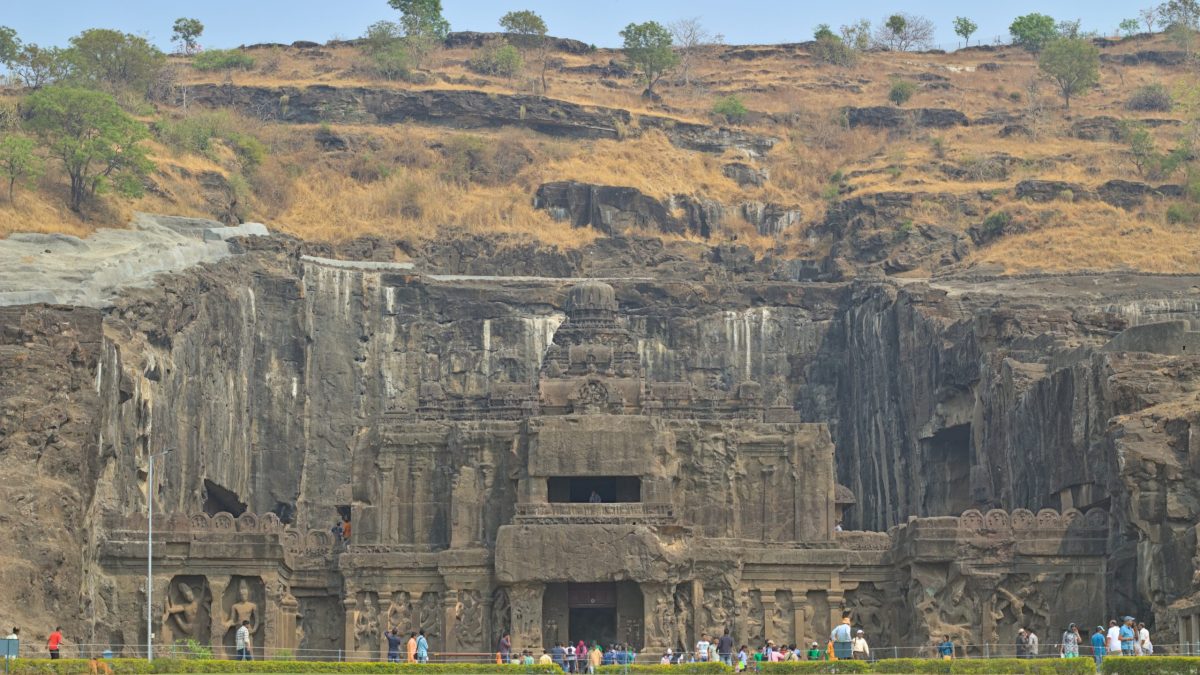
At Ellora in Maharashtra, a temple of Shiva, Cave 16, was carved from a single rock, from the top down. It is generally attributed to Krishna I, in the second half of the eighth century. The temple is about 60 metres long and rises to a height of about 30 metres, with sculptures of the epics, and it is the largest monolithic structure of its kind. Ellora, which also has Buddhist and Jain caves, is a UNESCO World Heritage Site.
Decline
In the tenth century the Rashtrakutas suffered from wars with the Chola kingdom, whose forces defeated them at Takkolam in about 949, and from revolts of their feudatories. In 973 the Western Chalukya ruler Taila II overthrew the last Rashtrakuta king and revived the Chalukya line at Kalyani. The age of the Rashtrakutas left a legacy in Kannada literature and in rock-cut architecture, and their rivals the Cholas rose to the greatest heights; see the Chola temples.
Featured image: The Kailasa Temple (Cave 16) at Ellora, carved from a single rock under the Rashtrakutas. Photo by Shishirdasika, licensed under CC BY-SA 4.0, via Wikimedia Commons.




Leave a Reply