
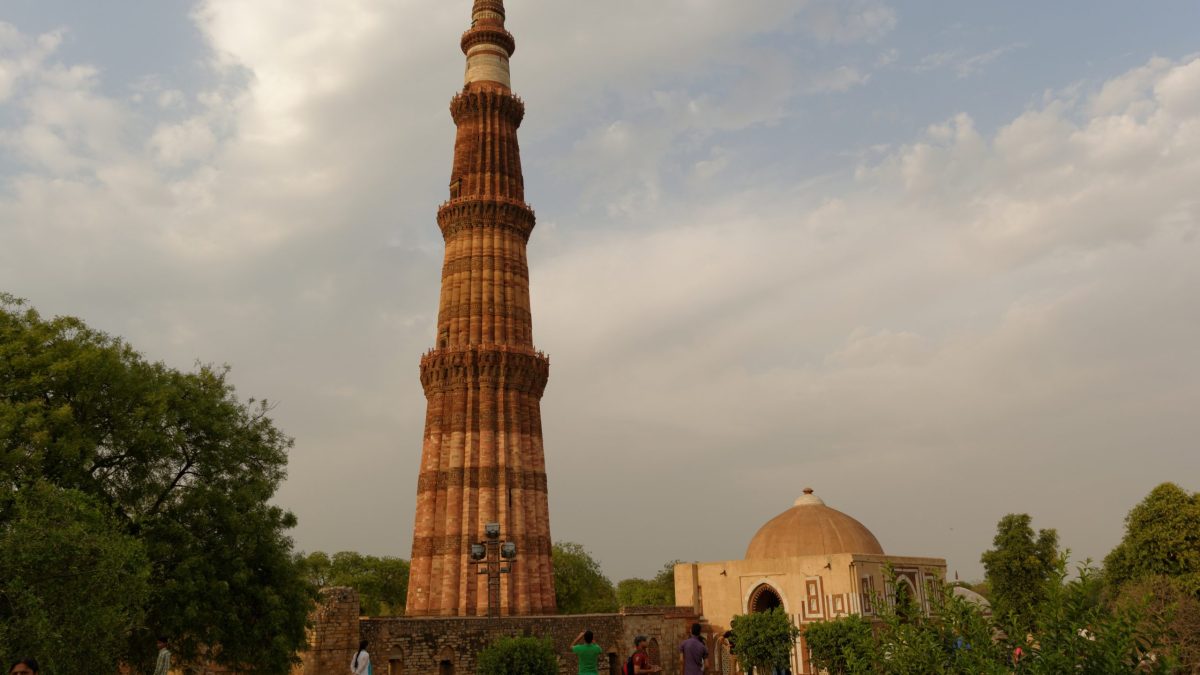
The Qutub Minar in Mehrauli, South Delhi, is a minaret and victory tower that stands at the heart of the Qutb complex, a UNESCO World Heritage Site. Its story is one of unfinished ambition: it was started by one ruler, extended by another and repaired by a third, which is why its five storeys look different from one another.
The tower was begun after the Ghurid conquest of Delhi. Qutb-ud-din Aibak, a deputy of Muhammad of Ghor who later founded the Delhi Sultanate, defeated Prithviraj Chauhan, the last Hindu ruler of Delhi before the Ghurid takeover, and started the tower in 1199 to mark the beginning of Islamic rule in the region. He finished only the first level. The site was the ruins of Lal Kot, the citadel of Dhillika, and the tower rose at the south-eastern corner of the Quwwat-ul-Islam mosque, which Aibak had begun first.
His successor and son-in-law, Shamsuddin Iltutmish, completed a further three storeys. The tower is therefore the work of more than one reign, and the bottom storey was completed during the lifetime of the Ghurid sultan Ghiyath al-Din Muhammad. After a lightning strike in 1369 damaged the then top storey, Firuz Shah Tughlaq replaced it and added one more, and in 1368, by another count, rebuilt the upper parts and added a cupola. Sources differ on the exact year, so the safest statement is that the Tughlaq repair came in the late 14th century. Sher Shah Suri added an entrance while the Mughal emperor Humayun was in exile.
The numbers explain why it is so often counted among the tallest of its kind. The tower is 72.5 metres high and is described as the tallest brick minaret in the world. It tapers from a base diameter of 14.3 metres to 2.7 metres at the top. Wikipedia gives its interior spiral staircase as 379 steps in one place and 399 in another, so the exact count is disputed and visitors should treat either figure with caution. The shaft is made of red and grey sandstone, with fluted pilasters and balconies carried on stalactite-like brackets called muqarnas corbels.
Scholars often compare it with the 62-metre brick Minaret of Jam in Afghanistan, built around 1190, a decade or so before the Delhi tower was probably started. Both are covered with inscriptions and geometric patterns. In India, minarets were slow to be adopted and are often detached from the mosque, and the Qutub Minar follows that pattern. One essay cited on Wikipedia calls it the earliest and best example of a fusion of Hindu and Muslim traditions, because the work was carried out by local craftsmen under Muslim supervision. Because some of those craftsmen did not know the Quran, the inscriptions are a compilation of disarranged Quranic texts and other Arabic expressions.
The name itself is disputed. It is usually thought to honour Qutb-ud-din Aibak, but it may instead refer to Khwaja Qutbuddin Bakhtiar Kaki, a 13th-century Sufi saint whom Iltutmish revered.
The surrounding complex shows how the tower grew with the city. The Quwwat-ul-Islam mosque, built in 1199, is the earliest surviving mosque of the Delhi Sultans, and its cloisters were built using carved columns taken from 27 Jain and Hindu temples, as Aibak’s own inscription on the eastern entrance records. In its courtyard stands an iron pillar carrying a Sanskrit inscription in Brahmi script of the fourth century, which says it was set up as a standard of Vishnu in memory of a king named Chandra. Both of these are older than the tower itself and make the site a layered one.
Natural disasters and repairs have shaped the monument. An earthquake damaged it in 1505, and Sikandar Lodi repaired it. A major earthquake on 1 September 1803 caused serious damage, and Major Robert Smith of the British Indian Army renovated the tower in 1828 and put a pillared cupola over the fifth storey, creating a sixth. The cupola was taken down in 1848 on the orders of the Governor General, Viscount Hardinge, and was re-erected at ground level to the east of the tower, where it stands today as “Smith’s Folly”.
UNESCO added the Qutb complex to the World Heritage list in 1993, and the tower remains one of the most visited heritage sites in Delhi. Its long, interrupted construction, from Aibak’s first storey to the Tughlaq repairs, is the reason it reads today as a record of several dynasties in one column.
Featured image: The Qutub Minar in Mehrauli, Delhi (file photo). Photo by Slyronit, licensed under CC BY-SA 4.0, via Wikimedia Commons.




Leave a Reply