
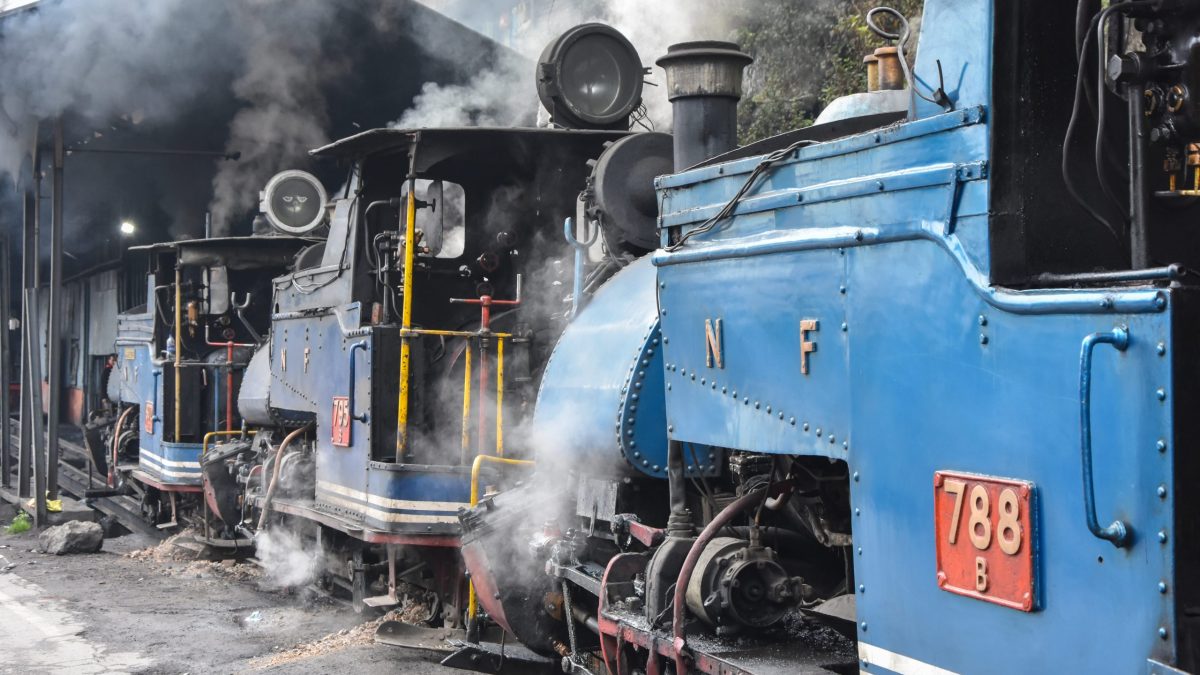
In the late nineteenth and early twentieth centuries British engineers built narrow-gauge railways up into the hills of India to reach the summer resorts of the colonial government. Three of these lines, still running, form a single World Heritage Site: the Mountain Railways of India.
At a glance
- Location: West Bengal, Tamil Nadu and Himachal Pradesh
- Inscribed: 1999 (Darjeeling), extended 2005 (Nilgiri) and 2008 (Kalka-Shimla)
- Type: Cultural
- Built: 1881 to 1908
Darjeeling Himalayan Railway
- Route: New Jalpaiguri to Darjeeling, West Bengal, about 88 kilometres
- Opened: 1881
- Gauge: two feet (610 mm)
The first and most famous of the hill railways climbs from the plains to more than 2,000 metres without tunnels of any length. Its engineers gained height by loops, in which the line circles over itself, and by zigzag reverses, in which the train runs backwards up a section. Ghum, at 2,258 metres, is the highest railway station in India. The Batasia Loop near Darjeeling gives a view of Kangchenjunga. Some services are still worked by small steam locomotives built over a century ago.
Nilgiri Mountain Railway
- Route: Mettupalayam to Udhagamandalam (Ooty), Tamil Nadu, about 46 kilometres
- Opened: 1899 to Coonoor, 1908 to Ooty
- Gauge: metre gauge
The steepest of the three. On the lower section a toothed rack rail laid between the running rails engages cogwheels under the locomotive, the only rack railway in India. Steam engines push the train from behind up to Coonoor.
Kalka-Shimla Railway
- Route: Kalka, Haryana, to Shimla, Himachal Pradesh, about 96 kilometres
- Opened: 1903
- Gauge: two feet six inches (762 mm)
Built to serve the summer capital of British India, it climbs about 1,400 metres through more than a hundred tunnels and over some 800 bridges, many of them tiered stone viaducts like Roman aqueducts.
Why they are a World Heritage Site
UNESCO recognises the lines as outstanding examples of bold and ingenious engineering solutions to the problem of building a railway through difficult mountain country, and of the social and economic change the railways brought to the hills.
Travelling
All three are run by Indian Railways and carry ordinary passengers as well as tourists. Seats on the popular services should be booked well ahead, especially in the summer and autumn holiday seasons.
Image: A train of the Darjeeling Himalayan Railway, West Bengal. Photo by Syed Sajidul Islam, licensed under CC BY-SA 4.0, via Wikimedia Commons.




Leave a Reply