
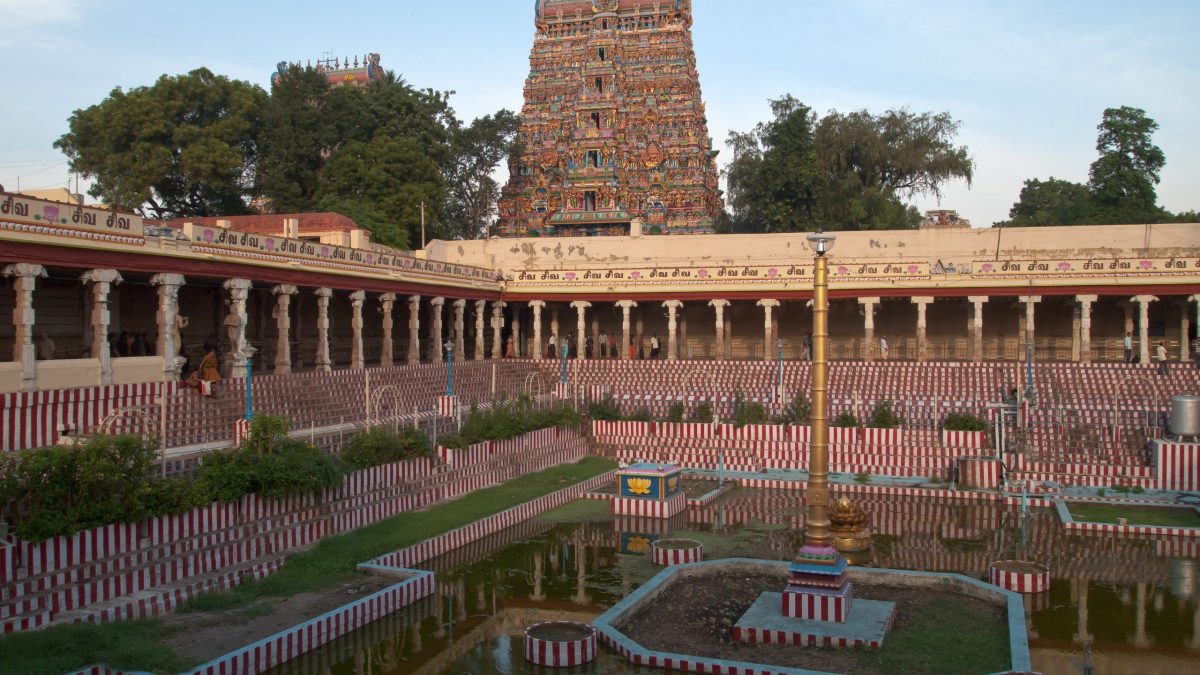
The Meenakshi Sundareswarar Temple in Madurai, on the southern bank of the Vaigai River, is dedicated to Meenakshi, a form of Parvati, and her consort Sundareswarar, a form of Shiva. It combines Shaivism, Shaktism and Vaishnavism, and its towering gateways are the tallest feature of the city’s skyline. The state emblem of Tamil Nadu is based on its west gopuram.
The temple city of Madurai is mentioned in Sangam literature, but the first reference to a temple comes from Tamil texts of the 6th century, and it is one of the Paadal Petra Sthalams praised in the Tevaram verses. The earliest surviving masonry was built under the Pandya emperor Sadayavarman Kulasekaran I, who ruled from 1190 to 1216. The gopuram at the entrance of the Sundareswarar shrine and the central portion of the Meenakshi shrine date to his time.
The temple was destroyed in the 14th century. According to the records cited on Wikipedia, Malik Kafur of the Delhi Sultanate raided towns in the Pandya kingdom and destroyed Hindu temples, including this one, taking a large loot of gold and jewellery to Delhi in 1311. The Vijayanagara Empire captured Madurai in 1378; Kumara Kampana is said to have rebuilt the temple structure, built defensive walls around it and brought back the hidden idols, which were reconsecrated.
The temple took its present shape under the Nayaks. In the mid-15th century, Lakana Nayak added defensive walls around the first enclosure, renovated the Mahamandapa and the Meenakshi shrine, and built the Paliarai, the bed chamber where the icons symbolically spend the night. During the reign of Vishwanatha Nayak (1529 to 1564) the complex was fortified further and the vimana above the Meenakshi shrine was gilded. His minister Ariyanatha Mudaliar supervised more towers and pillared halls, including the thousand-pillared hall. The Nayaka gopuram in the second enclosure was built in 1530.
The plan is a set of concentric enclosures, each protected by high masonry walls. The complex covers 5.7 hectares, with four large gopurams in the cardinal directions and 10 smaller ones. The southern tower, built in the 16th century, is the tallest, at 170 feet or 52 metres. The shrines of Meenakshi and Sundareswarar are in the innermost enclosure, and the complex has many mandapas, which house idols, host festivals and serve as rest houses. The Golden Lotus Tank, the Potramarai Kulam, is the main temple tank.
The name Meenakshi means “fish-eyed” in Tamil, from meen for fish and akshi for eyes. A 16th-century text, the Thiruvilaiyadal Puranam, tells that the king Malayadhwaja Pandya and his wife Kanchanamalai performed a yajna for a son, and a three-year-old girl emerged from the fire. The name Meenakshi became more common from the 17th century.
Later centuries brought further additions and neglect. The Servaikarar mandapa was built by the Marudu brothers in 1795, and the Mottai and Nadukkattu gopurams were completed in that period. Under British rule the temple deteriorated through neglect, and after independence it was restored with donations from the public. Kumbhabhishekam consecrations were conducted in 1974, 1995 and 2009, and the account lists one in 2026.
The temple is run by the Hindu Religious and Charitable Endowments Department of the Government of Tamil Nadu. In October 2017 it was judged the best Swachh Iconic Place in India under the Swachh Bharat Abhiyan.
The temple was not built at one time by one king. It is the result of repeated destruction and rebuilding, with the Pandya core, the Vijayanagara walls and the Nayak towers each still visible, and it is that layering that gives the complex its scale.
Featured image: A gopuram and the golden lotus tank of the Meenakshi Temple in Madurai (file photo). Photo by Vyacheslav Argenberg, licensed under CC BY 4.0, via Wikimedia Commons.


Leave a Reply