
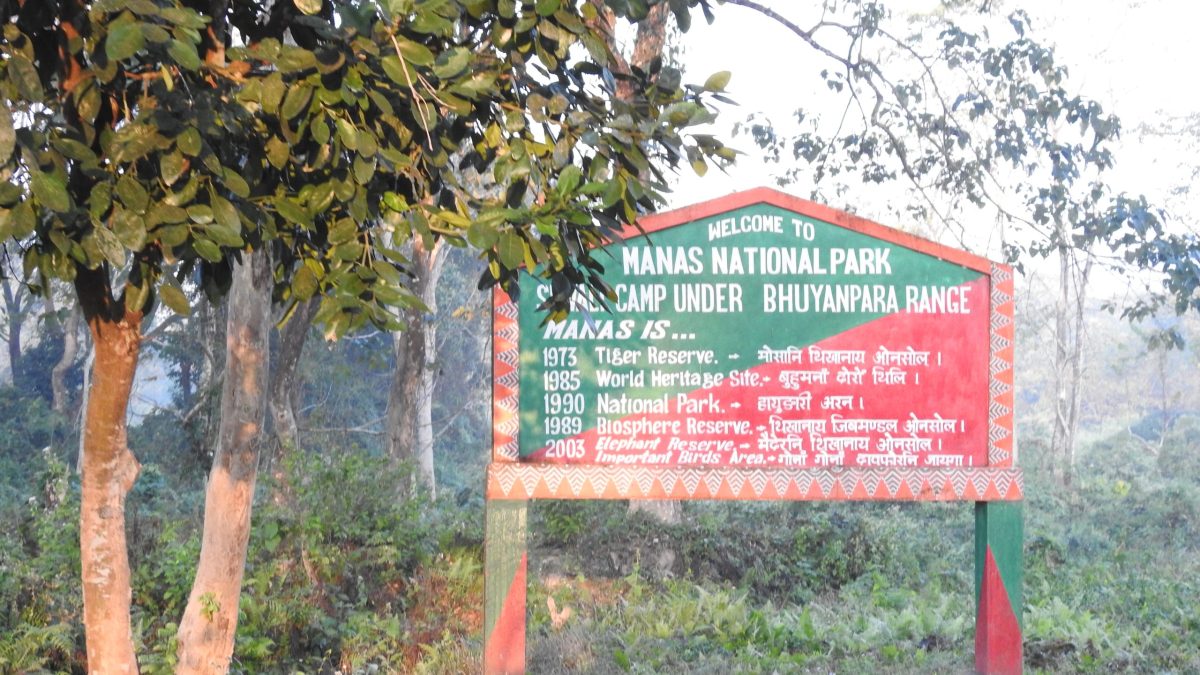
Manas National Park lies where the plains of Assam meet the foothills of the Bhutan Himalaya. Grassland, forest and river come together here, and the park shelters more endangered species than any other protected area in India. UNESCO inscribed it as a World Heritage Site in 1985.
At a glance
- Location: Baksa and Chirang districts, Assam, on the border with Bhutan
- Inscribed: 1985
- Type: Natural
- Also: tiger reserve (1973), elephant reserve, biosphere reserve
- Named after: the Manas river
The landscape
The Manas river, a tributary of the Brahmaputra, comes down from Bhutan and divides into channels as it reaches the plain. On the Indian side are wide alluvial grasslands and forests of sal and mixed trees; across the river is the Royal Manas National Park of Bhutan, so that the two countries together protect a very large stretch of wild country.
Rare animals
- Pygmy hog: the smallest wild pig in the world, once thought extinct and now found in the wild almost only at Manas
- Golden langur: a cream-and-gold monkey discovered by science only in the 1950s, living along the Bhutan border
- Hispid hare: a rare grassland rabbit
- Bengal florican: a critically endangered grassland bird
- Assam roofed turtle
- Also: tigers, elephants, wild buffalo, gaur, clouded leopards, capped langurs and more than 450 species of birds
The danger years
From the late 1980s the area was caught up in the Bodo agitation. Park buildings were burnt, guards were killed, and poachers wiped out the park’s rhinoceroses and many other animals. In 1992 UNESCO placed Manas on its List of World Heritage in Danger.
Recovery
After a peace accord in 2003, former militants and local young people were recruited as conservation volunteers. Rhinoceroses were brought from Kaziranga and Pobitora from 2008 onwards and began to breed. Pygmy hogs raised in captivity were released. In 2011 UNESCO removed the park from the danger list.
Why it is a World Heritage Site
Manas is recognised for its outstanding natural beauty and as the home of a great number of rare and threatened species, several of them found nowhere else.
Visiting
The park is open from about October to May. The main entrance is at Bansbari, about 140 kilometres from Guwahati. Visitors can take jeep safaris and raft on the Manas river. With Kaziranga, it is one of two natural World Heritage Sites in Assam.
Image: A signboard among the trees at Manas National Park, Assam. Photo by PJeganathan, licensed under CC BY-SA 4.0, via Wikimedia Commons.




Leave a Reply