
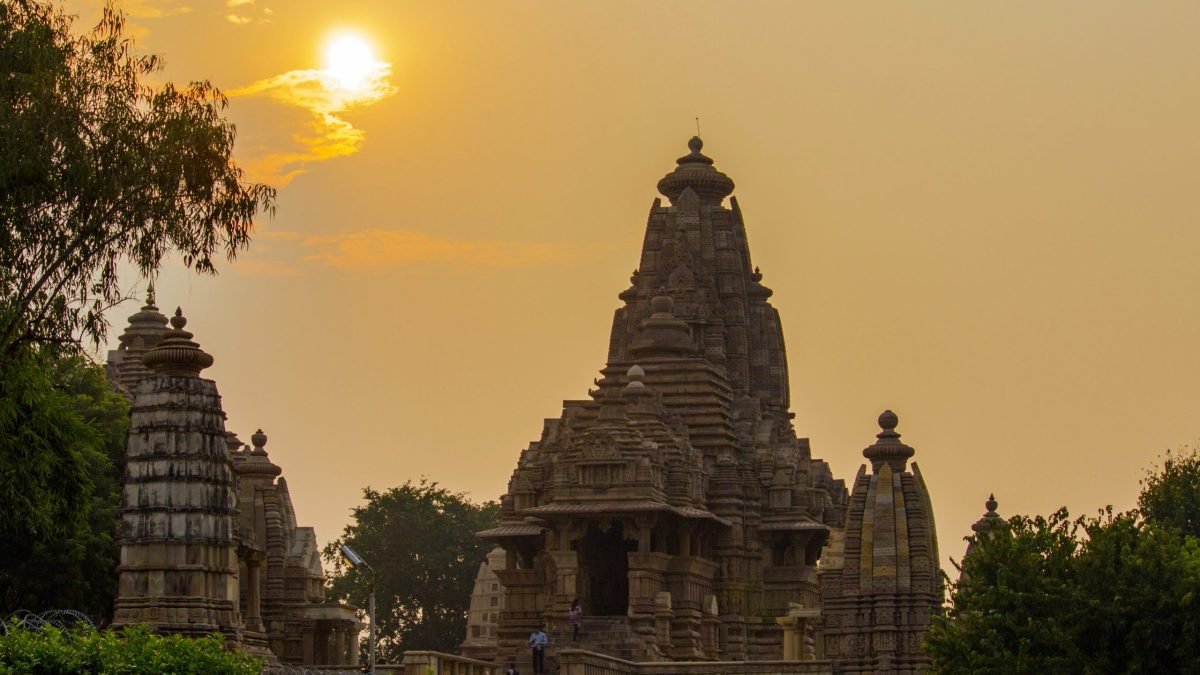
The temples of Khajuraho, in the Chhatarpur district of Madhya Pradesh, were built by the Chandela kings about a thousand years ago. They are known everywhere for their erotic sculpture, which is in fact a small part of their carving. UNESCO inscribed the Khajuraho Group of Monuments as a World Heritage Site in 1986.
At a glance
- Location: Chhatarpur district, Madhya Pradesh
- Inscribed: 1986
- Type: Cultural
- Built: about 950 to 1050 CE
- Built by: the Chandela dynasty
History
The Chandelas, a Rajput dynasty, ruled the Bundelkhand region. Tradition says they built eighty-five temples at their religious capital; about twenty-five survive. After the dynasty’s decline the place lay remote and forgotten, which saved the temples from destruction. A British engineer, T. S. Burt, was led to them by his palanquin bearers in 1838.
The temples
They are in three groups.
- Western group: the largest and best preserved. The Kandariya Mahadeva temple, built about 1030 and dedicated to Shiva, rises in a series of clustered towers to about 31 metres, like a mountain range. The Lakshmana and Vishvanatha temples stand nearby.
- Eastern group: including Jain temples, of which the Parshvanatha is the finest
- Southern group: the Duladeo and Chaturbhuja temples
Each temple stands on a high platform and is built of sandstone without mortar.
The sculpture
The walls carry bands of figures: gods and goddesses, celestial women adjusting their jewellery or removing a thorn from a foot, musicians, warriors, animals and scenes of daily life. The erotic groups, which are placed mainly at the junctions of the walls, make up about a tenth of the whole. Scholars have explained them variously, as symbols of fertility and good fortune, as illustrations of tantric ideas, or simply as part of a view of life in which pleasure had its accepted place.
Why it is a World Heritage Site
UNESCO cites the temples as a unique artistic creation in which architecture and sculpture are perfectly balanced, and as exceptional evidence of Chandela culture.
Visiting
Khajuraho has its own airport and railway station. A festival of classical dance is held before the western temples each February.
Image: The Kandariya Mahadeva Temple at Khajuraho, Madhya Pradesh. Photo by Taru23, licensed under CC BY-SA 4.0, via Wikimedia Commons.

Leave a Reply