
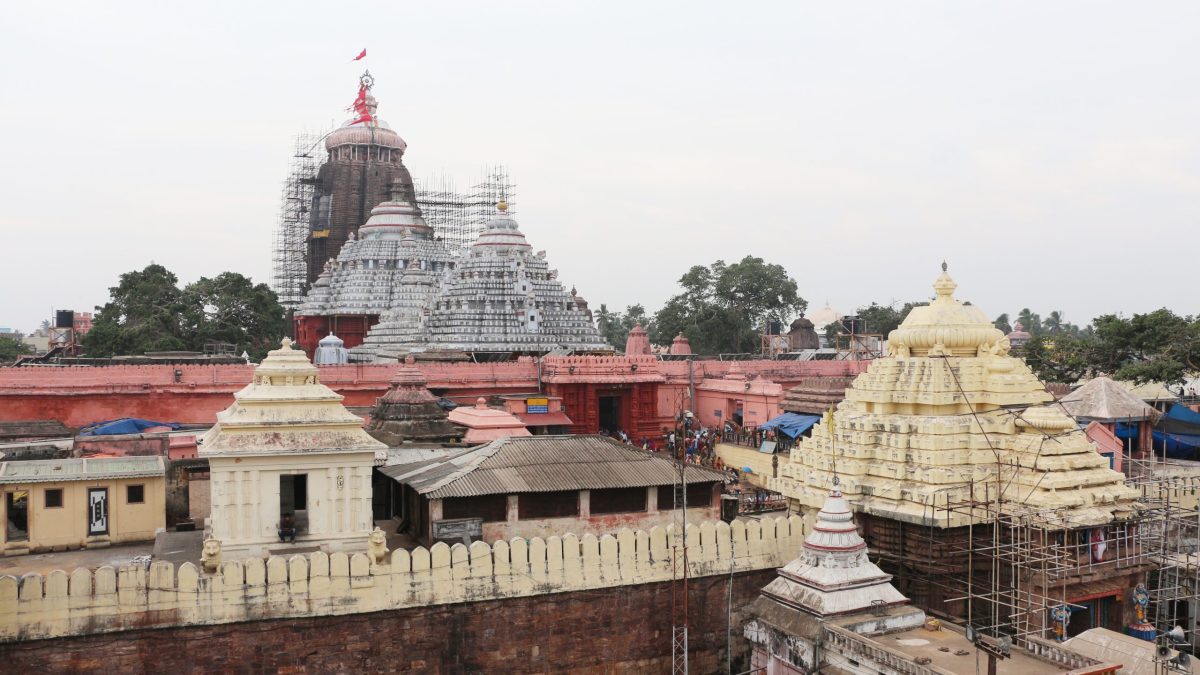
The Jagannath Temple in Puri, Odisha, is dedicated to Jagannath, a form of Vishnu, and stands on the eastern coast of India. It is one of the Char Dham pilgrimage sites and is known worldwide for its annual Ratha Yatra, in which the three deities, Jagannath, Balabhadra and Subhadra, are pulled through the town on large, decorated chariots. The structure that stands today is the product of several centuries of building.
According to temple records, the main temple was first built by the legendary King Indradyumna of Avanti. The legend says he intended it to be the tallest in the world, at 1,000 cubits, or about 457 metres, and that he invited Brahma to consecrate it. In another part of the story, a radiant log was found floating in the sea, and Vishnu himself appeared as a carpenter to carve the deities on condition that he be left undisturbed until he finished. These are traditions, not recorded history.
The documented history begins later. The site had religious significance well before the 12th century: the Skanda Purana and other texts refer to the area, known as Purushottama Kshetra, as a sacred centre of Vishnu worship. The earliest major reconstruction of the complex is attributed to Anantavarman Chodaganga of the Eastern Ganga dynasty, who ruled from about 1078 to 1150 and laid the foundation of the present temple in the early 12th century. He was originally a Shaivite and became a Vaishnavite after conquering the Utkala region in 1112, so work must have started after that year. An inscription of 1134 to 1135 records his donation to the temple.
His successor Anangabhima Deva III, who ruled from about 1211 to 1238, formally dedicated the kingdom to Jagannath and called himself the deity’s servant rather than a sovereign. In the 15th and 16th centuries the Gajapati kings of Odisha, such as Kapilendra Deva, made the temple a major state-supported religious centre.
The complex is large. It contains at least 120 temples and shrines on more than 37,000 square metres and is enclosed by a fortified wall about 6.1 metres high, called the Meghanada Pacheri. A second wall, the kurma bedha, surrounds the main temple. The architecture is in the Kalinga style, and the main temple is made of four sections: the deula, the vimana or sanctum, where the three deities sit on a throne called the ratnavedi, and the halls in front of it.
At the top of the shikhara is the Nila Chakra, or blue discus, an eight-metal disc with eight Navagunjaras carved around its edge. It is 3.5 metres high with a circumference of about 11 metres, and by custom a different flag is hoisted on it each day.
One feature is unusual among Hindu temples. The deities are not stone or metal but are carved from margosa wood, and they are ceremonially replaced with identical copies every 12 or 19 years in a month-long ritual called nabakalebar. Worship involves the Bhil Sabar tribal priests as well as priests from other communities, and many rituals are based on the Shabari Tantras, which the account links to tribal traditions.
The temple’s later history was troubled. The Madala Panji, the temple chronicle, says the temple was invaded and plundered 18 times, and during Mughal rule it faced periodic attacks and heavy political pressure. Governors and commanders, and later officials under Aurangzeb, raided Puri in the 17th century, and the deities were repeatedly moved by their servitors for safety. After the British took Odisha in 1803, the East India Company assumed control of the temple’s administration, and in 1809 supervision passed to the Raja of Khorddha and his successors.
The temple is sacred to many Vaishnava traditions. Saints associated with it include Chaitanya Mahaprabhu, who lived in Puri for many years, and Ramanujacharya, who set up the Emar Matha in its south-eastern corner. Adi Shankaracharya founded the Govardhan Math here, which is the seat of one of the four Shankaracharyas.
In short, the structure at Puri was built on a layered tradition: a legendary founding, a documented 12th-century rebuilding by Anantavarman Chodaganga, the support of later dynasties and a ritual cycle in which even the main images are renewed.
Featured image: The Jagannath Temple in Puri (file photo). Photo by Bernard Gagnon, licensed under CC BY-SA 3.0, via Wikimedia Commons.




Leave a Reply