
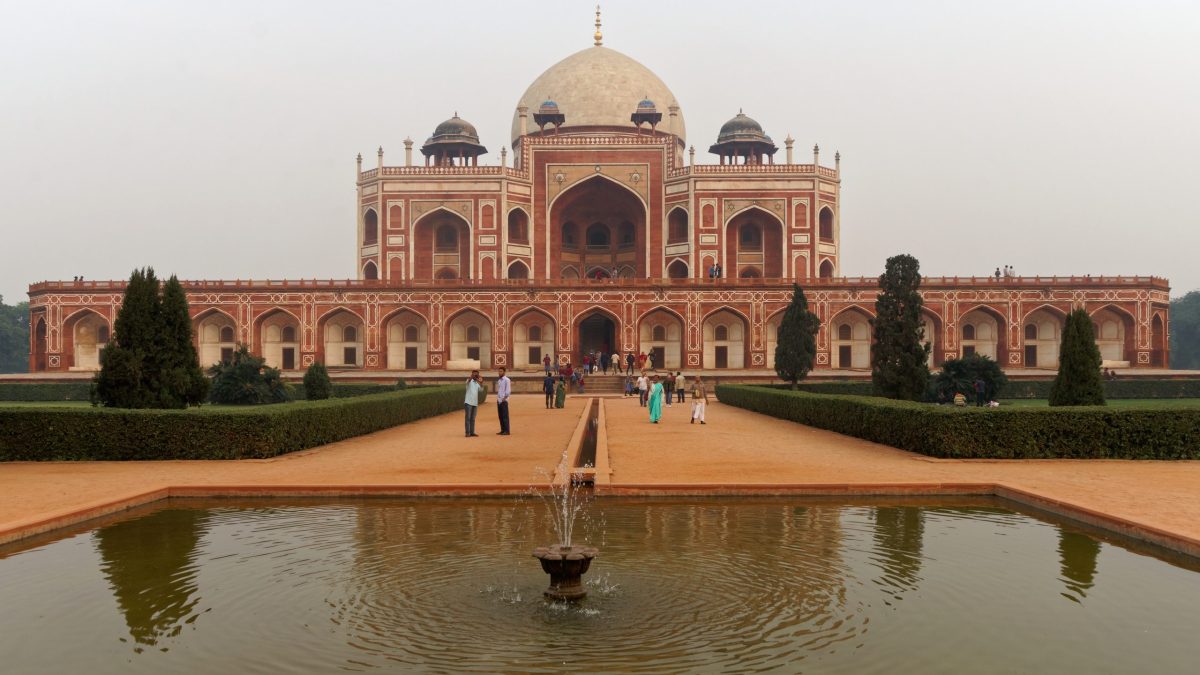
Humayun’s Tomb, in the Nizamuddin area of Delhi, was the first of the great garden tombs of the Mughal emperors. Built in the 1560s, it set the pattern that reached perfection eighty years later in the Taj Mahal. UNESCO inscribed it as a World Heritage Site in 1993.
At a glance
- Location: Nizamuddin East, New Delhi
- Inscribed: 1993
- Type: Cultural
- Built: about 1565 to 1572
- Commissioned by: Bega Begum, widow of Humayun
History
Humayun, the second Mughal emperor, lost his throne to Sher Shah Suri, recovered it after fifteen years of exile and died in 1556 after a fall on his library stairs. His senior widow, Bega Begum, also called Haji Begum, had the tomb built during the reign of their son Akbar. The architect was a Persian, Mirak Mirza Ghiyas.
Architecture
- The garden: a charbagh, a square walled garden divided by paths and water channels into four quarters and then into smaller squares, representing the gardens of paradise. It was the first of its kind on this scale in India.
- The tomb: an octagonal chamber surrounded by smaller rooms, standing on a high arcaded platform. It is faced with red sandstone trimmed with white and black marble.
- The dome: of white marble, double-shelled, rising about 42 metres
The combination of a Persian plan and dome with Indian materials and details such as the small domed kiosks was new.
The dormitory of the Mughals
More than 150 members of the Mughal family are buried in the building and its platform, among them Dara Shikoh, the prince defeated at Samugarh. In 1857 the last emperor, Bahadur Shah Zafar, took refuge here and was arrested by the British.
Other monuments
The enclosure includes the earlier tomb of Isa Khan, an Afghan noble, the Barber’s Tomb and the Arab Serai.
Why it is a World Heritage Site
The tomb is the first substantial example of the Mughal style and of the garden tomb on the subcontinent, and it led to several major architectural innovations.
Restoration
A restoration led by the Aga Khan Trust for Culture, completed in 2013, replanted the garden, restored the flow of water and repaired the building with traditional materials.
Visiting
The tomb is open daily and is close to the shrine of the Sufi saint Nizamuddin Auliya and to Sunder Nursery.
Image: Humayun’s Tomb in Delhi. Photo by Jakub Hałun, licensed under CC BY-SA 4.0, via Wikimedia Commons.




Leave a Reply