
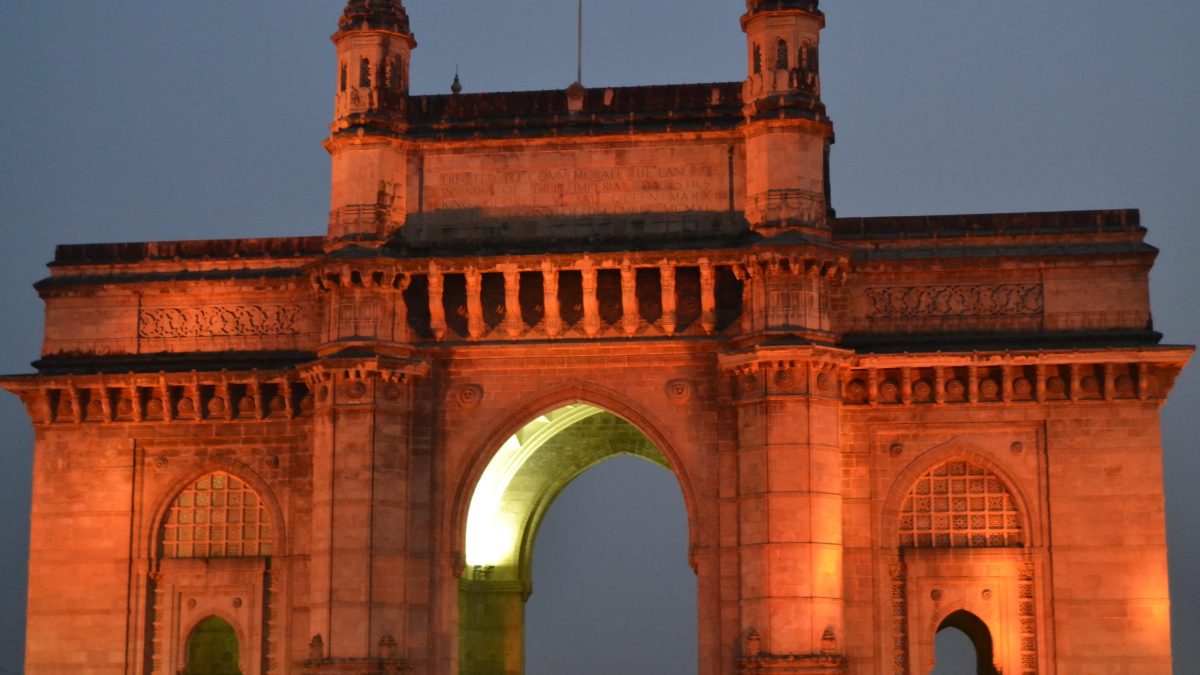
The Gateway of India is an arch monument on the waterfront of Mumbai, opposite the Taj Mahal Palace hotel. It was completed in 1924 to commemorate the landing of King George V at Apollo Bunder in December 1911, the first visit to India by a reigning British monarch. Today it is one of the best-known symbols of Mumbai and among the city’s prime tourist attractions.
The royal couple, George V and Mary of Teck, arrived on 2 December 1911 before the Delhi Durbar. The sources note that they saw only a cardboard model of the monument, because construction had not yet begun. The foundation stone was laid on 31 March 1913 by Sir George Sydenham Clarke, Governor of Bombay, and the final design by the Scottish architect George Wittet was sanctioned in 1914.
Before it was built, Apollo Bunder served as a native fishing ground. Between 1915 and 1919 the work focused on reclaiming land and building a sea wall, and the Gateway’s foundations were completed in 1920. Construction was finished in 1924 by Gammon India, and the Viceroy, Rufus Isaacs, 1st Marquess of Reading, opened it to the public on 4 December 1924. The harbour front was realigned to make an esplanade for the monument.
The Gateway is a memorial arch of yellow basalt and reinforced concrete, 26 metres high, with a central dome 15 metres in diameter. The stones were sourced locally, while the perforated stone screens, the jali work, came from Gwalior. Three arched passages run between the long sides, and the central arch is higher and wider, with an extra storey and four turrets above it. Steps behind the arch lead down to the water.
Its style is Indo-Saracenic, with many details borrowed from the Gujarati regional style. Wittet combined local elements with 16th-century Gujarati architecture, and the facade recalls Gujarati mosque facades such as the Jama Mosque of Ahmedabad of 1424. In classical terms the plan is an octopylon with eight piers, a form used in some triumphal arches and memorials, including the Arc de Triomphe du Carrousel in Paris.
The monument has a second meaning. It was built as a ceremonial entrance for important government personnel, and the last British troops left India through it. On 28 February 1948 the First Battalion of the Somerset Light Infantry passed through the arch with a 21-gun salute, marking the end of the Raj. N. Kamala, a professor at Jawaharlal Nehru University, calls the Gateway a “symbol of conquest and colonisation”, which shows that its meaning has been read differently over time.
It has also become a place for communal gathering. Since 2003 the local Jewish community has lit a menorah there for Hanukkah, a ritual started by Rabbi Gavriel Noach Holtzberg of the Chabad house at Nariman House, who was killed in the 2008 Mumbai attacks. The Gateway was the site of a bomb blast in a taxi in August 2003, and access to it was restricted after the 2008 attacks, in which the Taj hotel opposite was targeted.
Five jetties stand at the Gateway, two of them used for commercial ferries, and the monument remains among the first structures visitors see when they arrive in Mumbai by sea. In March 2019 the Maharashtra government proposed a four-step plan to develop the area for tourists.
The story of the Gateway shows how a monument can outlive its purpose. It was designed to welcome an emperor, finished after the visit it commemorated had long passed, and then became the exit for his troops and the symbol of the city that surrounds it.
Featured image: The Gateway of India in Mumbai (file photo, 2016). Photo by SriSriChinmaya, licensed under CC BY-SA 4.0, via Wikimedia Commons.

Leave a Reply