On 16 December 1971 the Pakistani army in the east surrendered to Indian and Bangladeshi forces at Dhaka. The war had lasted thirteen days. It produced a new country, Bangladesh, and remains India’s most decisive military victory.
The crisis in East Pakistan
Pakistan was then a country in two parts, separated by 1,600 kilometres of Indian territory. The Bengali-speaking east had more people but less power.
- December 1970: In Pakistan’s first general election, the Awami League of Sheikh Mujibur Rahman won a majority in the national assembly. The military ruler, General Yahya Khan, and the western politician Zulfikar Ali Bhutto would not let it take office.
- 25 March 1971: The army launched Operation Searchlight, a crackdown in Dhaka and across the east. Mujib was arrested. Killings of students, intellectuals and Hindus followed on a vast scale.
- Refugees: about one crore people fled into West Bengal, Tripura, Assam and Meghalaya.
India’s response
Prime Minister Indira Gandhi toured Western capitals seeking pressure on Pakistan, with little success; the United States under Richard Nixon backed Yahya Khan. In August India signed a treaty of friendship with the Soviet Union. India also trained and armed the Mukti Bahini, the Bengali resistance.
The Army chief, General Sam Manekshaw, had advised against fighting in the monsoon and asked for time to prepare. The war came in winter, when the Himalayan passes were closed to any Chinese move.
The thirteen days
- 3 December: Pakistan bombed Indian airfields in the west. India declared war.
- In the east: Indian columns under Lt Gen Jagjit Singh Aurora bypassed the fortified towns and raced for Dhaka, helped by the Mukti Bahini, helicopter crossings of the rivers and a parachute drop at Tangail.
- At sea: The Navy’s missile boats struck Karachi harbour on the night of 4 December, the date now marked as Navy Day, and the eastern fleet blockaded the Bay of Bengal. The submarine PNS Ghazi was lost off Visakhapatnam.
- In the west: A Pakistani armoured thrust was stopped at Longewala in Rajasthan.
- Pressure: The United States sent the aircraft carrier USS Enterprise into the Bay of Bengal; the Soviet Union vetoed ceasefire resolutions at the United Nations.
The surrender
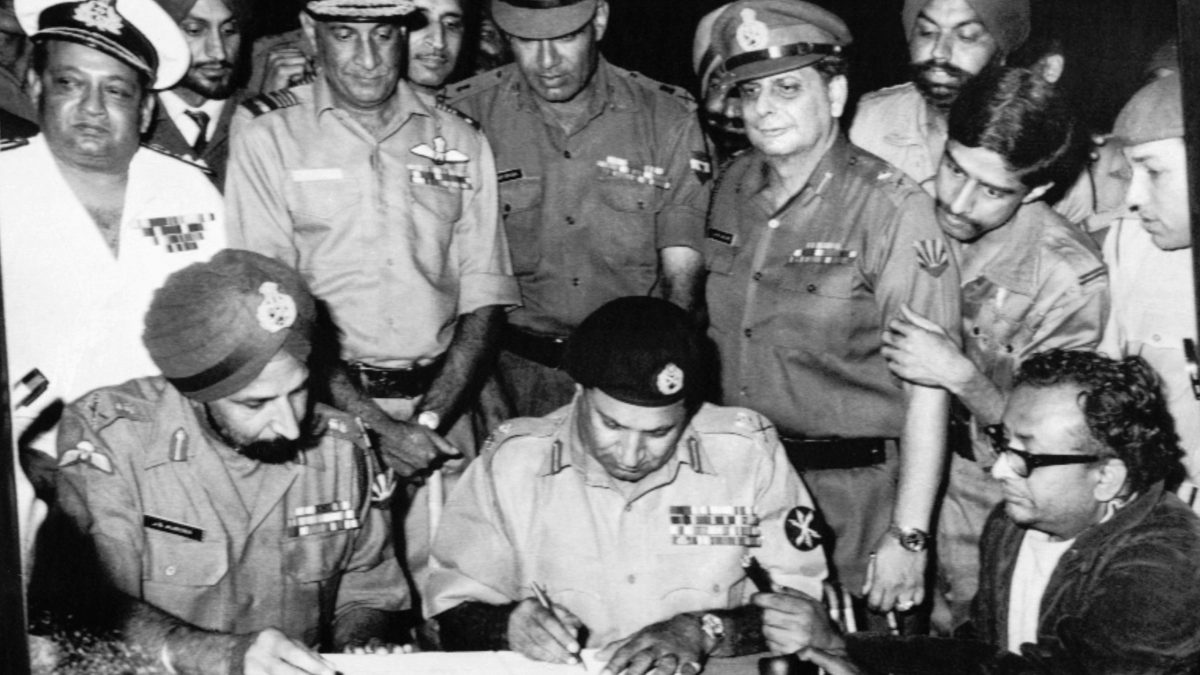
On 16 December, at the Ramna Race Course in Dhaka, Lt Gen A. A. K. Niazi signed the Instrument of Surrender. About 93,000 Pakistani soldiers and officials became prisoners of war, the largest surrender since the Second World War. India declared a ceasefire in the west the next day.
Afterwards
- Bangladesh became independent, and Mujib returned home in January 1972.
- Simla Agreement: On 2 July 1972 Indira Gandhi and Bhutto agreed to settle disputes bilaterally. India returned the prisoners and captured territory, and the ceasefire line in Kashmir became the Line of Control.
- Honours: Manekshaw was made Field Marshal in 1973.
16 December is observed as Vijay Diwas in India and as Victory Day in Bangladesh.
Image: Lt Gen A. A. K. Niazi of Pakistan signs the Instrument of Surrender beside Lt Gen Jagjit Singh Aurora at Dhaka, 16 December 1971. Photo by Indian Navy, licensed under Government Open Data License – India, via Wikimedia Commons.