
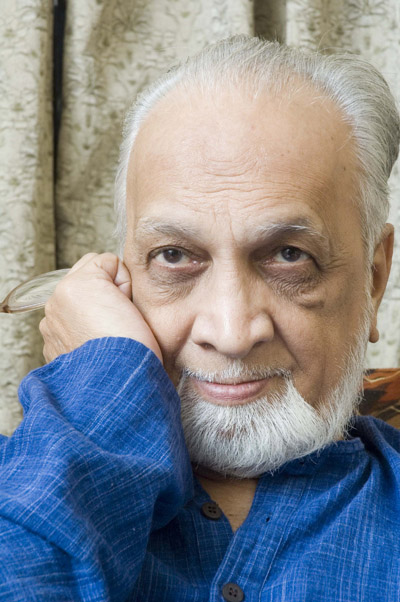
Vijay Dhondopant Tendulkar (6 January 1928 – 19 May 2008) was an Indian playwright, screenwriter and essayist who wrote in Marathi. His plays about violence, sex and power, among them Shantata! Court Chalu Aahe, Sakharam Binder and Ghashiram Kotwal, shocked audiences, provoked bans and attacks, and changed Indian theatre. He also wrote the screenplays of several of the best films of the Indian new wave.
Quick Facts
| Full name | Vijay Dhondopant Tendulkar |
| Born | 6 January 1928, Bombay |
| Died | 19 May 2008, Pune (aged 80) |
| Language | Marathi |
| Occupation | Playwright, screenwriter, journalist, essayist |
| Notable plays | Shantata! Court Chalu Aahe, Gidhade, Sakharam Binder, Ghashiram Kotwal, Kamala, Kanyadaan |
| Notable screenplays | Nishant, Manthan, Aakrosh, Ardh Satya, Umbartha |
| Awards | Padma Bhushan (1984), Sangeet Natak Akademi Fellowship (1998), Saraswati Samman (1993), National Film Award for Best Screenplay (1977) |
| Spouse | Nirmala Tendulkar |
| Children | 4 |
Early Life
He was born in the Girgaon district of Bombay into a Saraswat Brahmin family. His father was a clerk who ran a small publishing business and directed amateur plays, and the boy grew up among books and rehearsals; he wrote his first story at six and a play at eleven.
At fourteen he left school to take part in the Quit India movement of 1942. He never returned to formal education. Cut off from his schoolfellows, he spent his days in cinemas watching Hollywood films and in reading, and regarded this as his real schooling.
Career
Journalism
He earned his living as a journalist and sub-editor on Marathi newspapers and magazines for many years, and was later assistant editor of the daily Loksatta. He said that reporting taught him to observe without judging.
Plays
He wrote more than thirty full-length plays and many one-act plays and plays for children.
- Shrimant (1955) and other early plays brought the tensions of the middle-class family on to the stage.
- Shantata! Court Chalu Aahe (“Silence! The Court Is in Session”, 1967): a group of amateur actors stage a mock trial that turns into the real persecution of an unmarried woman among them.
- Gidhade (“The Vultures”), written in 1961 and staged in 1970: a family tearing itself apart for money.
- Sakharam Binder (1972): a bookbinder who takes in cast-off wives. It was banned in 1974 and released after a court battle.
- Ghashiram Kotwal (1972): a musical set in the Pune of the Peshwas, showing how the powerful create a tyrant and then discard him. Political parties tried to stop the production from travelling to Europe in 1980. It has had thousands of performances in many languages.
- Kamala (1981), based on a journalist’s real purchase of a woman to expose trafficking, and Kanyadaan (1983), on a marriage across caste.
Films
For Shyam Benegal he wrote Nishant (1975) and Manthan (1976), the latter winning him the National Film Award for Best Screenplay. For Govind Nihalani he wrote Aakrosh (1980) and Ardh Satya (1983), and for Jabbar Patel the Marathi films Samna, Sinhasan and Umbartha.
The study of violence
A Nehru Fellowship in 1973–74 allowed him to travel through India studying violence in its many forms, a subject he considered central to human nature and to his work.
Awards
- Sangeet Natak Akademi Award (1970) and Fellowship (1998)
- Padma Bhushan (1984)
- Kalidas Samman and Saraswati Samman (1993)
- Kamaladevi Chattopadhyay Award, Filmfare awards for screenplay
Personal Life
He married Nirmala; they had a son, Raja, a cinematographer, and three daughters, Sushma, Tanuja and Priya, the last a well-known actress. His wife, son and Priya all died within a few years of one another in the early 2000s. His brother Mangesh Tendulkar was a noted cartoonist. He died in Pune in 2008 of a muscular disease.
Featured image: Vijay Tendulkar at his home in Mumbai in January 2007. Photo by Satyen K. Bordoloi, licensed under CC BY-SA 3.0, via Wikimedia Commons.



