
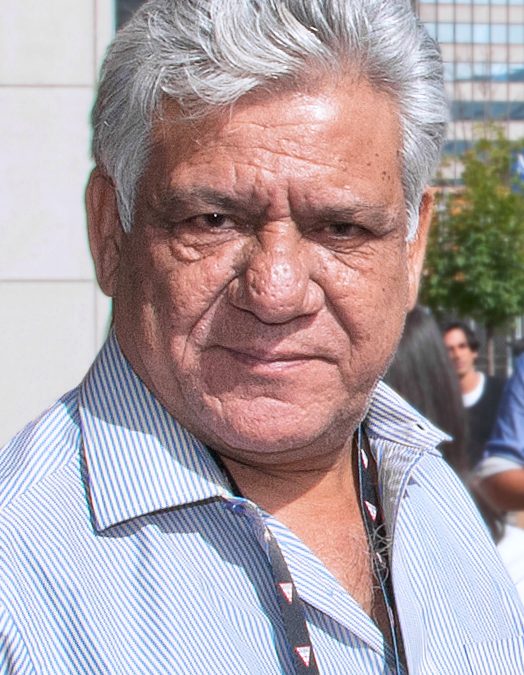
Om Prakash Puri (18 October 1950 – 6 January 2017) was an Indian actor, one of the finest of his generation. With a pockmarked face and a deep, gravelly voice that no one would once have thought fit for a hero, he became the face of India’s parallel cinema in the 1980s and went on to a second career in British and American films. He won two National Film Awards for Best Actor.
Quick Facts
| Full name | Om Prakash Puri |
| Born | 18 October 1950, Ambala, Punjab (now in Haryana) |
| Died | 6 January 2017, Mumbai (aged 66) |
| Education | National School of Drama, New Delhi (1973); Film and Television Institute of India, Pune (1976) |
| Occupation | Actor |
| Notable films | Aakrosh, Arohan, Ardh Satya, Jaane Bhi Do Yaaro, Mirch Masala, Maachis, My Son the Fanatic, East Is East |
| Awards | National Film Award for Best Actor (1982, 1984); Padma Shri (1990); honorary OBE (2004) |
| Children | 1 |
Early Life
He was born in Ambala into a Punjabi family; his father worked for the railways and the Army. The family was poor, and when he was a small boy his father was jailed on a charge of theft and they lost their home. He worked in a tea stall and collected coal from the railway tracks. There was no record of his birth; he chose 18 October himself, the day on which the festival of Dussehra had fallen the year he was born.
He grew up with relatives at Sanaur near Patiala, joined a theatre group while at college, and worked as a clerk to support himself.
Training
In 1970 he won a place at the National School of Drama in Delhi, where his classmate and lifelong friend was Naseeruddin Shah. He went on to the Film and Television Institute at Pune, borrowing money for the fees.
Career
Parallel cinema
His first film was Ghashiram Kotwal (1976). With Shah, Shabana Azmi and Smita Patil he became one of the four actors on whom the directors of the new Indian cinema relied.
- Aakrosh (1980): a tribal man, accused of killing his wife, who does not speak a word for most of the film
- Arohan (1982): a Bengal sharecropper fighting for his land; his first National Award
- Ardh Satya (1983): a police sub-inspector crushed between his violent father, his own rage and a corrupt system; his second National Award and his best-known role
- Jaane Bhi Do Yaaro (1983): a drunken builder in a much-loved black comedy
- Mirch Masala, Dharavi, Droh Kaal and the television series Tamas (1988), on Partition
Mainstream
From the 1990s he worked also in commercial Hindi films, as a character actor and comedian: Ghayal, Maachis, Chachi 420, Hera Pheri, Dabangg and many more. He appeared in some three hundred films in all.
Abroad
He had a brief part in Richard Attenborough’s Gandhi (1982). Later he played leads in British films, usually as a Pakistani or Indian immigrant: the taxi driver of My Son the Fanatic (1997) and the tyrannical fish-and-chip shop owner of East Is East (1999), which earned him a BAFTA nomination. In American films he appeared in City of Joy, Wolf, The Ghost and the Darkness, Charlie Wilson’s War, as the Pakistani president Zia-ul-Haq, and The Hundred-Foot Journey (2014), opposite Helen Mirren.
Honours
- National Film Award for Best Actor for Arohan and Ardh Satya
- Padma Shri (1990)
- Honorary Officer of the Order of the British Empire (2004), for services to the British film industry
Personal Life
He was married briefly to Seema Kapoor in 1991, and then in 1993 to the journalist Nandita Puri, with whom he had a son, Ishaan; they separated in 2013. Her biography of him, Unlikely Hero, caused a public quarrel between them by what it revealed of his early life.
He died of a heart attack at his home in Mumbai on 6 January 2017.
Featured image: Om Puri at the Toronto International Film Festival, September 2010. Photo by gdcgraphics, licensed under CC BY-SA 2.0, via Wikimedia Commons.



