
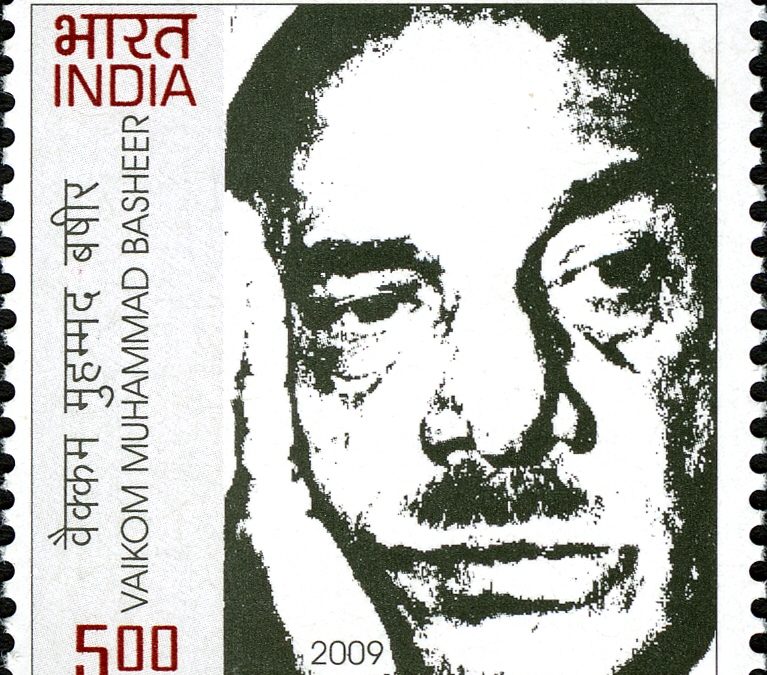
Vaikom Muhammad Basheer (21 January 1908 – 5 July 1994) was an Indian novelist and short-story writer in Malayalam, one of the most loved writers of Kerala. A freedom fighter who went to prison and then wandered the subcontinent for years doing whatever work he could find, he wrote short, apparently artless books in the everyday speech of ordinary people, full of laughter and of an unsentimental pity for the poor, the mad and the outcast. He is known as the Beypore Sultan.
Quick Facts
| Full name | Vaikom Muhammad Basheer |
| Born | 21 January 1908, Thalayolaparambu, near Vaikom, Kerala |
| Died | 5 July 1994, Beypore, Kozhikode (aged 86) |
| Language | Malayalam |
| Occupation | Novelist, short-story writer, freedom fighter |
| Notable works | Premalekhanam, Balyakalasakhi, Shabdangal, Ntuppuppakkoranendarnnu, Pathummayude Aadu, Mathilukal |
| Awards | Sahitya Akademi Fellowship (1970), Padma Shri (1982) |
| Spouse | Fathima (Fabi) Basheer |
| Children | 2 |
Early Life
He was born in a village near Vaikom in the princely state of Travancore, the eldest of six children of a timber merchant. He went to a Malayalam school and then to the English school at Vaikom.
In 1924 the town was the scene of a famous campaign for the right of the lower castes to use the roads around its temple. Mahatma Gandhi came, and the schoolboy pushed through the crowd and touched his arm. He went home and told his mother proudly that he had touched Gandhi.
Freedom Fighter
He left school and went north to Malabar to join the Congress. He took part in the salt satyagraha at Kozhikode in 1930, was beaten by the police and jailed. On his release he ran a revolutionary journal, was hunted by the police, and left Kerala.
The Wanderer
For some seven years he travelled across India and beyond, as far as the shores of Arabia and Africa by some accounts. He worked as a loom fitter, a fortune teller, a cook, a newspaper seller, a magician’s assistant, a watchman, a hotel manager; he lived for periods as a Hindu ascetic and as a Sufi. He went hungry often. He met, he said, every kind of human being, and none who was wholly bad.
He came home in the mid-1930s to find his family ruined, and began to write for a living.
Prison and Writing
He was jailed again in Travancore in the early 1940s for writing against the state’s chief minister. In prison he wrote the short comic novel Premalekhanam (“The Love Letter”), which the authorities banned.
- Balyakalasakhi (“Childhood Friend”, 1944): the love of Majeed and Suhra, neighbours as children, destroyed by poverty. It is drawn largely from his own life.
- Shabdangal (“Voices”, 1947): a soldier back from the war, told with a frankness about violence and sexuality that caused an outcry
- Ntuppuppakkoranendarnnu (“My Grandad Had an Elephant”, 1951): a satire on a Muslim family that lives on memories of past grandeur while the world moves on
- Pathummayude Aadu (“Pathumma’s Goat”, 1959): a hilarious account of his own chaotic household, in which a goat eats the manuscript of his book
- Mathilukal (“Walls”, 1965): a prisoner falls in love with a woman on the other side of the jail wall, whom he never sees. The director Adoor Gopalakrishnan filmed it in 1990.
- many short stories, among them “Poovan Banana” and “The Blue Light”, which he turned into the screenplay of a famous ghost film
Style
He wrote as people speak, in the idiom of the Muslims of Kerala, ignoring the rules of the grammarians, who objected. His books are brief; he cut and recut them until nothing unnecessary remained. He could make a reader laugh aloud and, a page later, see the hunger or loneliness behind the joke. He wrote about Muslims without apology or special pleading, and about everyone else in the same way.
He suffered from spells of mental illness and was treated in hospital more than once; he wrote about that too.
Beypore
He married Fathima, called Fabi, in 1958, and settled at Beypore, near Kozhikode. There, in an easy chair under a mangosteen tree in his yard, with a gramophone playing old Hindi songs beside him, he received a stream of visitors for thirty years.
Honours
- Fellowship of the Sahitya Akademi (1970)
- Padma Shri (1982)
- The Kerala Sahitya Akademi fellowship and the state’s highest literary awards
Death
He died at Beypore on 5 July 1994.
Legacy
His books have never been out of print and are read by schoolchildren and scholars alike. With Thakazhi and M. T. Vasudevan Nair he is one of the writers by whom Malayalam literature is known outside Kerala.
Featured image: Vaikom Muhammad Basheer, from a 2009 postage stamp of India. Photo by India Post, Government of India, licensed under Government Open Data License – India, via Wikimedia Commons.



