
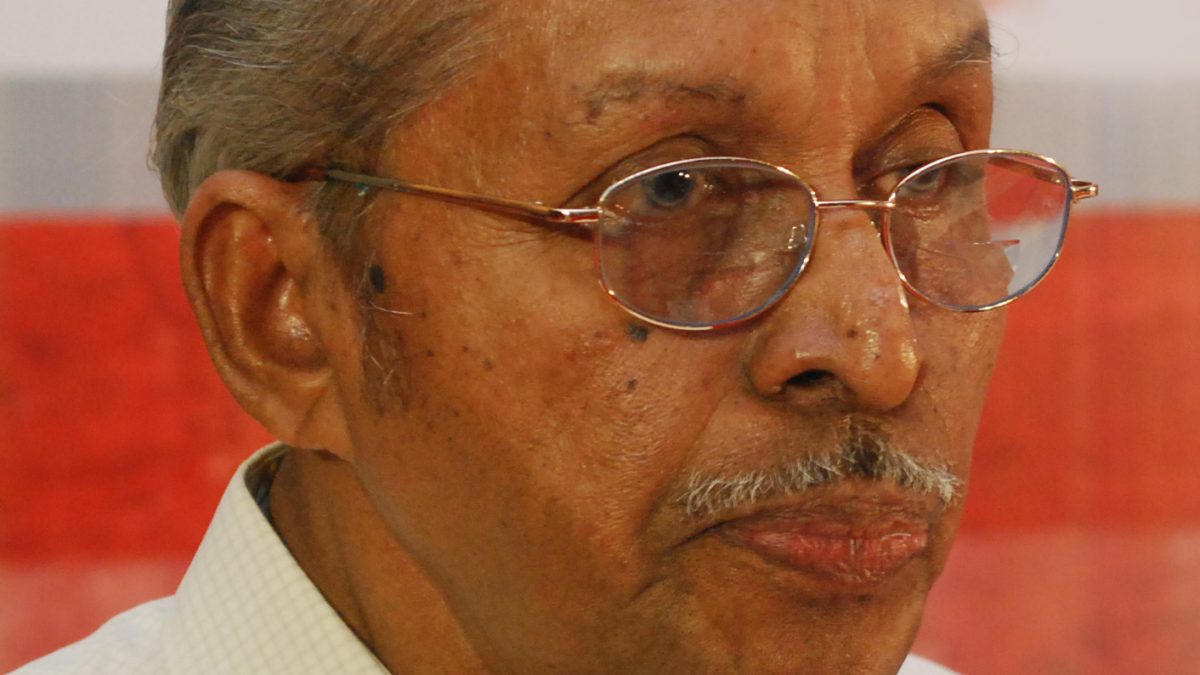
Ottaplakkal Neelakandan Velu Kurup (27 May 1931 – 13 February 2016), known as O. N. V. Kurup or simply ONV, was an Indian poet and lyricist in Malayalam. In a career of nearly seventy years he published more than twenty collections of poetry and wrote well over a thousand songs for the stage and cinema, many of which are part of everyday life in Kerala. He received the Jnanpith Award for 2007 and the Padma Vibhushan in 2011.
Quick Facts
| Full name | Ottaplakkal Neelakandan Velu Kurup |
| Born | 27 May 1931, Chavara, Kollam district, Kerala |
| Died | 13 February 2016 (aged 84), Thiruvananthapuram |
| Occupation | Poet, lyricist, professor |
| Language | Malayalam |
| Notable works | Agni Shalabhangal, Aksharam, Uppu, Bhoomikkoru Charamageetham, Ujjayini, Swayamvaram |
| Awards | Kendra Sahitya Akademi Award (1975); Padma Shri (1998); Jnanpith Award (2007); Padma Vibhushan (2011); National Film Award for Best Lyrics (1989) |
| Spouse | Sarojini |
| Children | 2 |
Early Life
ONV was born at Chavara, on the coast near Kollam, the youngest of three children of O. N. Krishna Kurup, an Ayurvedic physician and member of the Travancore legislature. His father died when he was eight, and the family moved from town back to the village. He published his first poem at fifteen. He studied economics at S. N. College in Kollam and took a master’s degree in Malayalam literature at University College, Thiruvananthapuram, in 1955.
Poet of the Left
As a student he was drawn to the communist movement, then surging through Kerala. In 1952 the Kerala People’s Arts Club staged Ningalenne Communistakki (“You Made Me a Communist”), a play that toured the state and is credited with helping the party to power. Its songs were written by ONV, then twenty-one, and set to music by G. Devarajan; “Ponnarivaal ambiliyil” and others were sung in every village. His early collections, among them Porutunna Soundaryam and Dahikunna Panapatram, belong to this period of revolutionary romanticism.
Teacher
He became a lecturer in 1957 and taught at government colleges in Ernakulam, Thiruvananthapuram, Kozhikode and Thalassery, retiring in 1986 as head of the Malayalam department at the Government Women’s College in Thiruvananthapuram. Because government employees were not supposed to write for films, some of his early lyrics appeared under a pseudonym.
Major Poetry
His mature work is quieter and broader. Agni Shalabhangal (1971) won the Kerala Sahitya Akademi Award and Aksharam the national Sahitya Akademi Award in 1975. Uppu (“Salt”, 1980) won the Soviet Land Nehru Award and the Vayalar Award. Bhoomikkoru Charamageetham (“A Requiem for the Earth”, 1984), written when the damage being done to forests and rivers was only beginning to be understood, is among the most quoted Malayalam poems, an elegy sung in advance for a planet that has not yet died. Ujjayini (1994) is a novel in verse about the poet Kalidasa, and Swayamvaram retells a story from the Mahabharata from the woman’s side.
Film Songs
His first film was Kalam Marunnu (1955). He wrote for some 230 films and worked with every major Malayalam composer, including Devarajan, M. B. Sreenivasan, Salil Chowdhury, Raveendran, Johnson and Ilaiyaraaja. Songs such as “Oru vattam koodi”, “Arikil nee undayirunnenkil”, “Saagarangale” and “Aadiyushassandhya” are among the most loved in the language. He won the Kerala State Film Award for Best Lyricist thirteen times and the National Film Award for Best Lyrics for Vaisali (1989).
Public Roles
He was chairman of the Kerala Kalamandalam and a fellow of the Sahitya Akademi, and represented India at literary gatherings abroad. In 1989 he stood for the Lok Sabha from Thiruvananthapuram as a left-backed independent and lost.
Death and Legacy
He died in Thiruvananthapuram on 13 February 2016. A cultural academy and an annual literary award carry his name. ONV kept faith with two things all his life: the hope of a juster society, and the music of the Malayalam language.
Frequently Asked Questions
When and where was O. N. V. Kurup born?
O. N. V. Kurup was born on 27 May 1931 in Chavara, Kollam district, Kerala.
When did O. N. V. Kurup die?
Died: 13 February 2016 (aged 84), Thiruvananthapuram.
What is O. N. V. Kurup’s occupation?
Occupation: Poet, lyricist, professor.
What honours has O. N. V. Kurup received?
Kendra Sahitya Akademi Award (1975); Padma Shri (1998); Jnanpith Award (2007); Padma Vibhushan (2011); National Film Award for Best Lyrics (1989).
Featured image: O. N. V. Kurup in May 2010. Photo by Kannan Shanmugam, licensed under CC BY 3.0, via Wikimedia Commons.



