Teejan Bai (born 1956) is an Indian folk artist and the best-known performer of Pandavani, a traditional style from Chhattisgarh in which stories from the Mahabharata are sung and acted out by a single performer with musical accompaniment. She was the first woman to perform in the standing Kapalik style, which had been reserved for men. In a career of more than five decades she has performed across India and abroad and has received the Padma Vibhushan, India’s second-highest civilian honour.
Quick Facts
| Name | Teejan Bai |
| Born | 1956, Ganiyari village, Durg district, Chhattisgarh, India |
| Art form | Pandavani (Kapalik style) |
| Instrument | Tambura |
| Years active | Since about 1969 |
| Honours | Padma Shri (1987), Padma Bhushan (2003), Padma Vibhushan (2019) |
| Known for | Solo performances of the Mahabharata |
Early Life
Teejan Bai was born in Ganiyari village, not far from the steel town of Bhilai, into the Pardhi community, a Scheduled Tribe. She did not go to school. As a child she listened to her maternal grandfather, Brijlal Pardhi, reciting the Mahabharata in the Chhattisgarhi language, and she learned long passages by heart. She later trained under Umed Singh Deshmukh.
Career
Pandavani has two styles. In Vedamati the performer sits and narrates; women were allowed to sing only in this style. In Kapalik the performer stands, moves about the stage and acts out the characters. Teejan Bai gave her first public performance at about the age of 13 in a neighbouring village, in the Kapalik style. Her community objected to a woman performing this way, and she was forced to leave her home and live on her own for a time. She kept performing in villages across the region.
The theatre director Habib Tanvir noticed her and helped bring her to wider attention, and she performed before Prime Minister Indira Gandhi. From the 1980s she toured abroad as a cultural ambassador, performing in countries including France, Germany, Britain and Japan. She also appeared in Shyam Benegal’s television series Bharat Ek Khoj. On stage she uses only a tambura, which becomes in turn Bhima’s mace, Arjuna’s bow or a chariot, and her powerful voice and expressions carry the whole epic.
Personal Life
Teejan Bai was married as a child and has spoken of the hardships of her early marriages. She worked for many years at the Bhilai Steel Plant, which employed her as a cultural artist. She lives in Chhattisgarh and has trained younger performers, many of them women.
Awards and Honours
Legacy
Teejan Bai turned a little-known village art into one admired around the world and opened the Kapalik style to women. Several honorary doctorates have been conferred on her although she never attended school.
Frequently Asked Questions
When was Teejan Bai born?
Teejan Bai was born in 1956, Ganiyari village, Durg district, Chhattisgarh, India.
What is Teejan Bai known for?
Known for: Solo performances of the Mahabharata.
What honours has Teejan Bai received?
Padma Shri (1987), Padma Bhushan (2003), Padma Vibhushan (2019).
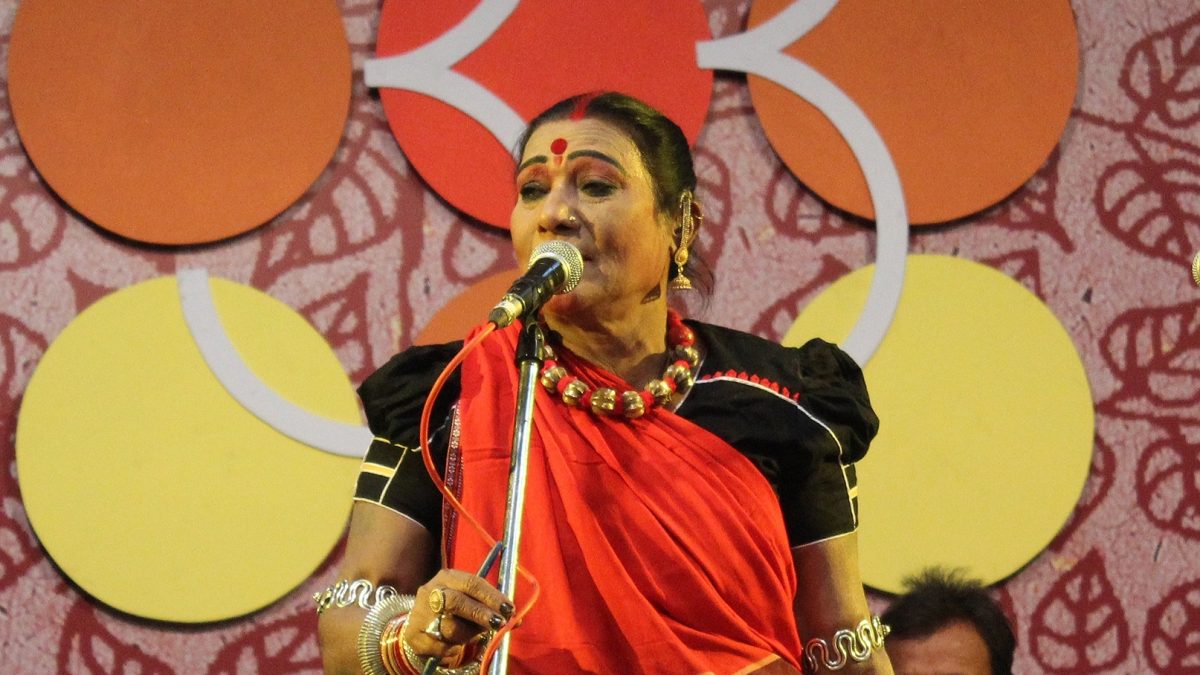
Featured image: Teejan Bai performs Pandavani at Bharat Bhavan, Bhopal. Photo by Suyash Dwivedi, licensed under CC BY-SA 4.0, via Wikimedia Commons.