Semmangudi Radhakrishna Srinivasa Iyer (25 July 1908 – 31 October 2003) was an Indian singer of Carnatic classical music, regarded for half a century as the grand old man of the art and called its Pitamaha, grandsire. He performed for more than seventy years, taught many of the leading musicians of the next generations, and as head of the music college at Thiruvananthapuram edited and popularised the compositions of the nineteenth-century ruler Swathi Thirunal.
Quick Facts
| Full name | Semmangudi Radhakrishna Srinivasa Iyer |
| Born | 25 July 1908, Tirukkodikaval, Thanjavur district, Tamil Nadu |
| Died | 31 October 2003, Chennai (aged 95) |
| Genre | Carnatic classical vocal |
| Occupation | Singer, teacher |
| Offices | Principal, Swathi Thirunal College of Music, Thiruvananthapuram (to 1963) |
| Awards | Sangita Kalanidhi (1947), Sangeet Natak Akademi Award (1953), Padma Bhushan (1969), Padma Vibhushan (1990) |
Early Life
He was born in a village in the Kaveri delta, the heartland of Carnatic music, and spent his first years in the house of his maternal uncle, a celebrated violinist. He grew up at Semmangudi, the village whose name he carried.
He learnt from a succession of masters: a cousin, a famous player of the gottuvadyam, a pupil of the lineage of the composer Tyagaraja, and finally the great singer Maharajapuram Viswanatha Iyer.
The Voice
His voice was his chief obstacle. It was nasal and rough and would not obey him, and several who heard him as a youth advised him to take up the violin. He trained it by years of relentless practice until it became the vehicle of a style of great warmth and vigour. He used to say that he had made a virtue of his struggle.
He gave his first concert in 1926 at Kumbakonam. In 1927 he sang during the session of the Indian National Congress at Madras, and his name was made.
Style
He was known above all for the emotional depth, the bhava, of his singing, for the richness of his raga expositions, particularly in Kharaharapriya, Bhairavi and Todi, and for his liking for brisk, energetic passages. His repertoire of compositions was immense. He planned his concerts with care and held that a concert should satisfy the learned and please the ordinary listener.
In 1947, at thirty-nine, he received the title Sangita Kalanidhi from the Music Academy, Madras, the highest honour in Carnatic music; he was the youngest person to receive it.
Travancore
At the invitation of the royal family of Travancore he went to Thiruvananthapuram in 1939. Swathi Thirunal, the Maharaja who ruled there in the 1830s and 1840s, had composed several hundred songs in many languages, most of which survived only as texts. With the scholar Harikesanallur Muthiah Bhagavatar, and later on his own, Semmangudi set many of them to music or restored their tunes, wrote them down in notation and sang them in concerts across the south. They are now part of every Carnatic musician’s repertoire.
He was principal of the Swathi Thirunal College of Music for more than twenty years, until 1963, and for a time chief producer of Carnatic music at All India Radio in Madras.
Teacher
His pupils included the violinist T. N. Krishnan and the singers T. M. Thiagarajan, P. S. Narayanaswamy and V. R. Krishnan, and many of the most famous musicians of the century learnt songs from him, M. S. Subbulakshmi among them. He was generous with what he knew and exacting about how it was sung.
The Man
He had a sharp, self-mocking wit and was the best of company. He was a nationalist in his youth, a follower of Gandhi, and gave concerts for the Congress. He sang in public until he was past ninety, and attended concerts by younger musicians almost to the end, sitting in the front row and letting them know what he thought.
Honours
- Sangita Kalanidhi (1947)
- Sangeet Natak Akademi Award (1953) and Fellowship
- Padma Bhushan (1969) and Padma Vibhushan (1990)
- Kalidas Samman and honorary doctorates
Death
He died in Chennai on 31 October 2003, aged ninety-five.
Legacy
A whole school of Carnatic singing, emotional, robust and attentive to the words, descends from him. In the north, a comparable figure of long life and authority was Gangubai Hangal.
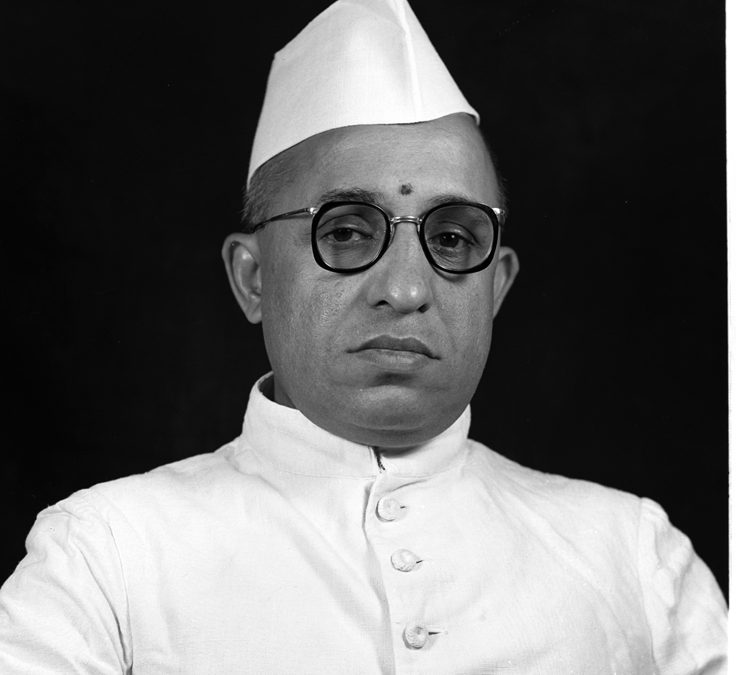
Featured image: Semmangudi Srinivasa Iyer in March 1953. Photo by the Photo Division, Government of India, in the public domain, via Wikimedia Commons.