
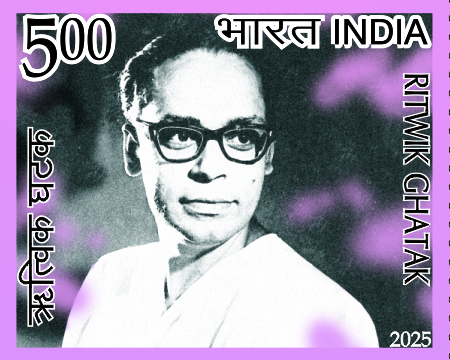
Ritwik Kumar Ghatak (4 November 1925 – 6 February 1976) was an Indian film director, screenwriter and playwright, one of the three masters of Bengali cinema with Satyajit Ray and Mrinal Sen. A refugee from East Bengal, he returned in film after film to the wound of Partition. He completed only eight features, most of which failed when released, and died at fifty. Meghe Dhaka Tara and Subarnarekha are now counted among the greatest films made in India.
Quick Facts
| Full name | Ritwik Kumar Ghatak |
| Born | 4 November 1925, Dhaka, Bengal (now Bangladesh) |
| Died | 6 February 1976, Calcutta (aged 50) |
| Occupation | Film director, screenwriter, playwright, teacher |
| Years active | 1948–1976 |
| Notable films | Nagarik, Ajantrik, Meghe Dhaka Tara, Komal Gandhar, Subarnarekha, Titash Ekti Nadir Naam, Jukti Takko Aar Gappo |
| Awards | Padma Shri (1970) |
| Spouse | Surama Ghatak |
| Children | 3 |
Early Life
He was born in Dhaka, with a twin sister, the youngest of the nine children of a district magistrate who was also a writer. The family was cultivated; his eldest brother, Manish Ghatak, was a noted poet, whose daughter was the novelist Mahasweta Devi.
He grew up beside the great rivers of East Bengal. The family moved west to Calcutta in the 1940s, and with the Partition of 1947 the land of his childhood became another country. He said that he could never accept it, and that everything he made came from that refusal.
Theatre
He took a degree at Baharampur and began a master’s in English at Calcutta. The famine of 1943 and the upheavals that followed made him a communist. He joined the Indian People’s Theatre Association in 1948 as an actor, playwright and director, translated Brecht and Gogol into Bengali, and wrote plays of his own, among them one on the refugees. He fell out with the party’s cultural leadership and was eventually expelled.
Into Film
He acted in and assisted on Chinnamul (1950), a film about refugees. His own first film, Nagarik (“The Citizen”), about a young man looking for work in Calcutta, was finished in 1952, three years before Ray’s Pather Panchali. It found no distributor and was first shown publicly in 1977, after his death.
He spent some time in Bombay as a writer, where he wrote the story and screenplay of Bimal Roy‘s Madhumati (1958).
Ajantrik
Ajantrik (1958) is the comedy of a small-town taxi driver and the battered old car he loves as a living being. It was one of the first Indian films to treat a machine as a character, and was shown at the Venice festival. Bari Theke Paliye (1959) followed, about a runaway boy in the city.
The Partition Trilogy
- Meghe Dhaka Tara (“The Cloud-Capped Star”, 1960): Neeta, the eldest daughter of a refugee family in a colony on the edge of Calcutta, gives up her studies, her earnings and the man she loves to keep the others afloat, and is thanked by none of them. Her cry near the end, that she wanted to live, is among the most famous moments in Indian film. It was the only one of his films to succeed with the public.
- Komal Gandhar (1961): two rival theatre troupes, and a love story set against the divided land
- Subarnarekha (made in 1962, released in 1965): a brother and sister uprooted by Partition, followed over two decades to a devastating end
He drew on myth, on the songs of Tagore and the folk music of Bengal, and on a use of sound that was years ahead of its time: the crack of a whip laid over a woman’s suffering, a song that breaks off. Critics of the day found the films melodramatic and uneven. Komal Gandhar failed badly, and the failure helped to break him.
Teacher
In 1965 he joined the Film Institute of India at Pune as a teacher and for a short time was its vice-principal. He stayed little more than a year, but the students he taught, among them Mani Kaul, Kumar Shahani, John Abraham and Adoor Gopalakrishnan, became the leaders of the new Indian cinema, and all spoke of him as their master. See Adoor Gopalakrishnan.
Last Films
By the late 1960s he was drinking heavily, and he spent periods in a mental hospital. He made documentaries and wrote.
In 1972 a producer in the newly independent Bangladesh invited him to film Titash Ekti Nadir Naam (“A River Called Titash”, 1973), from a novel about a community of fishermen whose river dries up. He shot it while seriously ill.
His last film, Jukti Takko Aar Gappo (“Reason, Debate and a Story”, 1974), is an autobiography in disguise. He himself plays the lead, a ruined, alcoholic intellectual who wanders the countryside and dies in a clash between the police and Naxalite rebels.
Death
He died in a Calcutta hospital on 6 February 1976, aged fifty. He was survived by his wife, Surama, a teacher who had supported the family, and three children.
Legacy
His reputation has grown steadily. His films have been restored and shown in retrospectives round the world, and directors in India and abroad have acknowledged their debt to him. Satyajit Ray wrote that Ghatak was, in his use of the medium, the most wholly Bengali of directors. The third of the trio was Mrinal Sen, his friend from the days of the people’s theatre.
Featured image: Ritwik Ghatak, from a 2025 postage stamp of India marking his birth centenary. Photo by India Post, Government of India, licensed under Government Open Data License – India, via Wikimedia Commons.



