
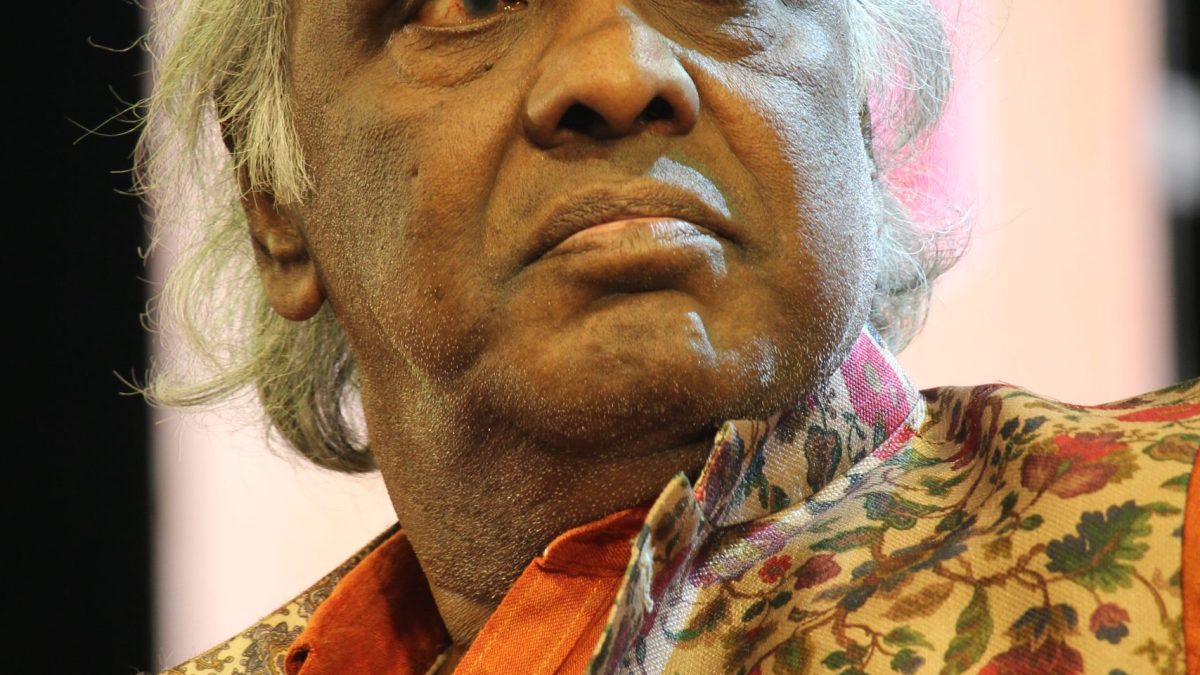
Rahat Indori (1 January 1950 – 11 August 2020) was an Indian Urdu poet and film lyricist from Indore, Madhya Pradesh. For nearly fifty years he was the star of the mushaira, the poetry gathering, in India and abroad, famous for a thunderous, theatrical way of reciting and for couplets of defiance. He also wrote the words of many Hindi film songs.
Quick Facts
| Full name | Rahat Qureshi |
| Pen name | Rahat Indori |
| Born | 1 January 1950, Indore, Madhya Pradesh |
| Died | 11 August 2020, Indore (aged 70) |
| State | Madhya Pradesh |
| Language | Urdu |
| Occupation | Poet, lyricist, professor, painter |
| Education | Islamia Karimia College, Indore; Barkatullah University, Bhopal (M.A. in Urdu); Ph.D. (1985) |
| Notable collections | Dhoop Dhoop, Naraz, Rut, Do Kadam aur Sahi, Mere Baad |
| Spouse | Seema Rahat |
Early Life
He was born in Indore, the fourth child of Rafatullah Qureshi, a worker in a cloth mill, and Maqbool-un-Nisa. The family was poor. From about the age of ten he worked as a painter of signboards, and became one of the busiest in the city; customers were prepared to wait months for his lettering and designs. He painted film posters and book covers as well.
Education
He went to school and college in Indore, took a master’s degree in Urdu literature from Bhopal in 1975 and a doctorate in 1985 for a thesis on the mushaira in Urdu. He taught Urdu literature at a college of the university in Indore for sixteen years.
The Poet
He recited his first poem in public at nineteen, at his college. Within a few years he was being invited across India, and then to the Gulf, Britain, the United States, Pakistan and elsewhere.
His poetry was written for the ear. He would begin a line softly, pause, raise an arm and deliver the second half at full volume, often turning his back on the audience first. The style was much imitated. The poems themselves were in plain, everyday Urdu, close to Hindi, and dealt with self-respect, love, the powerful and the rights of the ordinary citizen.
Famous lines
- “Sabhi ka khoon hai shaamil yahan ki mitti mein, kisi ke baap ka Hindustan thodi hai”: everyone’s blood is mixed in this soil; Hindustan is no one’s father’s property. Written in the 1980s, it became a slogan of the protests of 2019–20.
- “Bulati hai magar jaane ka nahin”: she calls, but one must not go. It became a craze on social media in early 2020.
- “Agar khilaaf hain hone do, jaan thodi hai”: if they are against me, let them be; it is not my life.
His collections include Dhoop Dhoop, Naraz, Rut, Chand Pagal Hai and Do Kadam aur Sahi.
Film Songs
He wrote lyrics for Hindi films from the early 1990s:
- “Tumsa Koi Pyaara” in Khuddar
- “Neend Churai Meri” in Ishq
- “Chori Chori Jab Nazrein Mili” in Kareeb
- “Bumbro” in Mission Kashmir
- “M Bole To” in Munna Bhai M.B.B.S.
- songs in Sir, Murder and Ghatak
He said that films paid the bills but the mushaira was his home, and he never moved to Mumbai.
Death
In August 2020 he tested positive for Covid-19 and was admitted to a hospital in Indore. He announced it himself on social media, asking people to pray that he would defeat the disease. He died of cardiac arrest the following day, 11 August 2020, and was buried in Indore that night.
Personal Life
He was married to Seema Rahat and had a daughter and sons, among them Satlaj Rahat, a poet, and Faisal. He took the name of his city as his own, and Indore regarded him as its voice.
He belongs with Javed Akhtar among the poets who carried Urdu verse to the largest audiences of their time.
Featured image: Rahat Indori in Ahmedabad, February 2020. Photo by Imfarhad7, licensed under CC BY-SA 4.0, via Wikimedia Commons.



