
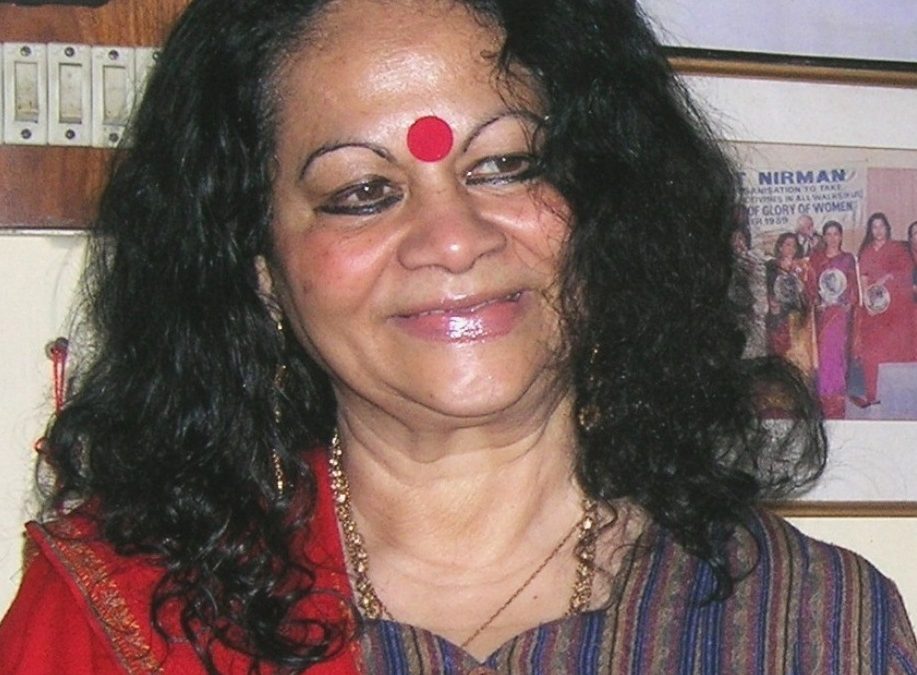
Indira Goswami (14 November 1942 – 29 November 2011), who wrote as Mamoni Raisom Goswami and was known in Assam as Mamoni Baideo, was an Indian novelist, short-story writer, scholar and professor who wrote in Assamese. Out of a life marked by early widowhood and depression she made fiction about the people society casts aside: widows, labourers, the victims of riots. She received the Jnanpith Award in 2000 and later tried to bring peace to Assam as a go-between for the rebel group ULFA and the government.
Quick Facts
| Full name | Indira Goswami |
| Pen name | Mamoni Raisom Goswami |
| Born | 14 November 1942, Guwahati, Assam |
| Died | 29 November 2011, Guwahati (aged 69) |
| Language | Assamese |
| Occupation | Novelist, short-story writer, scholar, professor |
| Notable works | Nilakanthi Braja, Mamare Dhara Tarowal, Dontal Hatir Une Khowa Howda, Tej Aru Dhulire Dhusarita Prishtha, Chinnamastar Manuhto, Adha Lekha Dastabej |
| Awards | Sahitya Akademi Award (1983), Jnanpith Award (2000), Principal Prince Claus Award (2008) |
| Spouse | Madhaven Raisom Ayengar (m. 1966; died 1967) |
Early Life
She was born in Guwahati into a Vaishnava Brahmin family that headed a sattra, a monastery, at Amranga in south Kamrup. Her father, Umakanta Goswami, was an educationist. She studied in Shillong and Guwahati and graduated in Assamese from Cotton College. Her first collection of stories appeared in 1962, while she was a student.
From childhood she suffered from depression, and after her father’s death she more than once tried to take her own life, as she related in her autobiography.
Marriage and Loss
In 1966 she married Madhaven Raisom Ayengar, an engineer from Karnataka who was working on a bridge in Assam. They lived at construction sites in Gujarat and Kashmir, where she observed the lives of the labourers. Eighteen months after the wedding he was killed in a road accident in Kashmir. She was twenty-four. She returned to Assam and for a time taught at a school in Goalpara.
Vrindavan
At the suggestion of her teacher, Upendra Chandra Lekharu, she went to Vrindavan to do research. There she lived among the Radheshyamis, the destitute widows who sing in the temples for a handful of rice. She completed a doctoral thesis comparing the Ramayana of Tulsidas with the fourteenth-century Assamese Ramayana of Madhava Kandali, and she wrote the novel Nilakanthi Braja (1976), which showed the misery of the widows of the holy town. The work, she said, gave her back her life.
Career
Professor
In 1971 she joined the Department of Modern Indian Languages at the University of Delhi, where she taught for nearly four decades and became head of the department. Much of her fiction was written in Delhi.
Novels
- Chenabar Srot and Ahiran: the construction labourers she had lived among
- Mamare Dhara Tarowal (“The Rusted Sword”): workers on an aqueduct in Uttar Pradesh; it won the Sahitya Akademi Award in 1983
- Dontal Hatir Une Khowa Howda (“The Moth-Eaten Howdah of the Tusker”, 1988): the widows of a decaying sattra like the one she was born into. It is her most admired book and was filmed as Adajya.
- Tej Aru Dhulire Dhusarita Prishtha (“Pages Stained with Blood”): the killing of Sikhs in Delhi in 1984, which she witnessed
- Chinnamastar Manuhto (“The Man from Chinnamasta”): an attack on animal sacrifice at the Kamakhya temple, which brought her threats
- Thengphakhri Tahsildarar Tamar Tarowal: a Bodo woman revenue collector of the nineteenth century, her last novel
Her autobiography, Adha Lekha Dastabej (“An Unfinished Autobiography”, 1988), was praised for its candour.
Peace Efforts
Distressed by the violence in Assam, she offered in 2004 to mediate between the United Liberation Front of Asom and the Government of India. She helped form the People’s Consultative Group that held talks with the government in 2005 and 2006. The talks broke down, but her effort was widely respected.
Awards
- Sahitya Akademi Award, 1983
- Jnanpith Award, 2000
- Principal Prince Claus Award of the Netherlands, 2008
She declined the Padma Shri in 2002.
Death
She suffered a stroke in February 2011 and died in Guwahati on 29 November 2011. She was cremated with state honours.
Featured image: Indira Goswami at a book launch in January 2007. Photo by AssamHeritage, licensed under CC BY-SA 4.0, via Wikimedia Commons.



