
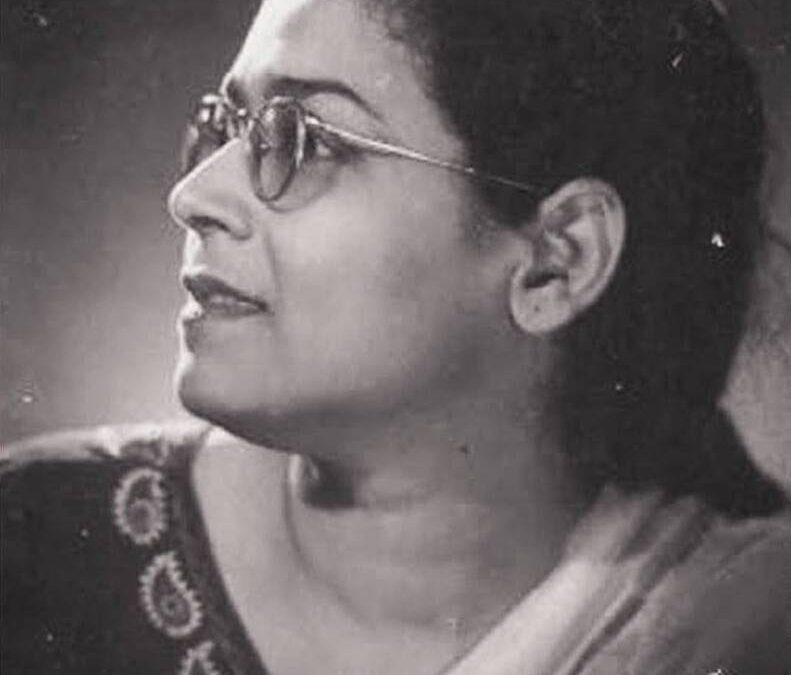
Ismat Chughtai (21 August 1915 – 24 October 1991) was an Indian novelist, short-story writer and screenwriter who wrote in Urdu. With wit, speed and an ear for the speech of women in the inner rooms of Muslim households, she wrote about their desires, marriages and rebellions as no one in the language had before. Her story “Lihaaf” brought a charge of obscenity, which she fought and won. She is counted among the four pillars of the modern Urdu short story.
Quick Facts
| Full name | Ismat Chughtai |
| Born | 21 August 1915, Badayun, United Provinces |
| Died | 24 October 1991, Bombay (aged 76) |
| Language | Urdu |
| Occupation | Novelist, short-story writer, screenwriter, film-maker |
| Notable works | Lihaaf, Terhi Lakeer, Chauthi ka Joda, Ziddi, Masooma, Dil ki Duniya, Kaghazi Hai Pairahan |
| Awards | Padma Shri (1976), Ghalib Award, Filmfare Award for Best Story (1975), Soviet Land Nehru Award (1982) |
| Spouse | Shahid Latif (m. 1942; died 1967) |
| Children | 2 |
Early Life
She was born at Badayun, the ninth of ten children of Mirza Qasim Beg Chughtai, a judicial magistrate, and Nusrat Khanam. Her father’s postings took the family to Jodhpur, Agra and Aligarh. Her sisters were married while she was small, and she grew up among her brothers, playing their games and arguing with them. She refused to learn cooking and sewing and insisted on going to school.
The second of her brothers, Mirza Azim Beg Chughtai, already a well-known humorous writer, became her teacher and first reader. She read Hardy, the Brontës, Dostoevsky, Chekhov and Shaw.
Education
When her parents arranged her marriage at fifteen, she threatened to run away and become a Christian so as to attend a mission school. She was allowed to study. She took her B.A. from Isabella Thoburn College, Lucknow, and a teaching degree from Aligarh, and is said to have been the first Indian Muslim woman to hold both.
In 1936, in Lucknow, she attended the first meeting of the Progressive Writers’ Association and heard Rashid Jahan, a doctor and writer whose boldness she took as her model.
Career
Teacher
She worked as headmistress of a girls’ school at Bareilly and then as an inspector of schools in Bombay.
Lihaaf and the trial
Her stories began to appear in 1938. In 1942 the Lahore journal Adab-i-Latif published “Lihaaf” (“The Quilt”), in which a small girl, staying with a neglected begum, watches the quilt on the lady’s bed heave in the night as her maid massages her. Nothing is named. Chughtai was summoned to Lahore on a charge of obscenity; her friend Saadat Hasan Manto was charged at the same time for a story of his own. She refused to apologise. The case was dismissed, since the prosecution could find no obscene word in the story.
She later regretted that this one story overshadowed the rest of her work.
Novels and stories
- Terhi Lakeer (“The Crooked Line”, 1943): a difficult, questioning girl’s growth to womanhood, partly autobiographical and generally considered her finest work
- Ziddi (1941): a love affair across class
- Masooma, Saudai, Dil ki Duniya, Ajeeb Aadmi, based on the life of the film-maker Guru Dutt, and Ek Qatra-e-Khoon, on the martyrdom of Imam Husain
- Collections of stories including Kaliyan, Chotein and Chhui Mui; “Chauthi ka Joda” and “Gharwali” are among the most admired
Films
In 1942 she married Shahid Latif, a screenwriter who became a director. They made films together, she writing and he directing: Ziddi (1948), which gave Dev Anand his first success, Arzoo (1950) and Sone ki Chidiya (1958). She directed one film herself. Garam Hawa (1973), M. S. Sathyu’s film about a Muslim family in Agra after Partition, was based on an unpublished story of hers and won her, with Kaifi Azmi, the Filmfare Award for Best Story. She also played a part in Shyam Benegal’s Junoon (1978).
Personal Life
She and Shahid Latif had two daughters, Seema and Sabrina. The marriage was stormy and companionable; he died in 1967. Her memoir, Kaghazi Hai Pairahan, covers her early years.
She suffered from Alzheimer’s disease towards the end. She died in Bombay on 24 October 1991 and, according to her wish, was cremated, which caused some controversy.
Legacy
Her work has been widely translated, and “Lihaaf” is read today as a landmark of both Urdu and feminist writing.
Featured image: Ismat Chughtai in the 1940s. Photo by an unknown photographer, in the public domain, via Wikimedia Commons.



