
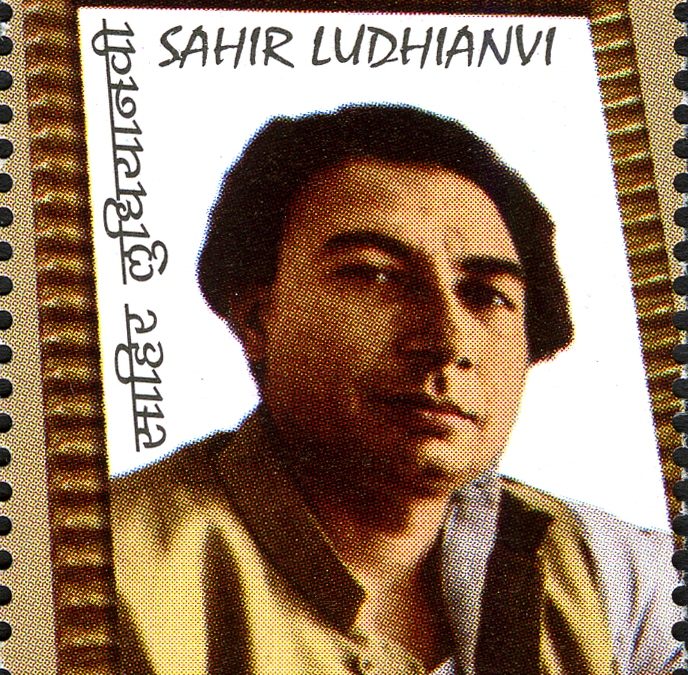
Sahir Ludhianvi (8 March 1921 – 25 October 1980), born Abdul Hayee, was an Indian Urdu poet and film lyricist. A leading figure of the progressive writers’ movement, he became the most respected songwriter of Hindi cinema, and showed that a film song could carry the anger, irony and intelligence of real poetry. His songs for Pyaasa, Phir Subah Hogi, Hum Dono and Kabhi Kabhie are landmarks. He also fought for and won recognition for lyricists.
Quick Facts
| Birth name | Abdul Hayee |
| Pen name | Sahir (“the enchanter”) |
| Born | 8 March 1921, Ludhiana, Punjab |
| Died | 25 October 1980, Bombay (aged 59) |
| Language | Urdu, Hindi |
| Occupation | Poet, film lyricist |
| Notable books | Talkhiyan, Parchhaiyan, Aao Ki Koi Khwab Bunen |
| Notable films | Baazi, Pyaasa, Naya Daur, Phir Subah Hogi, Sadhna, Hum Dono, Taj Mahal, Waqt, Kabhi Kabhie |
| Awards | Filmfare Awards for Best Lyricist (1964, 1977), Padma Shri (1971) |
Early Life
He was born in Ludhiana, the only son of a wealthy and dissolute landowner who had married many times. His mother, Sardar Begum, left her husband when the boy was a child and gave up all claim to his property. The father sued for custody and threatened to have the child taken by force. The court gave him to his mother, and the two lived in poverty and in fear. He remained devoted to her all his life, and the injustice done to women is one of the constant themes of his verse.
At the Government College in Ludhiana he was known as a poet and a firebrand, and was made to leave before taking his degree.
The Poet
He moved to Lahore, where his first collection, Talkhiyan (“Bitterness”), appeared in 1945 and made him famous at twenty-four. It contains the poem “Taj Mahal”, in which the lover refuses to meet his beloved at the monument, because an emperor used his wealth to mock the love of the poor.
He edited several of the leading Urdu literary magazines. After Partition, articles in one of them angered the government of Pakistan, and in 1949, with a warrant out for his arrest, he left Lahore for Delhi and then Bombay.
Films
His first songs were for Naujawan and Baazi (both 1951), with the composer S. D. Burman. Their partnership lasted six years and ended after Pyaasa.
- Pyaasa (1957), Guru Dutt‘s film about a rejected poet: “Jinhe naaz hai Hind par woh kahan hain”, a walk through the brothels of the city that asks where those who are proud of India have gone, and “Yeh duniya agar mil bhi jaye to kya hai”, “what if one gains this world?”
- Phir Subah Hogi (1958): “Woh subah kabhi to aayegi”, the dawn that will surely come, and a parody of a patriotic anthem sung by the homeless
- Sadhna (1958): “Aurat ne janam diya mardon ko”, woman gave birth to men, and men gave her the marketplace
- Hum Dono (1961): “Main zindagi ka saath nibhata chala gaya” and the prayer “Allah tero naam, Ishwar tero naam”
- Taj Mahal (1963): “Jo wada kiya woh nibhana padega”, which won his first Filmfare Award
- Waqt, Gumrah, Humraaz, Naya Daur and other films of the Chopra brothers, with whom he worked for twenty years
- Kabhi Kabhie (1976): the title poem, written years before, and “Main pal do pal ka shayar hoon”, I am a poet of a moment or two; a second Filmfare Award
He could write a love song, a lullaby, a qawwali or a bhajan with equal skill, and did not change his vocabulary or his convictions for the screen.
For the Lyricist
He insisted that the words mattered as much as the tune. He persuaded All India Radio to announce the names of lyricists along with those of singers and composers, campaigned for their right to royalties, and is said to have demanded a rupee more than the highest-paid singer for every song, on principle.
Personal Life
He never married. He was close for a time to the Punjabi poet Amrita Pritam, who wrote openly of her love for him, and later to the singer Sudha Malhotra. He lived with his mother in Bombay; her death in 1976 left him desolate. He was moody, proud and generous, and helped many younger writers.
His long poem Parchhaiyan (“Shadows”) is a protest against war. He received the Padma Shri in 1971.
Death
He died of a heart attack in Bombay on 25 October 1980, aged fifty-nine.
Legacy
A postage stamp was issued in his honour in 2013. Among the poets who followed him into films, the best known is Gulzar; among those who shared his politics and his calling was the father of Shabana Azmi, Kaifi Azmi.
Featured image: Sahir Ludhianvi, from a 2013 postage stamp of India. Photo by India Post, Government of India, licensed under CC BY 3.0, via Wikimedia Commons.



