Laxmanrao Kashinath Kirloskar (20 June 1869 – 26 September 1956) was an Indian industrialist, the founder of the Kirloskar group. A drawing teacher who started with a bicycle shop, he made the first iron plough manufactured in India and went on to produce pumps, engines and machine tools. In 1910 he created Kirloskarwadi, one of the country’s first planned industrial townships. He showed that Indians could design and build machinery, at a time when it was assumed they could not.
Quick Facts
| Full name | Laxmanrao Kashinath Kirloskar |
| Born | 20 June 1869, Gurlahosur, Belgaum district, Karnataka |
| Died | 26 September 1956, Pune (aged 87) |
| Education | Sir J. J. School of Art, Bombay |
| Occupation | Industrialist, engineer |
| Founded | Kirloskar Brothers (1888); Kirloskarwadi (1910) |
| Known for | India’s first iron plough; pumps and diesel engines |
| Spouse | Radhabai |
| Children | Shantanurao Kirloskar and others |
Early Life
He was born in a village in the Belgaum district into a Brahmin family; his father was a scholar. He had no taste for book learning and loved drawing and anything mechanical. He went to the Sir J. J. School of Art in Bombay to study painting and found that he was partly colour-blind. He switched to mechanical drawing.
Teacher
He became an assistant teacher of mechanical drawing at the Victoria Jubilee Technical Institute in Bombay. In his spare time he haunted the workshop, learnt to use every machine, and read American trade magazines. When a promotion he had earned went to an Anglo-Indian, he resigned.
The Bicycle Shop
In 1888 his elder brother, Ramuanna, had opened a small shop at Belgaum. Laxmanrao sent bicycles from Bombay, and the brothers sold and repaired them and taught customers to ride. After leaving his post he joined the shop, made steel furniture and windmills, and looked for a product with a wider market.
The Plough
Nearly everyone in the country lived by farming, and farmed with a wooden plough that barely scratched the soil. Kirloskar designed an iron plough and a chaff-cutter and made them in a shed.
For two years not one plough was sold. Farmers believed that iron would poison the land and make it barren. At last a landowner tried one, the crop was good, and orders began.
Kirloskarwadi
In 1910 the municipality of Belgaum ordered him to vacate his site to make way for a new suburb. He had no money and nowhere to go. The ruler of the small state of Aundh, Balasaheb Pant Pratinidhi, a friend, offered him a loan and a stretch of barren land beside a railway station, covered with cactus and infested with snakes.
There he built a factory and, around it, a village for his workers, on lines he had read of in accounts of industrial towns in America and Europe. Kirloskarwadi had houses, a school, a playground and a common water supply.
- no distinctions of caste were permitted, and workers of every community lived and ate together
- he employed men released from prison, among them a noted dacoit, whom he put in charge of the night watch, and maintained that no one was born a criminal
- workers were trained on the job and promoted from the floor
Growth
The firm added sugar-cane crushers, hand pumps, power-driven pumps and, later, oil engines. Kirloskar Brothers became a public company in 1920. He took part in the swadeshi movement and supported the nationalist cause.
The Next Generation
His son Shantanurao, trained at the Massachusetts Institute of Technology, joined in 1926 and led the group’s great expansion after independence: a diesel-engine company at Pune in 1946, electric motors at Bangalore, machine tools, compressors and tractors. The Kirloskars became one of India’s leading engineering groups and an early exporter of machinery.
Honours
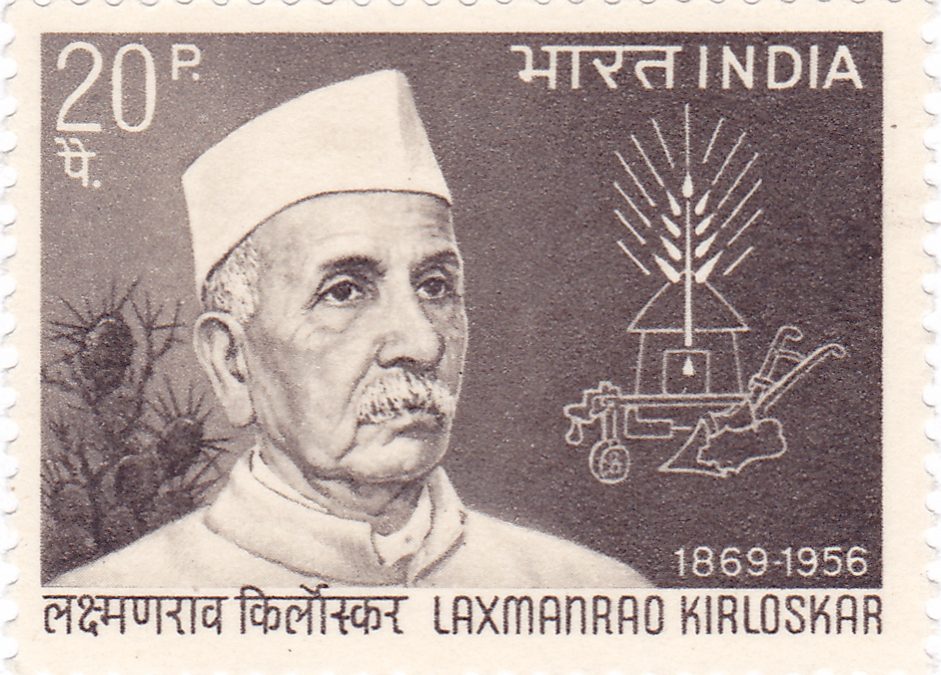
India issued a postage stamp in his honour on his birth centenary in 1969. His autobiography was written in Marathi.
Death
He died in Pune on 26 September 1956.
Legacy
He belongs with Jamsetji Tata and Walchand Hirachand among the Indians who started manufacturing under colonial rule. The pump on an Indian farm is still, as often as not, a Kirloskar.
Featured image: Laxmanrao Kirloskar, from a 1969 postage stamp of India. Photo by India Post, Government of India, licensed under Government Open Data License – India, via Wikimedia Commons.