
The Kerala High Court has quashed the suspension of 16 students of Sree Sankaracharya University of Sanskrit (SSUS) in Kalady who are affiliated with the Students' Federation of India (SFI), and has directed the university to conduct their semester examinations. The order, reported on Monday, 23 November 2026, also set aside the Enquiry Committee report that had found the students guilty of misconduct. Justice P.V. Kunhikrishnan allowed the students' plea challenging the suspension and seeking permission to appear for the semester examination, bringing to an end a dispute that had stretched over 84 days of suspension and had reached the Supreme Court.
The court directed the university to permit the students to enter the campus and attend regular classes. It also instructed the university to hold a separate examination for the suspended students, as it had undertaken before the Supreme Court, within six weeks. The Supreme Court had earlier referred the matter back to the High Court, stating that the university would hold a separate examination for the students if the High Court issued a favourable order. That sequence shows how the case moved between the two courts before being resolved on Monday.
The judgment is not a complete exoneration. The court said its ruling was not meant to impede a fresh inquiry. However, it clarified that the students should not be suspended pending the enquiry if a fresh probe is initiated, and that a fresh enquiry could not be used as a reason to withhold the examinations. It also ruled that the 84 days of suspension already served by the students should be counted towards any punishment imposed if they are found guilty after a new inquiry. These conditions protect the students' academic interests while preserving the university's right to examine the allegations again through a proper process.
The allegations at the centre of the case date to 13 August this year, when protests were held on the campus. The students were accused of staging a mock cremation of the vice-chancellor, Ciza Thomas, manhandling her and attempting to damage her property. They denied the allegations in full. A Syndicate meeting held on 2 November 2026 approved the findings of a five-member subcommittee that investigated the incidents of 13 August. It concluded that SFI activists had staged a mock funeral of the vice-chancellor and said the involvement of the suspended students had been established through CCTV footage examined by the officials concerned.
The students gave a different account. They maintained that they had merely staged a performance to draw attention to damaged lighting equipment in the Department of Theatre. The university authorities rejected that claim. According to them, the Head of the Department had told the Syndicate that the lights were damaged during the 2018 floods, and the university noted that it had received no complaint about damaged lights between 2018 and March 2026. This disagreement over what the protest was about, and whether the lights were the real issue, is at the core of the dispute and is one reason why a fresh inquiry may still be considered.
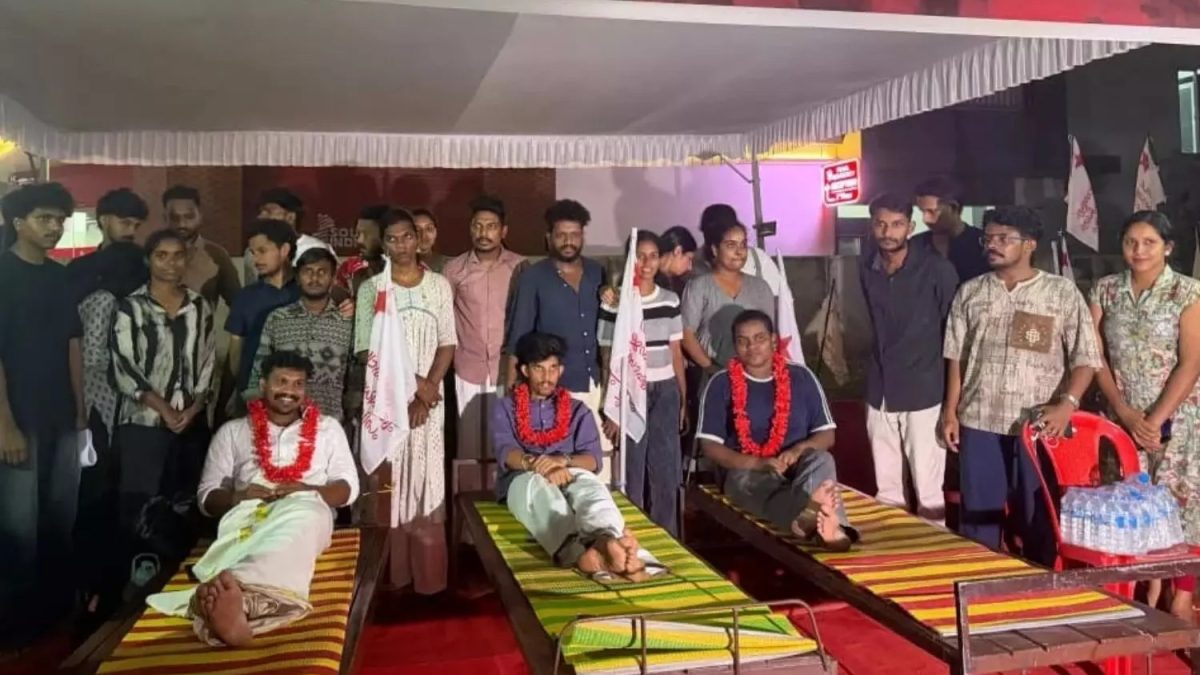
On the campus, the High Court's order was met with celebrations. At the protest pandal outside the university, students who had been on a relay hunger strike for 22 days against their suspension received the order "with tears of joy" as slogans filled the air. CPI(M) district secretary S. Satish ended the hunger strike by serving them lemon juice. The students were then taken to the campus in a march carrying a banner reading "The people united will never be defeated", an English version of the slogan "¡El pueblo unido, jamás será vencido!", which originated in Colombia in the 1940s and later became a global protest chant. SFI State president M. Sivaprasad and secretary P.S. Sanjeev accompanied them.
The students and their leaders used strong words. "After trying to destroy our academics and careers, Higher Education Minister Roji M. John had sarcastically asked us to return to classes. Yes, we are now going back to our classes," said P.S. Archana, one of the suspended students. "This is the victory of justice. No matter what happens, the truth will eventually come out." M.S. Sivakumar, a second-year MA Theatre student, said that the verdict "brings an end to the hardships that the 16 of us were subjected to" and that "we will now enter the campus and write our examinations." Another student said the Higher Education Minister, the Chief Minister, the vice-chancellor and the State government should apologise.
The political dimension of the dispute is evident. SFI is the student wing of the CPI(M), and its leaders framed the outcome as a victory over what they called a combination of the KSU, the RSS and the vice-chancellor. Mr. Satish said the politics behind the vice-chancellor's "unprecedented move" to approach the court to prevent her own students from writing their examinations had been exposed, and that the "RSS project" had been defeated. The Hindu's report describes these as claims made by the speakers. The university and the State government have their own account, and the court's ruling does not decide the political charges; it addresses the legality of the suspension and the process followed.
A separate development points to continuing tension inside the university. The SSUS Syndicate has sought a judicial probe into allegations of irregularities in faculty appointments, according to a separate report on Monday. The reports do not link this directly to the suspension case, but it shows that the university's administration is under scrutiny on more than one front. Actor and activist Prakash Raj had visited the protesting students in solidarity before the verdict, which gave the dispute wider attention.
The High Court's decision sends a message about the limits of disciplinary action against students. Universities have the authority to maintain order on campus and to punish misconduct, but the courts expect them to follow fair procedures and to avoid steps that damage a student's academic career without adequate justification. By quashing the suspension and the inquiry report, the court has indicated that the process used in this case did not meet that standard, even as it left open a path for a fresh inquiry. The direction to hold exams within six weeks underlines the importance placed on the students' right to continue their education.
The next phase will test how the university responds. It can accept the verdict and hold the examinations, or it can decide to order a fresh inquiry, which the court has permitted. If it does the latter, it will have to ensure that the students are not suspended or denied exams while the new probe is under way. It could also appeal the High Court's decision. The students, meanwhile, will return to classes and prepare for the separate examination, and the protest that dominated the campus for weeks has ended with a victory march. Whether the dispute is truly over, or merely paused, will depend on the university's next decision.

Leave a Reply