
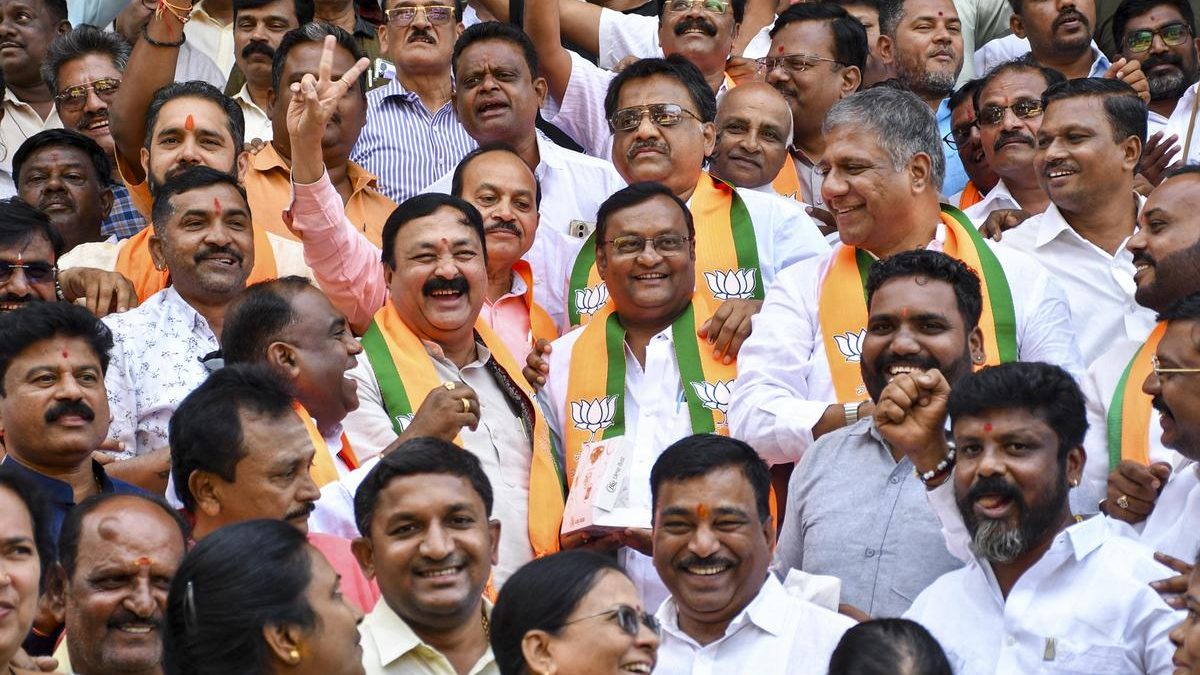
The BJP and its ally JD(S) have won all four seats in the Karnataka Legislative Council elections held on 23 October, leaving the ruling Congress without a single win. According to The South First, 43 candidates contested the four constituencies. The BJP retained the North-East Teachers', West Graduates' and South-East Graduates' seats, and JD(S) took Bengaluru Teachers' from the Congress. The vote is by teachers and graduates on paper ballots, and it is separate from the Council's indirect election in June, so it gives an early read on how the two opposition parties are working together in Karnataka.
For the opposition, the results are a convincing win and a sign that the alliance works. In Bengaluru Teachers', AP Ranganath of JD(S) beat the Congress candidate Puttanna by 10,810 votes to 9,902, a margin of 908 votes, on a turnout of 81.98%. Puttanna had won the seat in a 2024 by-election, having moved from JD(S) to Congress. In the West Graduates' seat, the sitting BJP member SV Sankanur won 33,711 votes to the Congress candidate's 24,388, a margin of 9,323. In North-East Teachers', the sitting member Shashil G Namoshi won 15,596 votes against 12,299, and in South-East Graduates' KM Suresh of the BJP won 66,020 votes against 42,922. JD(S) leader Nikhil Kumaraswamy mocked Rahul Gandhi on X, writing "No EVM to blame" and asking about "Paper Chori?", since the voting used paper ballots.
The case against reading too much into the results starts with who votes. In the South-East Graduates' seat the margin was about 23,100 votes by simple subtraction, the largest of the four, on a turnout of 73.58%, while North-East Teachers' saw the highest turnout at 86.97% and West Graduates' recorded 75.62%. Teachers' and graduates' constituencies have small, specialised electorates, however, and the voters in them are a narrow group. They are not a sample of the whole state. Congress won 135 of the 224 seats in the 2023 Assembly election, with about 42.88% of the vote, against 66 for the BJP and 19 for JD(S), according to Wikipedia. In the Council's indirect election on 18 June, the party won five of seven seats, against two for the BJP, according to India TV. Three of these four seats were also held by the BJP before the vote, so the BJP's gains were limited to retaining them. The one real change was the Bengaluru Teachers' seat, decided by 908 votes. The alliance has its own weak points, too. In the June election, the JD(S) candidate Govindaraju lost the seventh seat, and India TV reported that four of the party's 18 MLAs apparently cross-voted in the Congress's favour.
The results matter because the next Assembly election in Karnataka is due in 2028, and alliance arithmetic will count for a great deal. In 2023, Congress had its largest win in the state since 1989. Winning four from four on a common platform gives the two parties a story to tell about coordination, and it tests whether JD(S) voters will back BJP candidates and the other way round. The South First described the two parties as working to strengthen their coordination as opposition alliance partners ahead of the 2028 Assembly election. For the Congress, which is the ruling party, the defeat shows weakness among educated and salaried voters, who are often the most vocal critics of a government.
Taken together, the four results are a clear message from a narrow group of voters. The numbers do not threaten the Congress government, which won 135 of 224 Assembly seats in 2023. They do give the opposition a reason to keep working together and a warning for the ruling party that educated urban voters can still turn against it.




Leave a Reply