
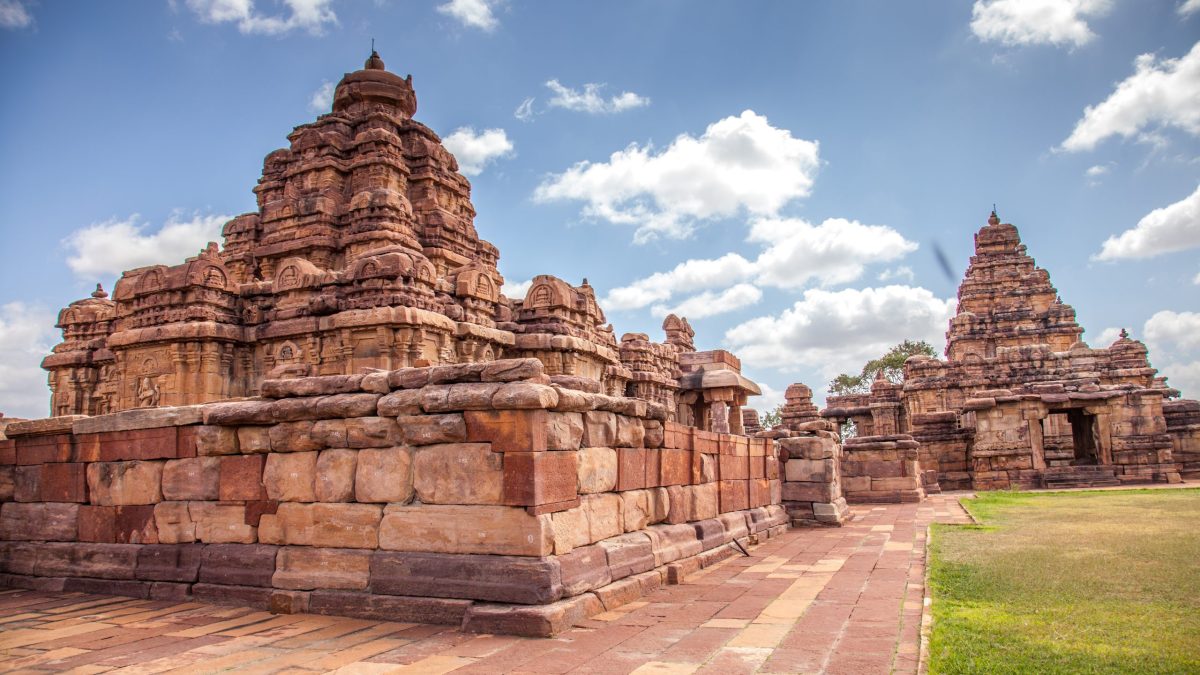
The Chalukyas of Badami were the first great empire to unite the Deccan and much of southern India between the Kaveri and the Narmada. They ruled from the middle of the sixth century until about 753, and their reign marked a change from small kingdoms to large empires. They are also the dynasty whose temples at Badami, Aihole and Pattadakal helped to create Indian temple architecture.
Quick Facts
| Period | c. 543–753 CE |
| Capital | Vatapi (Badami), Karnataka |
| Great rulers | Pulakeshin I, Pulakeshin II, Vikramaditya I |
| Known for | Aihole inscription, Badami and Pattadakal temples |
| Rivals | Harsha, the Pallavas, later the Rashtrakutas |
Rise
The Chalukyas rose as the Kadamba kingdom of Banavasi weakened. Pulakeshin I made Vatapi his capital in the middle of the sixth century and strengthened it as a fortress. His successors extended the kingdom, and under Pulakeshin II, who ruled from about 610 to 642, it became an empire.
Pulakeshin II
Pulakeshin II defeated his rivals at home, and his greatest success was his victory over Harsha of Kanauj, the ruler of the north, on the Narmada, which fixed the southern limit of Harsha’s rule; see the battle on the Narmada. His court poet Ravikirti recorded this in the Aihole inscription of 634, which is dated in the Saka era. He also sent an embassy to the Persian king Khosrow II, according to later accounts. The Chinese pilgrim Xuanzang described his kingdom and its brave soldiers.
War with the Pallavas
Pulakeshin II went to war with the Pallavas of Kanchipuram. In about 642 the Pallava king Narasimhavarman I invaded and took Vatapi, and Pulakeshin II died in the fighting or soon after. His son Vikramaditya I recovered the kingdom and in turn raided Kanchipuram. The long contest between the two powers wore down both; see the Pallavas.
Temples and Art
- **Aihole:** known as a cradle of temple architecture, with experiments in more than a hundred temples, including the Durga temple
- **Badami:** rock-cut cave temples dedicated to Shiva, Vishnu and Jain tirthankaras, cut into a sandstone hill above a lake
- **Pattadakal:** a group of Hindu and Jain temples of the eighth century, inscribed as a UNESCO World Heritage Site in 1987, with both northern and southern styles of building
The End and What Followed
In about 753 the Rashtrakuta chief Dantidurga overthrew the last Badami Chalukya, Kirtivarman II. The family was not extinct: the Eastern Chalukyas continued from Vengi, and the Western Chalukyas rose again at Kalyani in the late tenth century. The next great power of the Deccan, the Rashtrakutas, began its rise from the ruins of the Badami kingdom.
Featured image: The Mallikarjuna and Virupaksha temples at Pattadakal, Karnataka, built under the Chalukyas. Photo by Shivajidesai29, licensed under CC BY-SA 4.0, via Wikimedia Commons.

Leave a Reply