
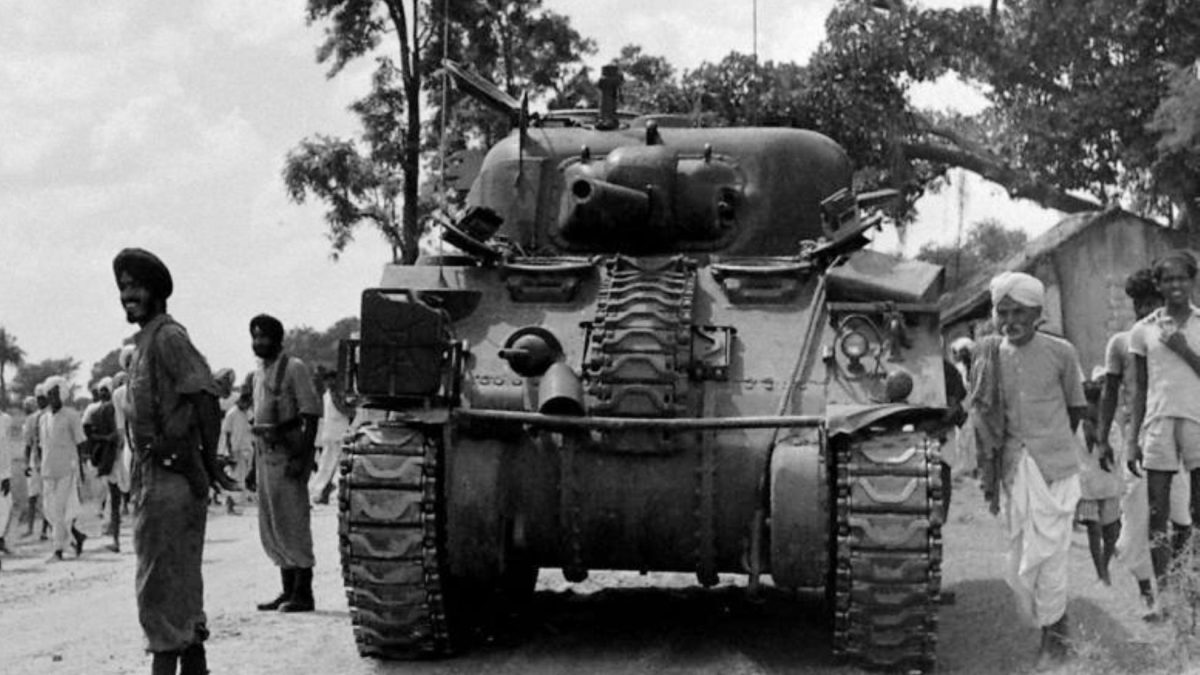
Operation Polo, launched on 13 September 1948, was the Indian Army’s action against the princely state of Hyderabad, the largest and richest of India’s princely states. It was officially described as a police action. In five days the army ended the rule of the Nizam, Mir Osman Ali Khan, who had hoped to keep Hyderabad independent after the British left. It also led to violence that is still debated.
Quick Facts
| Date | 13–17 September 1948 |
| Ruler of Hyderabad | Mir Osman Ali Khan, Nizam |
| Opponent | Government of India (Home Minister Vallabhbhai Patel) |
| Irregulars | The Razakars |
| Result | Nizam signed the instrument of accession; Hyderabad became part of India |
| Deaths | Disputed; 30,000–40,000 (Sunderlal Committee) to 200,000 or more |
The Problem of Hyderabad
When the British left in 1947 the princely states were told they could join India or Pakistan. Almost all did so, but Hyderabad, ruled by a Muslim Nizam over a mostly Hindu population, chose independence. In November 1947 it signed a standstill agreement with India, which continued existing arrangements except the stationing of Indian troops. The Nizam was troubled by the communist-led Telangana rebellion in the countryside, and the Razakars, a militia led by Qasim Razvi, claimed to defend his rule and became notorious for violence.
India feared that an independent Hyderabad in the centre of the country could become a problem. B. R. Ambedkar, the Law Minister, considered it a risk of further Balkanisation. Britain advised India to avoid force but refused the Nizam’s requests for help. An economic blockade, railway disruptions and border raids followed. On 7 September 1948 Jawaharlal Nehru gave the Nizam an ultimatum to ban the Razakars and let Indian troops return to Secunderabad.
The Operation
- **13 September:** Indian forces entered Hyderabad from several directions, including from Sholapur and Vijayawada
- **Resistance:** the Hyderabad army, about 24,000 men of whom about 6,000 were fully trained, and the Razakars were outmatched
- **17 September:** the Nizam’s commander, Major General El Edroos, surrendered to the Indian commander, Major General J. N. Chaudhuri, and a ceasefire was declared
The Nizam broadcast that he had banned the Razakars and he later signed the instrument of accession. He had earlier complained to the UN Security Council, but the Council took no action.
The Violence
The operation was followed by communal violence, including killings by mobs and by some troops. Nehru appointed the Sunderlal Committee to investigate, and it concluded that between 30,000 and 40,000 people died in the state in total. The report was not released until 2013. Other observers put the toll at 200,000 or more, and the figure remains disputed.
Aftermath
The Nizam became Rajpramukh of the state until 1956, when Hyderabad was divided under the States Reorganisation Act and its parts joined Andhra Pradesh, Bombay State and Mysore. The integration of Hyderabad was the last major step in the political unification of India, led by Sardar Vallabhbhai Patel, and 17 September is marked in Telangana every year under different names, and the day’s name and meaning are themselves a subject of political debate. For the larger story, see the Partition of India.
Featured image: An Indian Army tank and soldiers during Operation Polo in Hyderabad state, September 1948. Photo by Unknown, in the public domain, via Wikimedia Commons.




Leave a Reply