Sam Pitroda (born 4 May 1942) is an Indian telecommunications engineer, inventor and policy adviser. After a successful career in the United States he returned to India in 1984 and founded the Centre for Development of Telematics, which designed the rural telephone exchanges that carried the telephone into the Indian village. As adviser to Prime Minister Rajiv Gandhi he headed six national technology missions. He is widely called the father of India’s telecom revolution.
Quick Facts
| Full name | Satyanarayan Gangaram Pitroda |
| Born | 4 May 1942, Titlagarh, Odisha |
| Age | 84 |
| Education | Maharaja Sayajirao University, Baroda (M.Sc. in physics); Illinois Institute of Technology, Chicago (M.S. in electrical engineering) |
| Occupation | Telecom engineer, inventor, entrepreneur, policy adviser |
| Known for | Founding C-DOT (1984); the technology missions; the National Knowledge Commission |
| Awards | Padma Bhushan (2009) |
| Spouse | Anu Pitroda |
| Children | 2 |
Early Life
He was born at Titlagarh, a small town in western Odisha, into a Gujarati family of the carpenter community that had moved there for work. His father, who had little schooling, was a follower of Gandhi and sent his sons to Gujarat to be educated. He took a master’s degree in physics at Baroda.
In 1964 he left for Chicago to study electrical engineering. He had, he has often said, never used a telephone before he got there.
Career in America
He joined GTE in Chicago in 1966 and worked on the new technology of digital switching, the computer-controlled exchanges that were replacing mechanical ones. He took out dozens of patents. In 1974 he was a founder of a company, Wescom Switching, which was sold to Rockwell International in 1980, making him a wealthy man. He holds, by his own count, about a hundred patents, among them one of 1975 for an electronic diary.
Return to India
On a visit to Delhi around 1980 he tried to telephone his wife in Chicago from his hotel and could not get through. India then had about two million telephones for seven hundred million people, and the wait for a connection was measured in years.
He obtained a meeting with Prime Minister Indira Gandhi and argued that India could design its own digital exchanges, suited to heat, dust and unreliable power. Her son Rajiv Gandhi became his ally.
C-DOT
The Centre for Development of Telematics was set up in August 1984. Pitroda, who gave up his American citizenship and took a salary of one rupee a year, recruited some four hundred young engineers. Within three years they had designed a small rural automatic exchange that needed no air-conditioning, and larger exchanges followed. The designs were licensed to Indian manufacturers.
With them came the public call office: the yellow-signed booth, often run by a shopkeeper, from which anyone could make a long-distance call. Hundreds of thousands were opened, and they changed daily life in small-town India.
The Technology Missions
In 1987 Rajiv Gandhi made him adviser on technology missions, with the rank of minister. He directed six: drinking water, immunisation, literacy, oilseeds, telecommunications and dairy. He was also the first chairman of the Telecom Commission.
After the government changed in 1989 he was accused of irregularities, which were not established. He suffered a heart attack, and after Rajiv Gandhi’s assassination in 1991 he went back to Chicago.
Later Career
- **WorldTel:** an initiative of the International Telecommunication Union to finance telephone networks in poor countries, which he headed in the 1990s
- **National Knowledge Commission (2005–2009):** as chairman he recommended, among other things, a law on the right to education, a national knowledge network linking universities and new libraries and translation programmes
- **Adviser to the Prime Minister** on public information infrastructure and innovation, 2009–2014
Politics
He heads the Indian Overseas Congress, the party’s organisation abroad, and is close to Rahul Gandhi. Remarks of his, on inheritance tax and on the appearance of Indians from different regions, caused embarrassment to the party during the election of 2024; he resigned his post and was reappointed weeks later.
Personal Life
He married Anu Chhaya, whom he had met at university in Baroda, in 1966; they have a son and a daughter and live in Chicago. He paints, and has written an autobiography, Dreaming Big.
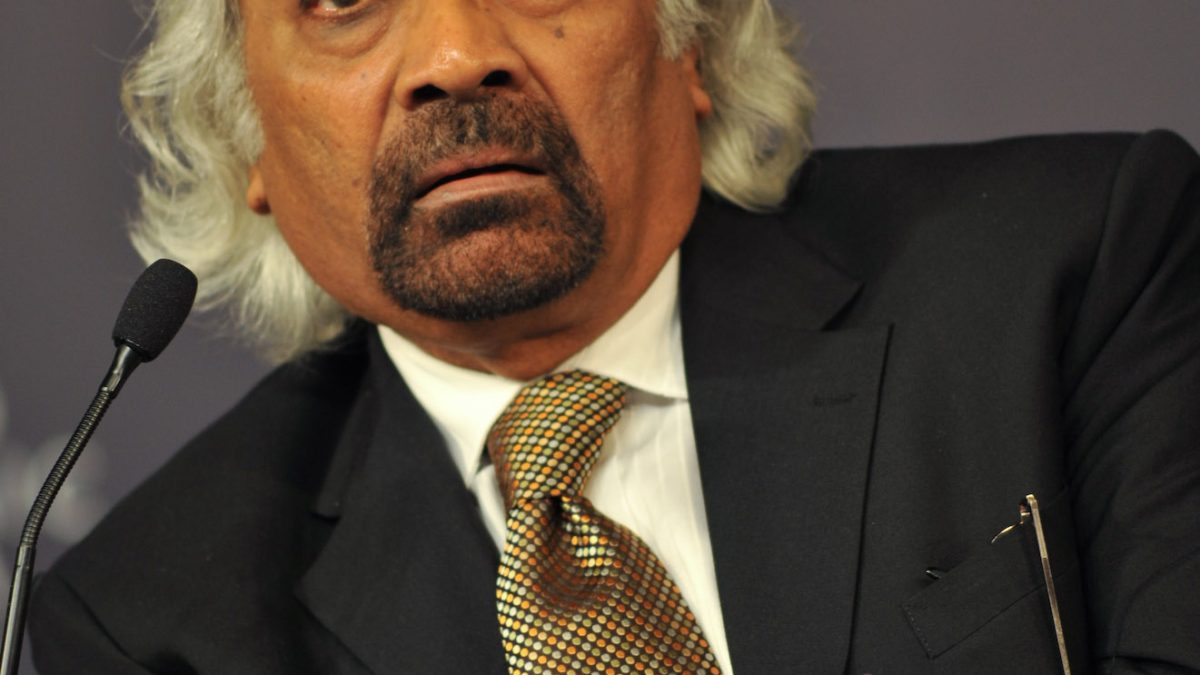
Featured image: Sam Pitroda at the India Economic Summit, November 2009. Photo by the World Economic Forum, licensed under CC BY-SA 2.0, via Wikimedia Commons.