S. Nambi Narayanan (born 12 December 1941) is an Indian aerospace engineer who led the development of liquid-fuel rocket engines at the Indian Space Research Organisation. The Vikas engine, which his team built, has powered India’s main launch vehicles for more than thirty years. In 1994 he was arrested on a charge of selling space secrets. The case was false. He fought for nearly a quarter of a century to clear his name, and in 2018 the Supreme Court held that he had been wrongly arrested and awarded him compensation.
Quick Facts
| Full name | S. Nambi Narayanan |
| Born | 12 December 1941, Nagercoil, Tamil Nadu |
| Age | 84 |
| Education | Thiagarajar College of Engineering, Madurai; Princeton University (master’s in chemical rocket propulsion) |
| Occupation | Aerospace engineer |
| Organisation | Indian Space Research Organisation (1966–2001) |
| Known for | The Vikas liquid-fuel engine; the ISRO espionage case |
| Awards | Padma Bhushan (2019) |
| Spouse | Meena Narayanan |
| Children | 2 |
Early Life
He was born at Nagercoil, near the southern tip of India, into a Tamil family; his father traded in coconut products. His father died soon after he finished an engineering degree at Madurai, and he supported his mother and sisters.
ISRO
He joined the space programme in 1966 at the rocket launching station at Thumba in Kerala, then a handful of buildings around a fishing village church, and worked with Vikram Sarabhai and beside A. P. J. Abdul Kalam.
Indian rocketry at the time used solid fuel. Narayanan argued that large satellites could be launched only with liquid-fuel engines, which are more powerful and can be controlled. Sarabhai sent him in 1969 to Princeton University, where he took a master’s degree in chemical rocket propulsion in under a year. He declined offers to stay in the United States.
Vikas
In the 1970s India made an agreement with France: Indian engineers would work for the French space agency on its programme, and in return India would receive the technology of the French Viking engine. Narayanan led a team of about fifty who lived in France for several years.
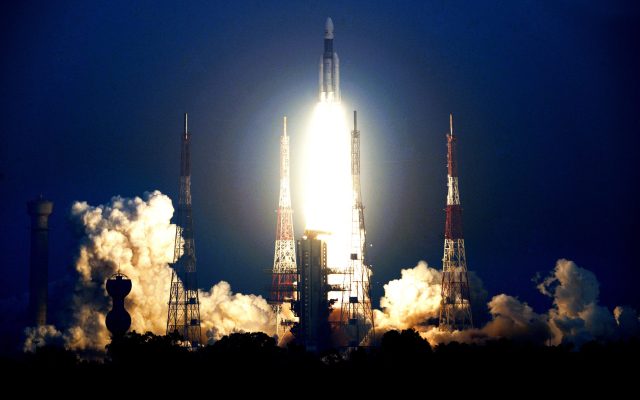
Back in India the team built the engine with Indian materials and industry. It was named Vikas, and was first test-fired successfully in 1985. It powers the second stage of the Polar Satellite Launch Vehicle and stages of the heavier rockets, and flew on the missions that took Indian spacecraft to the Moon and Mars.
In the early 1990s he was in charge of the project to acquire cryogenic engine technology from Russia, which the United States was pressing Russia to cancel.
The Arrest
On 30 November 1994 the Kerala police arrested him. They alleged that he and a colleague, with two businessmen, had passed drawings of rocket engines to Pakistan through two women from the Maldives. He was held for fifty days. He has said that officers of the Intelligence Bureau questioned him for days without rest, beat him and demanded that he name senior colleagues. The press called him a traitor; his family was shunned, and his wife became ill.
The case was handed to the Central Bureau of Investigation. In 1996 it reported that the allegations were false, that there was no evidence that any document had been passed, and that the police and intelligence officers had acted wrongly. A court discharged all the accused. When the state government tried to reopen the inquiry, the Supreme Court stopped it in 1998.
The Fight
He returned to a desk job at ISRO and retired in 2001. He pursued the officials responsible through the courts.
- **2001:** the National Human Rights Commission ordered interim compensation of ten lakh rupees
- **2018:** the Supreme Court held that his arrest had been needless and his treatment a violation of his dignity, ordered the Kerala government to pay fifty lakh rupees, and set up a committee under a retired judge to examine the conduct of the officers
- **2020:** the state paid a further sum of more than a crore to settle his civil claim
- **2021:** on the committee’s report the court directed a new investigation, and the Bureau registered a case against former police and intelligence officers
Why the case was fabricated has never been established. He has maintained that it was meant to cripple India’s cryogenic engine programme, which was indeed delayed by many years.
Recognition
He was awarded the Padma Bhushan in 2019. His story is told in his memoirs and in the film Rocketry: The Nambi Effect (2022), written and directed by the actor R. Madhavan, who played him.
Personal Life
He lives in Thiruvananthapuram with his wife, Meena; they have a son and a daughter.
Later leaders of the organisation he served include K. Sivan and S. Somanath, both specialists in the launch vehicles his engine drives.
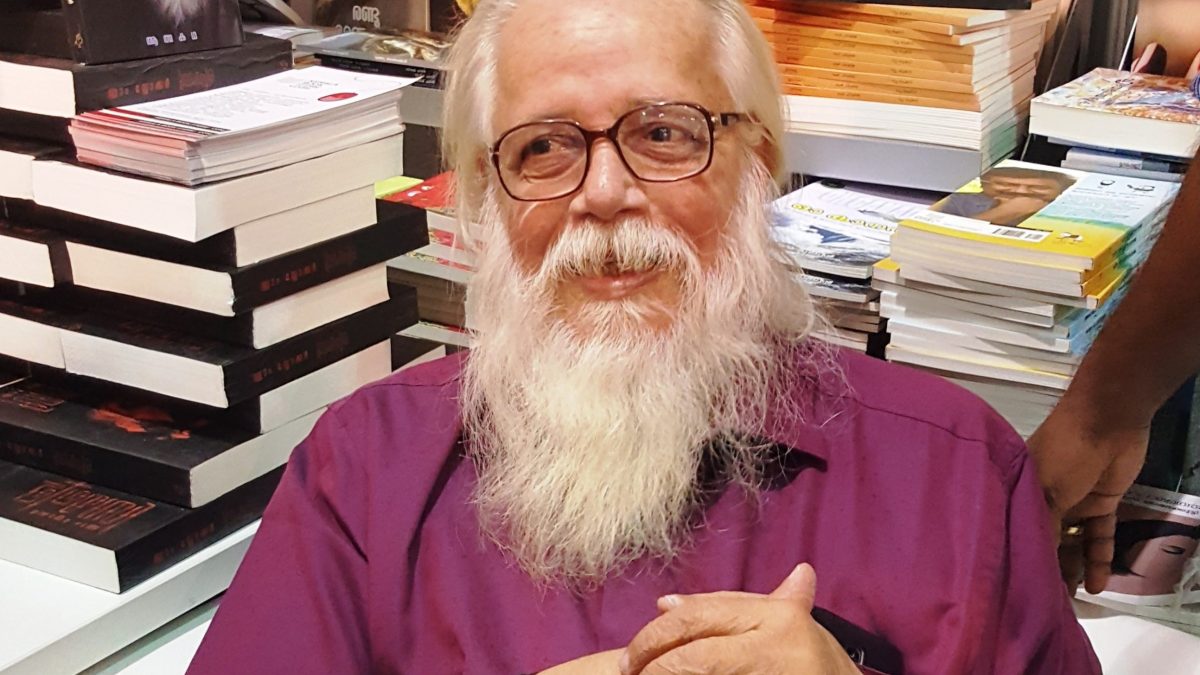
Featured image: Nambi Narayanan in November 2017. Photo by Vicharam, licensed under CC BY-SA 4.0, via Wikimedia Commons.