
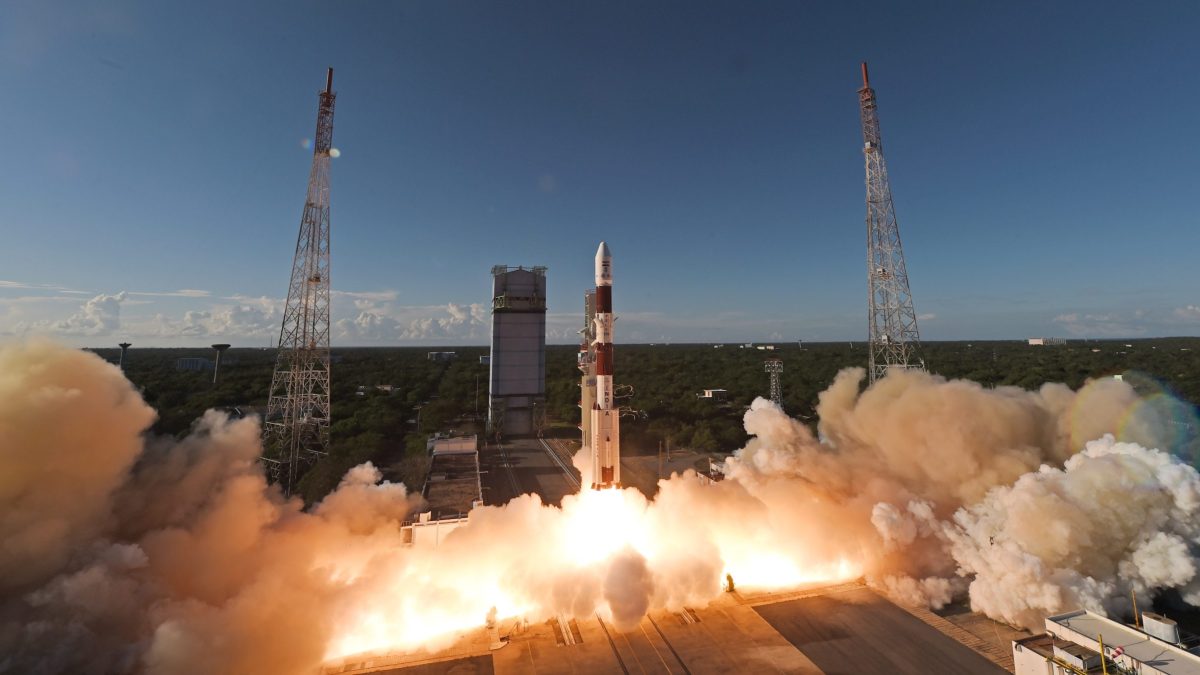
The Indian Space Research Organisation plans to launch its Technology Demonstration Satellite-01, or TDS-01, in November 2026 on a Polar Satellite Launch Vehicle from the first launch pad at the Satish Dhawan Space Centre, according to the Wikipedia entry for the mission. IndiaX24 has not found a confirmed launch date from ISRO, and the entry describes the mission as planned and not yet launched.
The satellite is meant to test new technologies in geostationary orbit, using an INSAT satellite bus, according to the entry. It will carry payloads for ISRO’s Institute of Plasma Research in Gandhinagar and for the CSIR-CEERI laboratory in Pilani, and it will test 35 new technologies, ranging from atomic clocks to an ion propulsion demonstration.
The headline experiment is electric propulsion. The satellite carries a 300 millinewton ion thruster, rated at 5.4 kilowatts, developed by ISRO’s Liquid Propulsion Systems Centre, according to the entry. Three hundred millinewtons is 0.3 newton, a conversion by IndiaX24, which is a very small push that works over long periods and not as a rocket engine does.
The saving in fuel could be large. The entry says that the electric propulsion is expected to reduce the xenon fuel load by up to 90 per cent compared with conventional geostationary satellites, from about two tonnes to less than 200 kg. The numbers are consistent, since 200 kg is 10 per cent of 2,000 kg, a check by IndiaX24. A satellite that carries less fuel can carry more payload or be launched on a smaller rocket, which is general background and not a statement in the entry.
The other payloads include multiple atomic clocks to be validated in orbit, travelling wave tube amplifiers, and a quantum communication suite called QuTDS that is meant to demonstrate quantum key distribution technology, according to the entry. Atomic clocks are central to satellite navigation systems, and quantum key distribution is a method of sharing encryption keys that can reveal eavesdropping, which is general background.
The mission has a stated budget. More than 18,700 lakh rupees, or about Rs 187 crore, was allocated for hardware development from 2021 to 2026, according to the entry. That is a conversion by IndiaX24 of lakhs into crores at 100 lakh to a crore, and the entry does not say whether the figure covers the launch.
IndiaX24 has reported on a dispute among ISRO’s employees’ associations, who have sought a meeting with the agency’s chairperson, and on other space matters including the Skyroot launch company’s first US customer. The reports reviewed do not link these to the TDS-01 mission.
Several details remain unconfirmed. The Wikipedia entry is not a primary source, and IndiaX24 did not find an ISRO announcement of the launch date, the satellite’s mass or the exact orbital slot. Launch dates for ISRO missions can move by weeks, which is general background.
The value of the mission lies in what it proves. A successful test of the ion thruster and the atomic clocks would allow Indian-built systems to be used on later operational satellites, according to the general logic of a technology demonstrator, though ISRO has not said which satellites would use them.
IndiaX24 will report when ISRO confirms the launch date and the lift-off.
Image: An ISRO PSLV launch, PSLV-C59 (file photo). Photo by Indian Space Research Organisation, licensed under Government Open Data License – India, via Wikimedia Commons.


Leave a Reply