Govindappa Venkataswamy (1 October 1918 – 7 July 2006), known as Dr V, was an Indian ophthalmologist who founded the Aravind Eye Hospital at Madurai in 1976. Starting with eleven beds in a rented house after his retirement, he built what became the largest provider of eye care in the world, giving most of its operations free or at very low cost and paying its way from the fees of those who could afford them. Its methods are studied in medical and business schools everywhere.
Quick Facts
| Full name | Govindappa Venkataswamy |
| Born | 1 October 1918, Vadamalapuram, Tamil Nadu |
| Died | 7 July 2006, Madurai (aged 87) |
| Education | American College, Madurai; Stanley Medical College, Madras (M.B.B.S., 1944); Government Ophthalmic Hospital, Madras |
| Occupation | Ophthalmologist |
| Founded | Aravind Eye Hospital, Madurai (1976) |
| Awards | Padma Shri (1973) |
Early Life
He was born in a farming village in the south of Tamil Nadu, the eldest of five children. He walked several kilometres to school and wrote his first letters in sand. The deaths in childbirth of three cousins made him decide to become an obstetrician.
He qualified in medicine at Madras in 1944 and joined the Indian Army Medical Corps.
Illness
In 1948 he was struck by severe rheumatoid arthritis and was bedridden for nearly two years. His fingers were permanently twisted and fused. Obstetrics was no longer possible. He chose ophthalmology, and taught himself to hold a scalpel and to operate on the eye with instruments made to fit his hands.
Government Service
He joined the faculty of Madurai Medical College and became head of ophthalmology and vice-dean. He introduced eye camps, in which a team went out to villages to examine people and operate on them, a school for the blind, and training for ophthalmic assistants. He is said to have personally performed more than a hundred thousand operations. He retired in 1976, at fifty-eight.
Aravind
He then opened a hospital of eleven beds in a house in Madurai, with his sister Dr G. Natchiar, her husband Dr P. Namperumalsamy and other members of the family, mortgaging their property to do it. It was named after the philosopher Sri Aurobindo, whose teaching guided his life.
India then had many millions blind from cataract, a condition cured by a short operation. His aim was to do that operation on a very large scale.
The model
- **Assembly-line surgery:** he said he had learnt from the hamburger chain McDonald’s that a standard product could be delivered well and cheaply in huge numbers. Surgeons at Aravind do only the surgery; trained assistants prepare and move patients, and a surgeon operates on one patient after another at adjoining tables, performing several times as many operations a year as is usual elsewhere.
- **Paying and free:** patients choose whether to pay. Those who pay get a private room; those who do not get a mat in a ward. The surgery and the surgeon are the same. Roughly half or more are treated free or below cost, and the surplus from the rest covers them.
- **Outreach:** camps in villages bring patients in by bus
- **Staff:** young women from villages are trained for two years as ophthalmic assistants
Aurolab
The artificial lens put in the eye after cataract removal cost more than most Indians could pay. In 1992 Aravind set up Aurolab to make lenses, which it sold at a small fraction of the imported price, and exports to more than a hundred countries.
Results
The system now consists of several large hospitals and many smaller centres across Tamil Nadu and beyond, sees millions of patients a year and performs several hundred thousand operations. Its complication rates compare with the best hospitals in the West. It has trained eye doctors and managers from scores of countries.
The Man
He never married, lived with his brother’s family and took no salary from the hospital beyond his government pension. He kept a daily journal of his spiritual effort and said that his aim was not only to restore sight but to do the work with love.
Death
He died in Madurai on 7 July 2006. The family he trained continues to lead the institution.
Among Indian doctors who have applied scale to bring down the cost of treatment, the best known after him is the heart surgeon Devi Shetty.
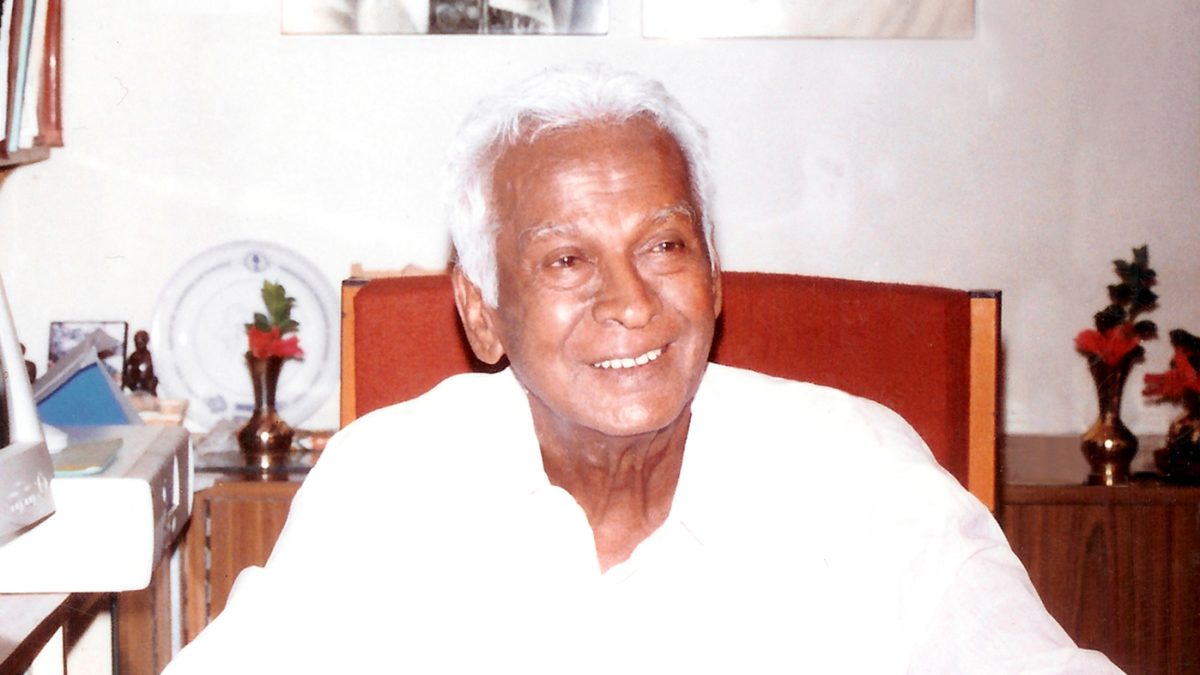
Featured image: Dr Govindappa Venkataswamy at his desk at Aravind Eye Hospital. Photo by Aravind Eye Care System, licensed under CC BY-SA 4.0, via Wikimedia Commons.