
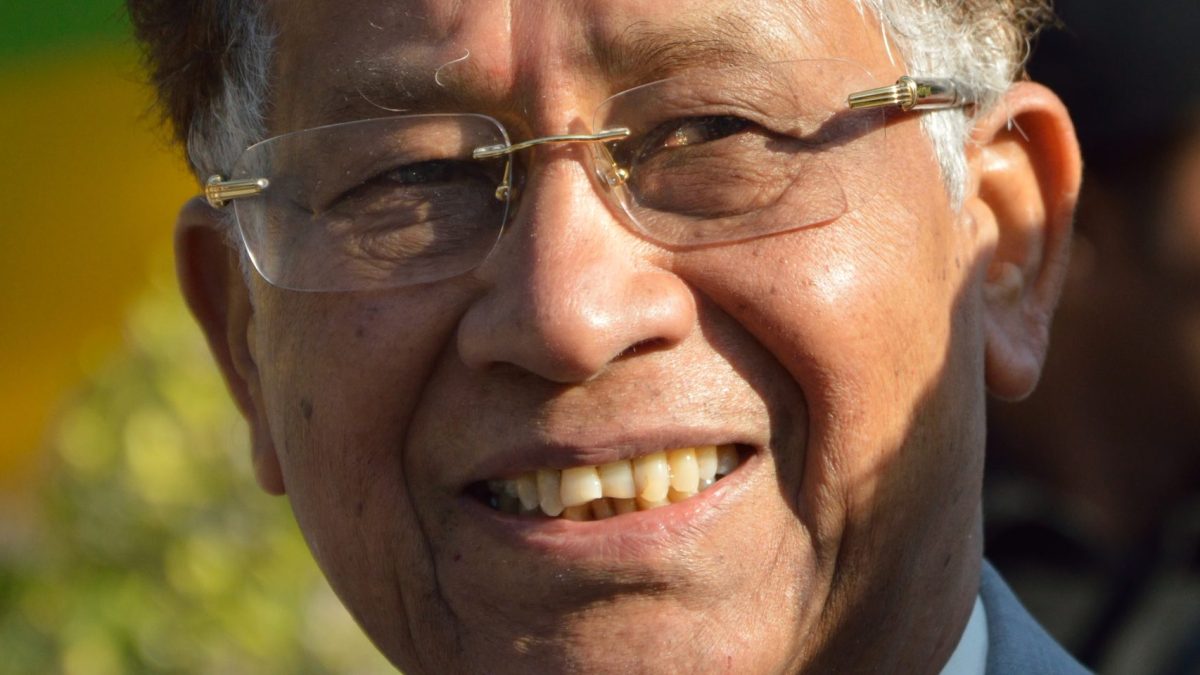
Tarun Kumar Gogoi (11 October 1934 – 23 November 2020) was an Indian politician of the Indian National Congress who was Chief Minister of Assam for three consecutive terms, from 2001 to 2016, longer than anyone else. He took office in a state exhausted by insurgency and near bankruptcy, and is credited with restoring a measure of peace and financial stability. He was earlier a member of the Lok Sabha for six terms and a Union minister.
Quick Facts
| Full name | Tarun Kumar Gogoi |
| Born | 11 October 1934, Rangajan tea estate, Jorhat district, Assam (some records give 1 April 1936) |
| Died | 23 November 2020, Guwahati |
| State | Assam |
| Education | Jagannath Barooah College, Jorhat; Gauhati University (LL.B.) |
| Party | Indian National Congress |
| Offices | Chief Minister of Assam (2001–2016); Union Minister of State (1991–1996); Member of the Lok Sabha (six terms) |
| Awards | Padma Bhushan (2021, posthumous) |
| Spouse | Dolly Gogoi |
| Children | Chandrima and Gaurav Gogoi |
Early Life
He was born on a tea estate in the Jorhat district of upper Assam, where his father, Dr Kamaleshwar Gogoi, was the medical officer. The family belonged to the Ahom community, descended from the dynasty that ruled Assam for six centuries. He was educated at Jorhat and took a law degree from Gauhati University. He practised briefly as a lawyer.
Career
Parliament
He entered politics through the Jorhat municipal board in 1968 and was elected to the Lok Sabha from Jorhat in 1971, when Indira Gandhi chose him among the young candidates of that year. He won the seat three times and later sat for Kaliabor. He rose in the party organisation under Rajiv Gandhi, serving as a general secretary of the All India Congress Committee, and was Union Minister of State for food and then for food processing in the government of P. V. Narasimha Rao.
Chief Minister
He led the Congress to victory in the Assam election of 2001 and was sworn in on 18 May. The treasury was empty, government salaries were months in arrears, and several armed groups were active.
- **Finances:** he cut the deficit and, with central help, brought the state back to solvency within a few years
- **Peace:** his government held talks with a number of insurgent groups. Accords were signed with Bodo organisations, and a faction of the United Liberation Front of Asom came to the table. Violence fell sharply over his tenure, though it did not end, and there were serious outbreaks of ethnic killing, notably in the Bodo areas in 2012.
- **Development:** roads, bridges, medical colleges and a programme of rural health
He won again in 2006 and, with an increased majority, in 2011.
Defeat
His third term was troubled by dissidence. In 2015 his ambitious lieutenant Himanta Biswa Sarma left for the Bharatiya Janata Party, taking several legislators. In 2016 the BJP and its allies won Assam for the first time, and Gogoi’s fifteen years ended. He kept his own seat of Titabor and remained an active and often witty critic of the new government, strongly opposing the Citizenship Amendment Act.
Death
He contracted Covid-19 in August 2020, recovered, and was readmitted with complications. He died in Guwahati on 23 November 2020. He was awarded the Padma Bhushan posthumously.
Personal Life
He married Dolly Gogoi, a zoology graduate, in 1972. Their son, Gaurav Gogoi, has been a member of the Lok Sabha since 2014 and is the Congress party’s deputy leader there; their daughter, Chandrima, is a business graduate. He was fond of gardening, golf and reading, and was known for his easy manner with the press.
Featured image: Tarun Gogoi in Kolkata, February 2013. Photo by Biswarup Ganguly, licensed under CC BY 3.0, via Wikimedia Commons.



