
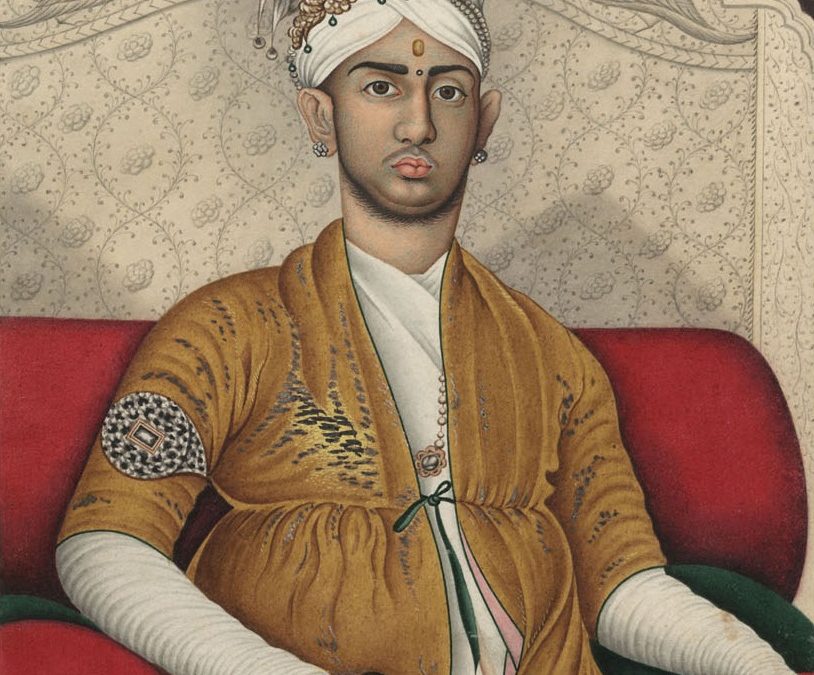
Swathi Thirunal Rama Varma (16 April 1813 – 26 December 1846) was the Maharaja of the kingdom of Travancore, in southern Kerala, from 1829 until his death. He is remembered equally as a ruler who gave Thiruvananthapuram many of its modern institutions and as one of the great composers of Indian classical music, the author of more than four hundred compositions in several languages and in both the Carnatic and Hindustani traditions.
Quick Facts
| Full name | Swathi Thirunal Rama Varma |
| Born | 16 April 1813, Travancore |
| Died | 26 December 1846 (aged 33), Thiruvananthapuram |
| Title | Maharaja of Travancore |
| Reign | 1829 – 1846 |
| Mother | Gowri Lakshmi Bayi |
| Known for | Musical compositions; observatory, English school, public library and museum in Thiruvananthapuram |
| Signature | Padmanabha (the deity of Thiruvananthapuram) |
Early Life
He was born into the matrilineal royal house of Travancore and was proclaimed ruler in infancy; the lullaby “Omanathinkal Kidavo”, still sung in Kerala, was composed for him by the court poet Irayimman Thampi. His mother, Rani Gowri Lakshmi Bayi, died when he was two, and his aunt, Gowri Parvati Bayi, governed as regent until he came of age in 1829. He was given an exceptional education and is said to have known a dozen or more languages, among them Malayalam, Sanskrit, Tamil, Telugu, Kannada, Marathi, Hindustani, Persian and English, together with geometry and music.
Ruler
Assuming power at sixteen, he governed with the help of his former tutor, whom he made chief minister. His reign brought a series of reforms:
He also abolished several oppressive practices, including trial by ordeal.
His later years were unhappy. The British Resident, General William Cullen, interfered constantly in the administration and supported officials whom the Maharaja distrusted. Unable to prevail, he withdrew more and more into music and devotion.
Composer
His court was a meeting place of musicians from all over India: the four brothers known as the Tanjore Quartet, who shaped the dance later called Bharatanatyam, Carnatic singers, and Hindustani vocalists from the north. Out of this came a body of work unusual in its range. He composed kritis, varnams, padams for dance and tillanas in the southern style, and dhrupads, khayals, thumris and bhajans in the northern, in Sanskrit, Malayalam, Telugu, Kannada and Hindustani. Most carry a form of the name Padmanabha, the deity of the great temple of his capital, as his signature.
Among the best known are the Navaratri kritis, nine songs sung on the nine nights of the festival; the Utsava Prabandham, describing the temple festival; “Bhavayami Raghuramam”, which tells the Ramayana in a single piece; “Deva deva kalayami” and the tillana in the raga Dhanashri. He also wrote poetry and narrative works for musical discourse, and encouraged the dance of Mohiniyattam.
Death and Legacy
He died on 26 December 1846, at thirty-three, and was succeeded by his brother. His music was for a time neglected outside Kerala; in the twentieth century singers such as Semmangudi Srinivasa Iyer edited and popularised it, and it is now part of the standard concert repertoire. The music college in Thiruvananthapuram bears his name, an annual festival is held in the palace where he lived, and Kerala’s highest award for musicians is the Swathi Puraskaram.
Frequently Asked Questions
When and where was Swathi Thirunal born?
Swathi Thirunal was born on 16 April 1813 in Travancore.
When did Swathi Thirunal die?
Died: 26 December 1846 (aged 33), Thiruvananthapuram.
What is Swathi Thirunal known for?
Known for: Musical compositions; observatory, English school, public library and museum in Thiruvananthapuram.
Featured image: Swathi Thirunal Rama Varma, Maharaja of Travancore, portrait of 1842. Photo by Stephen Crening, in the public domain, via Wikimedia Commons.



