
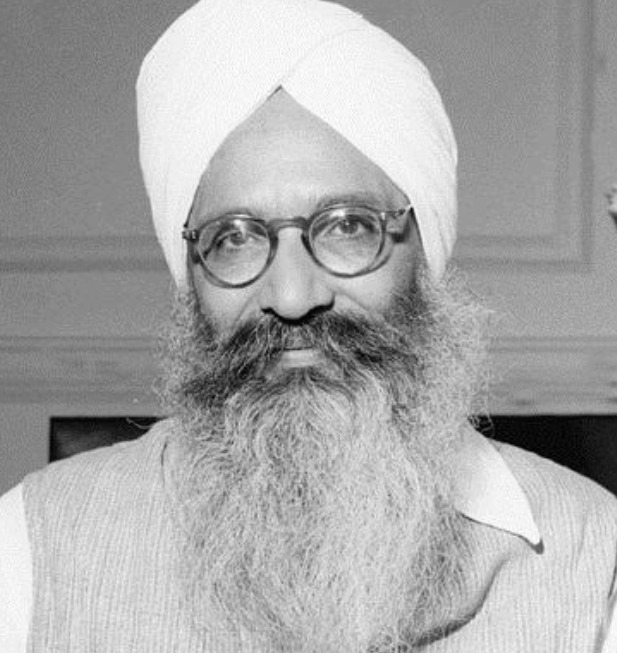
Partap Singh Kairon (1 October 1901 – 6 February 1965) was an Indian politician who was Chief Minister of Punjab from 1956 to 1964. Driving and impatient, he rebuilt a province shattered by Partition: its farms were consolidated and irrigated, its villages given roads and electricity, and new towns and industries created. He is regarded as the architect of modern Punjab. He resigned after a commission of inquiry found against him, and was assassinated the following year.
Quick Facts
| Full name | Partap Singh Kairon |
| Born | 1 October 1901, Kairon, Amritsar district (now in Tarn Taran district), Punjab |
| Died | 6 February 1965, near Rasoi, Haryana (aged 63) |
| Education | Khalsa College, Amritsar; University of Michigan (M.A. in political science); University of California (M.A. in economics) |
| Party | Indian National Congress; earlier Shiromani Akali Dal |
| Offices | Chief Minister of Punjab (1956–1964); minister for rehabilitation and development |
| Spouse | Ram Kaur |
| Children | 2 sons |
Early Life
He was born in the village from which he took his name, into a Sikh Jat family. His father, Nihal Singh, was a pioneer of education for girls in the region. After Khalsa College he went to the United States, where he worked on farms and in factories to pay for his studies and took master’s degrees at Michigan and California. The energy and practical methods of American agriculture left a permanent mark on him.
The Freedom Movement
He returned in 1929, started a weekly newspaper in Amritsar and joined both the Akali Dal and the Congress. He was jailed in 1932 for five years for his part in civil disobedience and again during the Quit India movement. He was general secretary of the provincial Congress and a member of the Constituent Assembly.
Rebuilding Punjab
After Partition, as minister for rehabilitation and then for development, he took a leading part in resettling several million refugees from West Punjab on the lands left by those who had gone the other way.
Chief Minister
He became Chief Minister on 21 January 1956 and held the post for more than eight years. He worked at a furious pace, toured constantly, and decided matters on the spot.
- **Consolidation of holdings:** the scattered strips of each farmer were exchanged and gathered into compact blocks across the whole state, the step that made tube wells and tractors worthwhile
- **Water and power:** the Bhakra-Nangal project was completed in his time; tube wells multiplied; and the electrification of villages was pushed further than anywhere else in India
- **Roads:** nearly every village was linked to a metalled road and a market
- **The agricultural university at Ludhiana (1962),** on the American land-grant model, which a few years later bred and spread the new wheat; see M. S. Swaminathan
- **Industry:** the industrial town of Faridabad, and small engineering works at Ludhiana, Jalandhar and Batala
- **Education and health:** free schooling up to the middle classes, engineering and medical colleges, the postgraduate medical institute at Chandigarh and a new university at Kurukshetra
- **Chandigarh,** the new capital, was built and occupied; see the Capitol Complex
He was an early advocate of a strong defence along the border, and mobilised the state behind the war effort in 1962. He firmly opposed the Akali demand for a separate Punjabi-speaking state and jailed its agitators by the thousand.
The Das Commission
His methods were high-handed, and his sons had prospered in business while he was in office. Opponents presented a list of charges to the President. A commission under the former Chief Justice S. R. Das reported in June 1964 that, while he had not personally taken money, he had allowed his family to use his position to enrich themselves. He resigned on 21 June 1964.
Assassination
On 6 February 1965, as he was being driven from Delhi to Chandigarh, his car was stopped on the Grand Trunk Road near the village of Rasoi and he, his secretary and two others were shot dead. The killers were men with a personal grievance; the leader was later hanged.
Legacy
Jawaharlal Nehru, who stood by him to the end, held him to be the most effective chief minister in the country. The agricultural base he created made Punjab the granary of India within a few years of his death. The state was divided in 1966 on the lines he had resisted.
A generation earlier, the farmers of the region had found their champion in Sir Chhotu Ram.
Featured image: Partap Singh Kairon in 1956. Photo by an unknown photographer, in the public domain, via Wikimedia Commons.



