
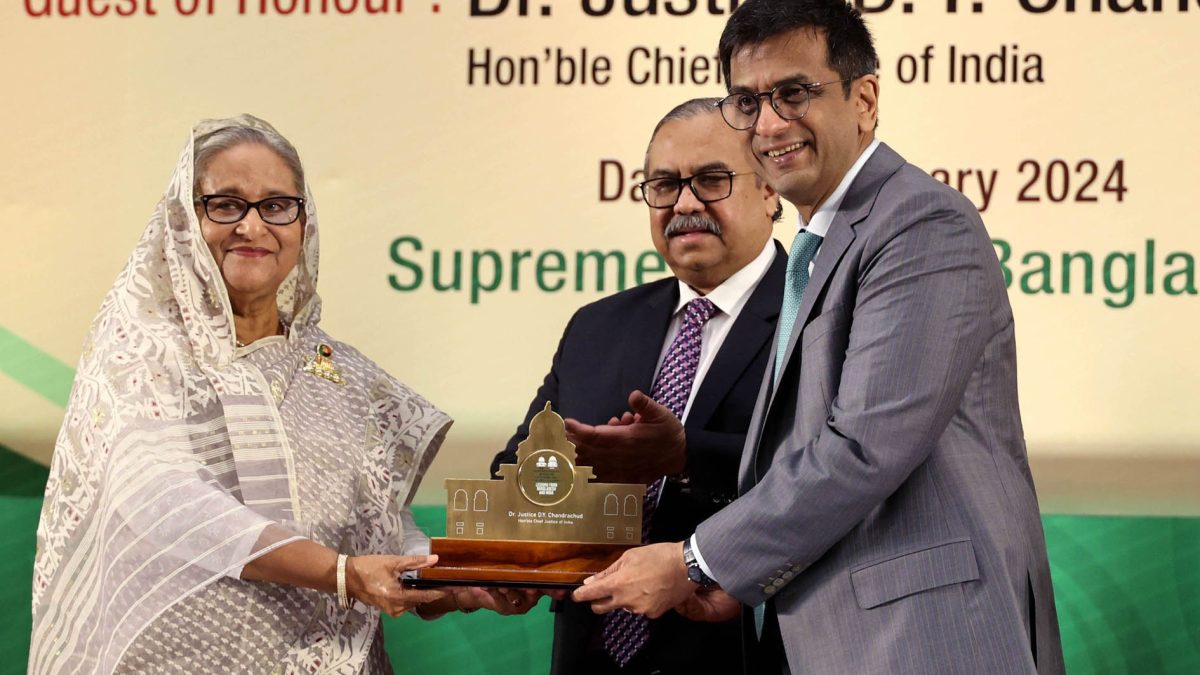
Dhananjaya Yeshwant Chandrachud (born 11 November 1959) is a retired Indian judge who was the 50th Chief Justice of India from 9 November 2022 to 10 November 2024. In more than eight years on the Supreme Court he wrote or joined many of its most important decisions, on privacy, the decriminalisation of homosexuality, the Ayodhya dispute and electoral bonds. His father, Y. V. Chandrachud, was the longest-serving Chief Justice of India.
Quick Facts
| Full name | Dhananjaya Yeshwant Chandrachud |
| Born | 11 November 1959, Bombay (now Mumbai), India |
| Age | 66 |
| Office | 50th Chief Justice of India (2022–2024) |
| Judge, Supreme Court | 13 May 2016 – 10 November 2024 |
| Earlier posts | Judge, Bombay High Court (2000–2013); Chief Justice, Allahabad High Court (2013–2016) |
| Education | St. Stephen’s College, Delhi (B.A.); University of Delhi (LL.B.); Harvard Law School (LL.M., S.J.D.) |
| Father | Y. V. Chandrachud (Chief Justice of India, 1978–1985) |
| Spouse | Rashmi (d. 2007); Kalpana Das |
| Children | 2 sons and 2 foster daughters |
Early Life
Chandrachud grew up in Mumbai and Delhi; his mother, Prabha, was a classical singer. He studied economics and mathematics at St. Stephen’s College and law at Delhi University, then took a master’s and a doctorate at Harvard. He practised in the Bombay High Court and the Supreme Court, was designated a senior advocate in 1998 and served as Additional Solicitor General.
Judicial Career
He became a judge of the Bombay High Court in March 2000 and Chief Justice of the Allahabad High Court in October 2013.
In 2017 he wrote the main opinion of the nine-judge bench that declared privacy a fundamental right; it expressly overruled a 1976 Emergency-era decision his father had joined. He was part of the benches that struck down the law criminalising gay sex and the law on adultery in 2018, and that opened the Sabarimala temple to women of all ages. He dissented on the Aadhaar law and on the arrests of activists in the Bhima Koregaon case. He sat on the bench that unanimously decided the Ayodhya title dispute in 2019.
As Chief Justice he presided over the bench that upheld the removal of Jammu and Kashmir’s special status in December 2023 and the one that struck down the electoral bonds scheme for political funding in February 2024. In October 2023 the court declined to legalise same-sex marriage; he was in the minority in favouring recognition of civil unions. He expanded live-streaming of hearings, paperless filing and translation of judgments into Indian languages.
Criticism
Admirers saw him as a liberal voice. Critics said that as Chief Justice his rulings seldom checked the government in practice and questioned the listing of some sensitive cases; a visit by the Prime Minister to his home for a religious ceremony in 2024 also drew comment.
Personal Life
His sons, Abhinav and Chintan, are lawyers. He and his wife, Kalpana, have two foster daughters with special needs.
Frequently Asked Questions
When and where was D. Y. Chandrachud born?
D. Y. Chandrachud was born on 11 November 1959 in Bombay (now Mumbai), India and is 66 years old.
Featured image: Chief Justice D. Y. Chandrachud (right) receives a memento from Bangladesh’s then Prime Minister, Sheikh Hasina, at a conference in Dhaka, 24 February 2024. Photo by Press Information Department, in the public domain, via Wikimedia Commons.



