
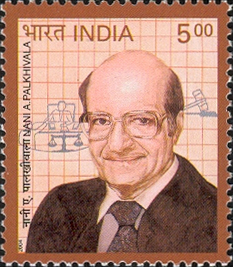
Nanabhoy Ardeshir Palkhivala (16 January 1920 – 11 December 2002), known as Nani Palkhivala, was an Indian lawyer, economist and diplomat, widely regarded as the finest advocate India has produced. He argued the case in which the Supreme Court held that Parliament cannot destroy the basic structure of the Constitution. For nearly forty years his annual speech on the Union budget drew crowds that filled a cricket stadium. He was Ambassador to the United States from 1977 to 1979.
Quick Facts
| Full name | Nanabhoy Ardeshir Palkhivala |
| Born | 16 January 1920, Bombay |
| Died | 11 December 2002, Mumbai (aged 82) |
| Community | Parsi |
| Education | St Xavier’s College, Bombay (M.A. in English); Government Law College, Bombay |
| Occupation | Advocate, tax expert, author, diplomat |
| Offices | Ambassador of India to the United States (1977–1979) |
| Notable works | The Law and Practice of Income Tax; We, the People; We, the Nation |
| Awards | Padma Vibhushan (1998) |
| Spouse | Nargesh Palkhivala |
Early Life
He was born in Bombay into a middle-class Parsi family; the surname comes from an ancestor’s trade of making palanquins. As a boy he had a severe stammer, which he overcame by force of will. He took a master’s degree in English literature at St Xavier’s College and applied for a lecturer’s post. It went to another candidate. With admissions to most courses closed, he enrolled at the Government Law College.
The Bar
He joined the chambers of Sir Jamshedji Kanga in 1946 and within a few years was appearing in major cases. In 1950, at thirty, he wrote with Kanga The Law and Practice of Income Tax, which became and remains the standard work on the subject. He was offered a seat on the Supreme Court in his early forties, and later the post of Attorney-General, and declined both.
Defender of the Constitution
From the late 1960s the government of Indira Gandhi sought, by a series of constitutional amendments, to put its measures beyond the reach of the courts. Palkhivala led the resistance in the Supreme Court.
- **Bank nationalisation (1970) and privy purses (1970):** he won both for the petitioners
- **Kesavananda Bharati (1973):** before a bench of thirteen judges, the largest ever to sit, he argued for some five months that the power to amend the Constitution does not include the power to abolish its essential features. By seven to six the court agreed. The basic structure doctrine has protected democracy, federalism, secularism and judicial review ever since.
- **The attempted review (1975):** during the Emergency the Chief Justice convened another bench of thirteen to reconsider the ruling. Palkhivala’s argument on the opening days is spoken of by those present as the greatest advocacy heard in an Indian court. The bench was dissolved after two days.
- **Minerva Mills (1980):** the court struck down amendments that sought to remove the limits again
He had agreed to appear for Indira Gandhi in her appeal against the judgment setting aside her election. When the Emergency was declared in June 1975 he returned the brief. See the Emergency of 1975–77.
The Budget Speeches
From 1958 he spoke each year in Bombay, a few days after the Finance Minister, on the Union budget. He spoke without a note, quoting figures and section numbers from memory, for an hour and a half. The audience outgrew hall after hall until the meeting moved to the Brabourne Stadium, where tens of thousands came to listen. It was said that there were two budget speeches, and that his was the better attended. He gave the last in 1994.
He was a tireless critic of high taxation, controls and the growth of the state, long before such views were fashionable.
Ambassador
The government that took office after the Emergency sent him to Washington in 1977. He was a great success as a speaker at American universities and returned in 1979.
Business
He was a director of Tata Sons, close to J. R. D. Tata, and chairman of several companies, among them a cement company and the software firm that became India’s largest.
Books
His speeches and essays were collected as We, the People (1984) and We, the Nation (1994). He also wrote on the Constitution and on the country’s heritage.
Personal Life
He married Nargesh in 1945; they had no children, and her death in 2000 broke him. He gave away most of his earnings to charity, quietly. He died in Mumbai on 11 December 2002.
Among the lawyers who came out of the same chambers was Fali Nariman.
Featured image: Nani Palkhivala, from a 2004 postage stamp of India. Photo by India Post, Government of India, licensed under Government Open Data License – India, via Wikimedia Commons.



