
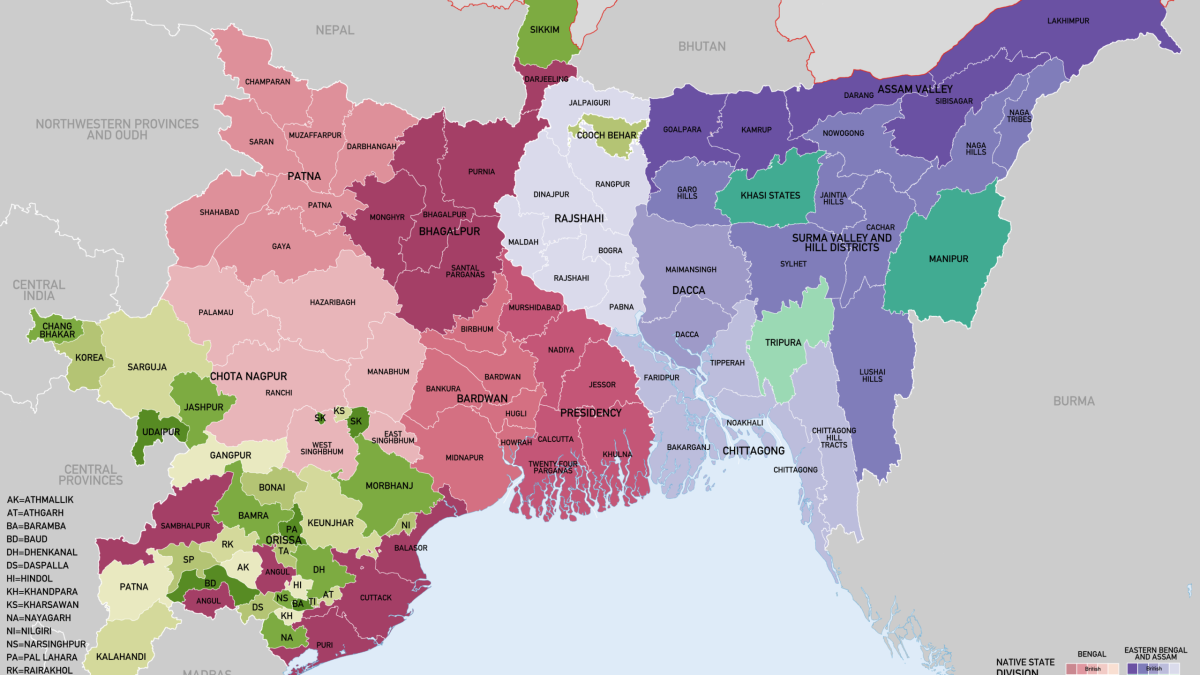
On 16 October 1905 the Viceroy, Lord Curzon, divided the province of Bengal in two. The partition was presented as an administrative reform, but it was widely seen in Bengal as an attempt to divide the people on religious lines and to weaken the nationalist movement. It led to the Swadeshi movement, a boycott of British goods, and to protests that spread across India. In 1911 the British reversed it.
Quick Facts
| Date | Took effect 16 October 1905 |
| Viceroy | Lord Curzon |
| New provinces | East Bengal and Assam (capital Dhaka); Bengal (with Bihar and Orissa) |
| Reversed | 1911, announced at the Delhi Durbar |
| Movements | Swadeshi and boycott |
The Plan
The Bengal Presidency was the largest province in British India, with a population of about 78.5 million, taking in Bengal, Bihar, Orissa and parts of present-day Chhattisgarh and Assam. British officials argued for decades that it was too big to be administered well and that the eastern districts were neglected. Curzon proposed to join fifteen eastern districts with Assam to form a new province with its capital at Dhaka and a population of about 31 million, most of them Muslim. The rest of Bengal, with Bihar and Orissa, formed the other province, where Bengali speakers were now a minority.
The Reaction
The Bengali middle class, led by figures such as Surendranath Banerjee, saw the partition as a divide-and-rule measure. Many Hindus, who dominated business and professional life in the west, feared becoming a minority in their own province. Some Muslim leaders welcomed the new province, which promised jobs and schools in the east, and the partition deepened communal divisions.
The Swadeshi Movement
- **Boycott:** crowds burned foreign cloth, and shops stopped selling British goods, in a movement of the whole province
- **Rakhi Bandhan:** on 16 October 1905 Bengalis tied rakhis on each other’s wrists as a sign of unity; Rabindranath Tagore wrote songs for the day
- **National education:** a National Council of Education was founded in 1906, with schools outside government control
- **Swadeshi enterprise:** Indian-owned textile mills, banks and shipping companies were started
- **Slogans:** Bande Mataram became the cry of the movement, and the authorities tried to restrict its public use
The movement spread beyond Bengal, and leaders such as Bal Gangadhar Tilak in Maharashtra, Lala Lajpat Rai in Punjab and Bipin Chandra Pal in Bengal took up the call. It marked a split in Congress between the moderates and the extremists, which came to a head at the Surat session of 1907.
Reversal in 1911
The British had tried repression and then conciliation. In December 1911 King George V announced at the Delhi Durbar that the partition was annulled, Bengal would be reunited, and the capital would move from Calcutta to Delhi. Meanwhile, the Muslim League had been founded at Dhaka in December 1906, in part as a reaction to the agitation.
Why It Matters
The partition showed the power of mass boycott and gave Indian nationalism its first experience of a national campaign, a pattern that Gandhi would develop on a far larger scale. The idea of dividing Bengal along religious lines returned in 1947, as described in the Partition of India.
Featured image: Map of the partition of Bengal in 1905. Photo by XrysD, licensed under CC BY-SA 4.0, via Wikimedia Commons.

Leave a Reply