In the first week of June 1984 the Indian Army entered the Golden Temple complex in Amritsar, the holiest shrine of the Sikhs, to remove armed militants who had fortified it. The action, code-named Operation Blue Star, was followed within months by the assassination of the Prime Minister and by mass killings of Sikhs. Its effects were felt for a generation.
The background
- Political demands: The Akali Dal, Punjab’s main Sikh party, had long sought more autonomy for the state, the transfer of Chandigarh and a larger share of river waters, demands set out in the Anandpur Sahib Resolution of 1973.
- Bhindranwale: Jarnail Singh Bhindranwale, head of a Sikh seminary, emerged as a militant preacher around 1978. His rise was at first encouraged by some in the Congress as a counter to the Akalis.
- Violence: From 1981 Punjab saw killings of officials, journalists, moderate Sikhs and Hindus. In October 1983 the state was placed under President’s Rule.
- The complex: Bhindranwale moved into the Golden Temple complex, and by early 1984 his men, trained by a former army general, Shabeg Singh, had fortified the Akal Takht with weapons.
Negotiations between the government and the Akalis repeatedly failed.
The operation
- Ordered by: Prime Minister Indira Gandhi
- Dates: 1 to 10 June 1984; the main assault came on the night of 5-6 June
- Commander on the ground: Major General K. S. Brar
Punjab was put under curfew, and communications and the press were cut off. The first infantry assaults met heavy fire and took severe losses. Tanks were then brought in and their guns used against the Akal Takht, which was badly damaged. Bhindranwale and Shabeg Singh were killed.
The timing added to the toll. The operation coincided with the anniversary of the martyrdom of Guru Arjan Dev, and many pilgrims were inside the complex.
The casualties
The government’s White Paper put the dead at 83 soldiers and 493 others. Independent estimates are much higher, running into the thousands. The Sikh Reference Library, with its rare manuscripts, was destroyed.
The reaction
The entry of troops into the shrine caused deep hurt among Sikhs everywhere, including those who had no sympathy for the militants. Some Sikh soldiers mutinied. Prominent Sikhs returned state honours.
The aftermath
- 31 October 1984: Indira Gandhi was shot dead at her residence in Delhi by two of her Sikh bodyguards, Beant Singh and Satwant Singh.
- Anti-Sikh violence: In the days that followed, mobs killed about 2,700 Sikhs in Delhi by the official count, and more elsewhere. Inquiries later pointed to the involvement of some Congress politicians; convictions came slowly and were few.
- Punjab: Militancy grew worse and lasted until the mid-1990s, taking many thousands of lives. Rajiv Gandhi signed an accord with the Akali leader Harchand Singh Longowal in 1985; Longowal was assassinated weeks later.
- General A. S. Vaidya, the Army chief during the operation, was assassinated in Pune in 1986.
The Akal Takht was later rebuilt by the Sikh community through voluntary service. In 2005 Prime Minister Manmohan Singh apologised in Parliament for the 1984 violence against Sikhs.
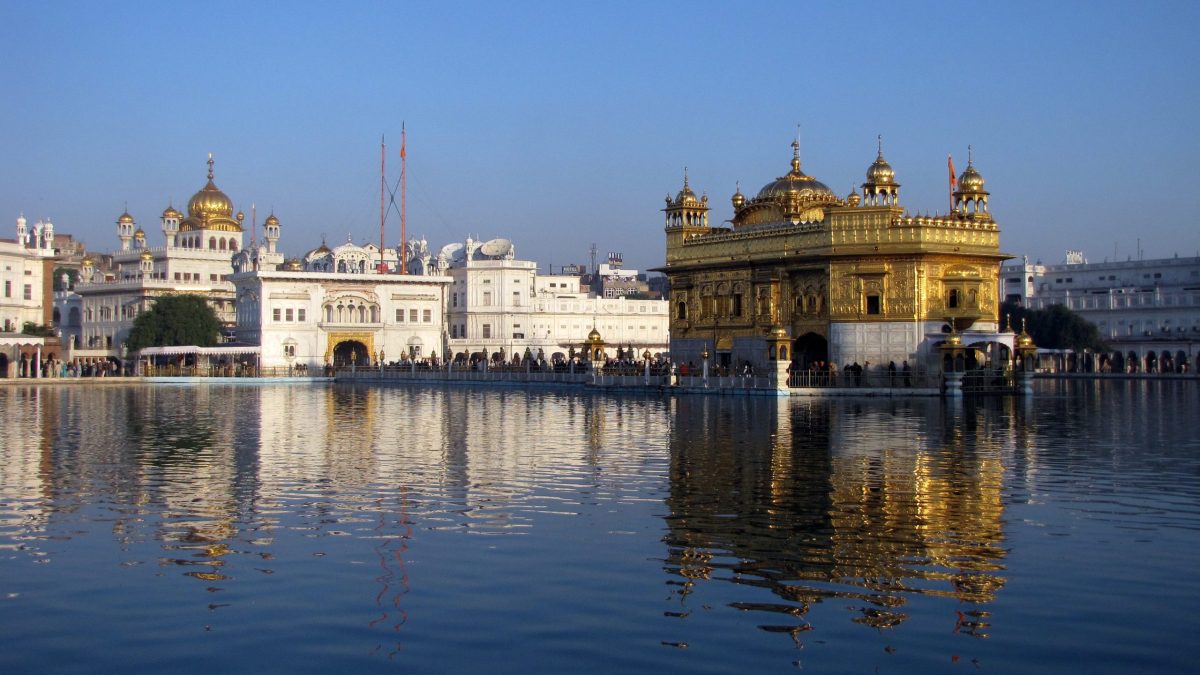
Image: The Harmandir Sahib (Golden Temple) and the Akal Takht at Amritsar, photographed in 2008. Photo by Jasleen Kaur, licensed under CC BY-SA 2.0, via Wikimedia Commons.