
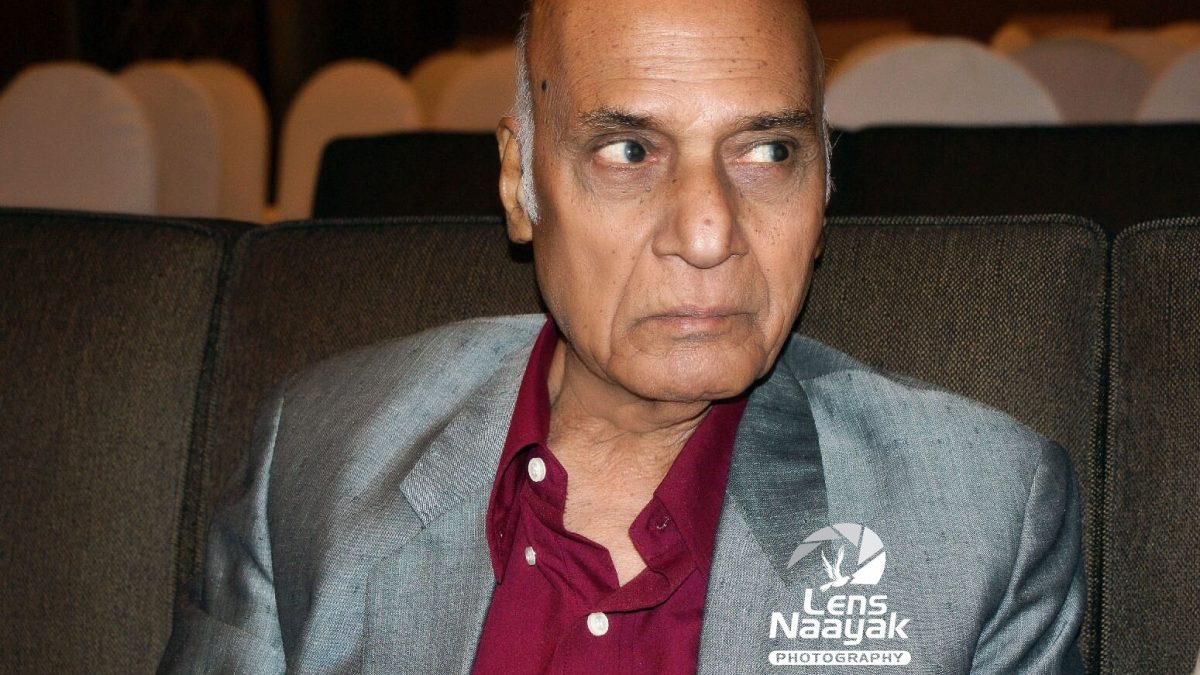
Mohammed Zahur Khayyam Hashmi, known as Khayyam, was born on 18 February 1927 and died on 19 August 2019. He was an Indian music director and background score composer whose career spanned four decades. He won Filmfare Awards for Best Music for Kabhie Kabhie (1977) and Umrao Jaan (1982) and a Filmfare Lifetime Achievement Award in 2010. He received the Sangeet Natak Akademi Award in Creative Music in 2007 and the Padma Bhushan in 2011.
He was born into a Punjabi Muslim family in Rahon in Punjab, British India. As a boy he ran away to his uncle’s house in New Delhi, where he was trained by the classical vocalist and composer Pandit Amarnath. He went to Lahore looking for film work and met the Punjabi music director Baba Chishti, who offered him a job as an assistant after he sang the first part of a Chishti composition. He assisted Chishti for six months and came to Ludhiana in 1943, aged only 17.
After a stint in the army in the Second World War he went to Bombay and made his debut as Sharmaji of the composer duo Sharmaji–Varmaji with Heer Ranjha in 1948. He went solo after his partner, Rehman Verma, moved to the newly created Pakistan after Partition. One of his earliest breaks was Biwi (1950), in which “Akele Mein Woh Ghabrate To Honge”, sung by Mohammed Rafi, was a hit, and “Shaam-e-Gham Ki Kasam”, sung by Talat Mahmood in Footpath (1953), struck a chord with the public.
He gained greater recognition with Phir Subha Hogi (1958), starring Raj Kapoor and Mala Sinha, in which songs written by Sahir Ludhianvi and sung by Mukesh and Asha Bhosle included “Woh Subah Kabhi To Aayegi”. Songs from Shola Aur Shabnam (1961), written by Kaifi Azmi, established his reputation, and the Chetan Anand film Aakhri Khat (1966) produced hits such as “Baharon Mera Jeevan Bhi Sanwaro” by Lata Mangeshkar and “Aur Kuchh Der Thehar” by Rafi.
In Shagoon (1964), his wife, Jagjit Kaur, sang “Tum Apna Ranj-o-Gham”, and the film also had the Rafi–Suman Kalyanpur duet “Parbaton Ke Pedon Par”. In Mohabbat Isko Kahete Hain (1965) the Rafi–Suman duet “Thehriye Hosh Mein Aa Loon” was popular. In the 1970s he teamed up again with Sahir Ludhianvi for Yash Chopra’s Kabhi Kabhie (1976), whose hits included the title song sung by Mukesh and Lata, “Tere Chehre Se Nazar Nahin Hatti” and “Main Pal Do Pal Ka Shayar Hoon”. Rajesh Khanna liked the songs so much that he gave Khayyam one of his cars, and Khayyam went on to compose for Khanna’s films Thodisi Bewafaii and Dard (both 1981) and Dil-e-Nadaan (1982).
His best work came in Muzaffar Ali’s Umrao Jaan (1981), with Asha Bhosle singing “In Aankhon Ki Masti Ke”, “Yeh Kya Jagah Hai Doston” and “Dil Cheez Kya Hai”, which remain popular. He also composed music for Kamal Amrohi’s Razia Sultan (1983), in which “Ae Dil-e-Nadaan” sung by Lata is considered a milestone, and for the 1971 album I Write, I Recite by Meena Kumari, featuring nazms she wrote and sang. He composed non-film songs too.
He preferred to work with poets rather than film lyricists, which is why poetry plays as large a role in his songs as the music and the singer. He gave poets full freedom, and his work includes verses by Mirza Ghalib, Daagh, Wali Mohammed Wali, Ali Sardar Jafri, Majrooh Sultanpuri and Sahir Ludhianvi, and among newer writers Naqsh Lyallpuri, Nida Fazli, Jan Nisar Akhtar and Ahmed Wasi. His music had the touch of the ghazal but was rooted in Indian classical music, and the compositions were soulful, melodious and emotional.
Featured image: Khayyam, the music director (file photo, 2010). Photo by CreativoCamaal, licensed under CC BY 4.0, via Wikimedia Commons.



