For a month in the autumn of 1962, India and China fought a war along their Himalayan border. India was defeated. The war lasted from 20 October to 21 November, and its effects on Indian policy have lasted to this day.
The dispute
The two countries disagreed about the border in two sectors.
- West: Aksai Chin, a high desert next to Ladakh, claimed by India but valued by China because the road linking Tibet and Xinjiang ran through it. India discovered the road only in the late 1950s.
- East: China rejected the McMahon Line, drawn in 1914, as the boundary of what was then the North-East Frontier Agency, now Arunachal Pradesh.
The road to war
- 1954: India and China signed the Panchsheel agreement; the slogan of the time was “Hindi-Chini bhai-bhai”.
- 1959: The Dalai Lama fled Tibet and was given asylum in India. Border clashes followed at Longju and Kongka Pass.
- 1960: Talks between Jawaharlal Nehru and Zhou Enlai failed.
- 1961: India adopted the Forward Policy, setting up small posts in disputed areas, many of them impossible to supply or defend.
The fighting
- 20 October 1962: China attacked in both sectors at once. Indian posts on the Namka Chu river in the east and in the Galwan and Chip Chap valleys in the west were overrun.
- 24 October: Tawang fell.
- Mid-November: After a pause, China attacked again. The Indian positions at Se La and Bomdila collapsed, and Chinese troops approached the plains of Assam.
- Rezang La, 18 November: In Ladakh, a company of the 13th Kumaon Regiment under Major Shaitan Singh fought almost to the last man defending the approach to Chushul. He was awarded the Param Vir Chakra posthumously.
- 21 November: China declared a ceasefire on its own and withdrew in the east to behind the McMahon Line, while keeping Aksai Chin.
The cost
India lost about 1,400 soldiers killed, with roughly 1,700 missing and nearly 4,000 taken prisoner. The troops had fought at great heights in cotton uniforms, with old rifles and little ammunition.
Why India lost
- Unprepared army: Defence spending had been low, and the army was neither equipped nor trained for mountain war.
- Misjudgment: The government believed China would not attack.
- Leadership: Command arrangements were poor, and some senior appointments were political.
- No air power: The Air Force was not used in combat for fear of escalation.
The aftermath
- The Defence Minister, V. K. Krishna Menon, resigned.
- Nehru, deeply shaken, died in May 1964.
- India doubled its defence budget, raised mountain divisions and modernised the army, changes that told in the wars of 1965 and 1971.
- The official inquiry, the Henderson Brooks-Bhagat report, has never been formally released.
The border remains unsettled. The line where the armies stopped, the Line of Actual Control, has seen repeated stand-offs, including the deadly clash in the Galwan valley in June 2020.
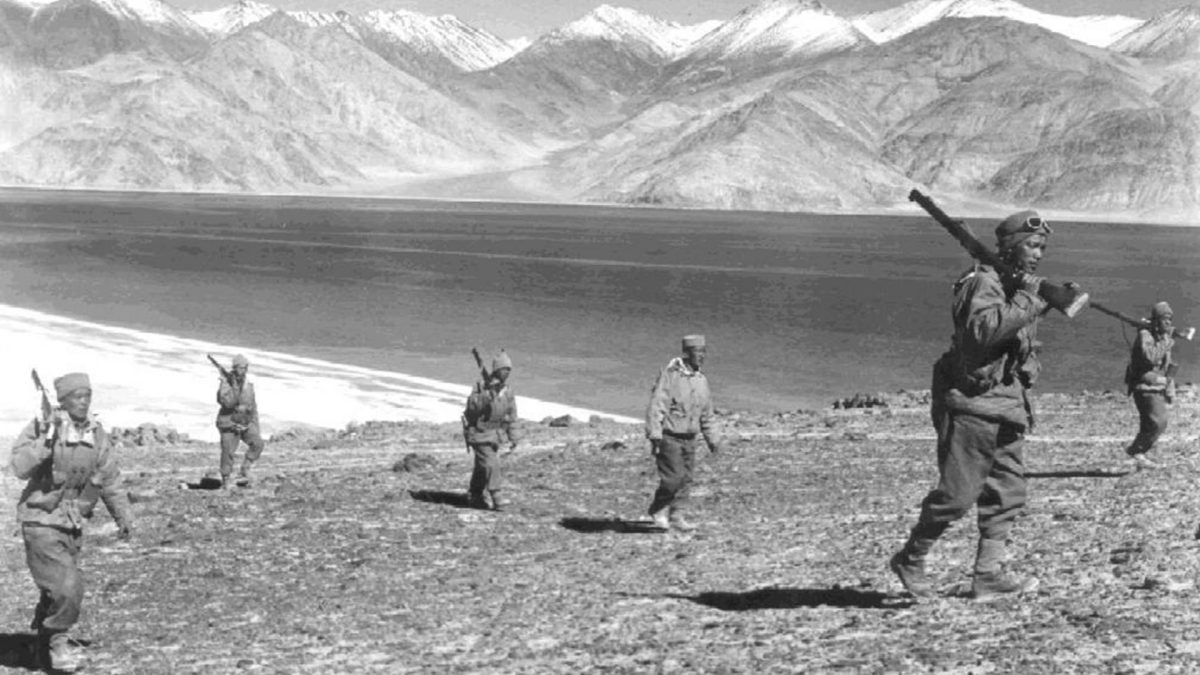
Image: Indian soldiers on patrol in the Himalayas during the 1962 border war. Photo by an unknown photographer, in the public domain, via Wikimedia Commons.